Thursday, June 28, 2012

A Better Feel For McLaren Vale

It's quite amazing how your appreciation for a region undergoes a complete overhaul after you've visited it for a first time. Prior to getting started on this post, I took a look at the blogs topic bar and I saw that I've referred to McLaren Vale at least 16 times since I started identifying it as a separate topic, worthy of mention. It's a pretty basic truth to say that I had no real sense of place while drinking any of those bottles before Boo and I enjoyed our quick visit to South of Adelaide district in April.

1183. 2005 Pertaringa Undercover Shiraz (McLaren Vale - Australia)

I must have picked up this bottle - for whatever reason - long before we'd ever set foot in the classic Aussie wine region, but I sure have a better feel for the wine now than I ever would have when I picked it up. Even though we didn't get an opportunity to stop in at the Pertaringa winery during our couple of days in McLaren Vale, there's no taking a sip of wine without having some mental picture of a general feeling for the area now.

The wine was an easy drinking drop and it featured a healthy does of big fruit, in that true Aussie; yet it wasn't over the top in any sense.  Indeed, that was an overall feel of our's for McLaren Vale.  The vineyards have little or no problem ripening the grapes; however, the region experiences a more calming influence of breezes coming off the nearby ocean waters and the resulting wines tend to be not as rich as some of the Barossans that make it to the North American market. Pertaringa, itself, is located in the Eastern foothills of the Vale which tend to be even a bit cooler weather-wise still.

Pertaringa has been around since 1980 and it produces around 10,000 cases annually.  The winery has chosen an assortment of interesting names for its wine - drawing from local stories.  The "Undercover" name comes from the winery's "recognition of McLaren Vale's history of supplying other regions with our finest red grapes."  The fruit was regarded for its contribution to the mid-palate - yet, no one really knew that they were drinking wines that featured McLaren Vale grapes.

No worries about that now - particularly in our home.

Monday, June 25, 2012

Lobstah, Buttah & Chard

Came home to a bit of a surprise dinner tonight. Boo had hit Costco and brought home a couple of lobster tails. Only seemed natural to me to break out the melted butter and the Chardonnay.

1182. 2009 Church & State Chardonnay (VQA Okanagan Valley)

Granted, regular readers will know that I'm not the most enthusiastic Chard drinker out and about. All the same, I'm hardly an ABC ("Anything But Chardonnay") kind of guy. Heck, we even have the stemless Chardonnay glasses on the shelf for when duty calls. I'm just not a huge fan of the big, heavy, overly oaked wines that were everywhere for awhile.

The Church & State bottle doesn't shy away from that New World style but the oak is more restrained. I'd picked this bottle up last year during the BC Wine Appreciation Society's annual bus tour. We made a stop at the gorgeous new Church & State facility on Black Sage Road and our taste of the Chard there obviously impressed me enough to throw some into my basket.

In addition to liking the wine's balance of richness with bright acidity, I like that the back label provides all sorts of information that calls out to wine geeks like me: the grapes came from two of the winery's vineyards (Gravelbourg and Coyote Bowl) and were picked in October 2009; the soils consist of sand and gravel; the wine was aged in French oak, a third of it being new; and only 722 cases were made. I could ask a few more questions but this is more info that I'd normally hope to find without a whack of research.

If recollection serves, I grabbed a number of other Church & State wines that day. No doubt, I'll be adding a few more to The List in the not too distant future - and likely a lot sooner than I'll be coming home to lobster again.

Sunday, June 24, 2012

Stargirl's Time to Move On

Not to say I'm old, but when did high school graduation ceremonies become such an extravagant affair? Stargirl, the #1 Niece, is about to leave all the high school hallways and classrooms behind her and take those next, big steps into growing up. This was no quick walk across the high school gym stage - like it was for my generation - though. Not even close; there were caps and gowns and local dignitaries and it was all grandly choreographed with an entry procession across the Simon Fraser University reflecting pond and down the grand stairway to Convocation Mall.

Stargirl's class was a rather large one. So, the most amusing aspect of the ceremony - as we waited for Stargirl's introduction in the M's - was that each of the students prepared a short statement to be read out as the crossed the stage. With 30 words or so to be thankful, pithy, wise, humorous or just weird, the range of insights was both amusing and rather astonishing in the range of approaches that the kids had to encapsulate all those years.

I heard at least three or four quotes from Dr. Seuss's "Oh The Places You'll Go" - which I'll admit rather alarmed me. I'd picked up the classic read for Stargirl, thinking that I'd cottoned on to a brilliant introduction to her life to come. It was starting to seem that everyone thoroughly knew its brilliantly catchy words already. Turns out that no one in our family, including Stargirl, had run across the book before. Saved.

After all the caps had been thrown into the air - again, I'm rather sure I didn't get to do that even at university graduations - we hit Stargirl's restaurant of choice: that old family favourite, Spaghetti Factory.

1181. 2008 Osborne Solaz Tempranillo Cabernet Sauvignon (Tierra di Castilla - Spain)

OK, so it's not a celebratory Champagne. It was the Spaghetti Factory and Stargirl doesn't even like wine - YET (if her uncle has any influence at all). But, I "needed" a drink even if she didn't and I'd remembered having a simple bottle of Solaz some years back. I recalled it as being cheap and cheerful - much like the Spaghetti Factory.

Indeed, I took a quick look at the blog and saw that a bottle of the 2006 vintage was added to The List at #328. That quick look also reminded me that there's quite the interesting story behind Osborne wines and their trademark bull. I won't go into that story all over again - seeing as how far behind I am in my posts - but I think it's worth a look-see and read of your own. The story is perhaps a little more interesting than the wine but that's so unique - and, again, I remind you that we're at the Spaghetti Factory where wine, in general, is good.

So, Stargirl experiences one of those landmark days in her young life and I drink a entry level wine. Here's to all the big times and better wines that Stargirl will encounter down the road. Oh, The Places She'll Go!

Friday, June 22, 2012

Project Empty Bowl

A Loving Spoonful has been a favourite charity of mine from its inception. A volunteer-driven, non-partisan society, its "mission is to make sure that no one living with AIDS lives with hunger" and it has been providing free, nutritious meals to people with HIV/AIDS, on a weekly basis, for almost twenty years now. One of the society's signature events is Project Empty Bowl.

The evening's genesis sprang from a Montana teacher and his request, in the early 90's, that his ceramics students make enough bowls to serve a luncheon to school staff. The guests all donated $5 for a simple meal of a bowl of soup and a piece of bread. All the funds raised were donated to a local food bank and the guests were asked to keep the bowls as a reminder of all the empty bowls around the world that still needed to be filled. The concept rapidly spread from community to community and A Loving Spoonful has worked with an enthusiastic Potters Guild of British Columbia and the Canadian Craft & Design Museum to host their fundraising event since 1997.

I'm a little shocked that it's taken me this long to actually attend. Luckily there were plenty of auction items to bid after and plenty of wine to assuage that shock and guilt.

1180. 2011 Calona Vineyards - Artist Series Pinot Gris (VQA Okanagan Valley)

As you'll note, the bartender was generous to a fault with the size of his pour. I guess he might have been giving his best to loosen any constraints the guests might have had when it came to topping up those auction bids. I stayed with this Pinot Gris through the evening (unless you count the vodka martini - which I won't) and, with glass sizes like this, I didn't need many top ups.

Calona is the oldest continuously operating winery in British Columbia and I have to admit that I don't regularly drink much of their wine. Like my previous non-attendance of the Empty Bowl Project, my seeming avoidance of Calona wines is somewhat surprising - particularly when you consider that Howard Soon is the executive winemaker and their parent company also owns Sandhill and Red Rooster. Howard is a winemaking star in BC and the wines of both Sandhill and Red Rooster fill many posts in this blog and take up numerous spots on The List. I'm not sure why but maybe the lack of Calona wines on The List relates to a lingering reminiscence of the old Calona jug wines that were rampant while I was growing up. I don't know that I'll ever be able to disassociate the Calona brand from Schloss Laderheim - the wine that ensured the Calona's existence until vinifera grapes and a modernized industry arrived in the province and one that, even back then, I never associated with the phrase "fine wine."

The Pinot Gris was clearly no throwback to those 70's and 80's wines though. It was fresh and vibrant with acidity and it worked nicely with the array of nibblies in my bowl. It also helped ensure that I kept upping my bids on various auction items.

As is oft the case at these fundraisers, I ran into more than a handful of friends and acquaintances, including some that I hadn't seen for some time. It was particularly nice to have a chance to chat briefly with Easter Armas - a guiding force behind the host organization. Given the occasion, I'm going to add a brief statement from the society's website as it captures some of the society's beginnings and highlights the loving nature behind one of Vancouver's living angels.

"A Loving Spoonful started in 1989, sprung from nothing more than Easter Armas' determination that no one living with AIDS should live with hunger. She saw an acquaintance of hers, a brilliant lawyer who had lost his job because he was HIV-positive, eating from a dumpster. She was devastated. November 19, 1989, marked the first of many Easter's Sundays, monthly dinners held at McLaren House for people living with HIV/AIDS... Easter's Sundays aimed to diminish the isolation felt by people with AIDS by providing food, community, and comfort. From the determination of one woman and her tireless friends, the Vancouver Meals Society [later to be re-named A Loving Spoonful] was born. It was the first meal program in Canada to provide free meals for people living with HIV/AIDS."

A fun evening, a worthy cause and a great way to add another bottle to The List.

Thursday, June 21, 2012

A New Taste of Chile

Just to show you how seriously we take matching our wines to the evening's dinner, I made sure that the picture shows just how magically the wine label matches the colour of the roses and even the tomato and cream based sauce. Now, that's some kind of matching!

Actually, I didn't really know this wine but I'd originally picked it up because I liked the thought of trying a Chilean Syrah. The hope for tonight was that it might exhibit some Old World restraint with a good dose of New World fruit and that, therefore, it'd go well with the spice of the dish and cut through the cream and acidity of the sauce.

1179. 2008 Antu Ninquén Syrah (Colchagua Valley D.O. - Chile)

The BC market doesn't see a lot of Syrah coming in from Chile but I did try some very nice, high end ones at this Spring's Vancouver Playhouse Wine Festival. Antu is part of the Montgras group and, as such, was one of the participating wineries this year. They served the 2010 vintage of their Syrah but I'd already spotted and picked up this bottle on the shelves prior to the big show.

The winery's website states that "Ninquén" means "plateau on a mountain" in one of the native dialects and that this is, indeed, the first mountain vineyard in Chile. The website showed a neat picture of the vineyard - it appeared to be set in almost a crater like setting - but I wasn't able to download it to use on the blog.

Although, I've read that the Ninquén project was started in 1997 to give Montgras an opening into the higher end of wines in Chile, it still clocks in at around $25. For that price though, I might be more resigned to stick with some tried and true Aussie Shiraz. I can't, however, deny that the label certainly matched the roses nicely.

Wednesday, June 20, 2012

Wine Blogging Wednesday 78 - Get Yo Viggy On

Goodness. Here it is, time for another wine Blogging Wednesday and I've found myself in a bit of quandary. It's WBW78. It's June. And I'm still trying to finish up all my blog entries from our trip Down Under - a trip that was back in April. Should I carry on - in a sensible sequence - and work my back to present times or do I throw all sense of order to the wind and join in with Frank Morgan, of Drink What You Like blog, and get my viggy on?

For reasons that perhaps defy logic, I'm going with this 78th instalment of Wine Blogging Wednesday.

Based in Virginia - where Viognier has made a thriving home for itself - Frank has proffered the traditional Rhône grape as this month's WBW topic and he's invited everyone to virtually weigh in on its varietal virtues.

Every wine geek has likely heard the story about how - after having been grown in the Northern Rhône for approximately 2000 years - the Viognier varietal was almost extinct by the 1960's. In 1965, there were only eight acres or so of the grape planted in its traditional home and total production levels were down to about 10,000 litres of wine or about 1100 cases. Known as a difficult grape to grow because of unpredictably low yields, the need for long growing seasons and its susceptibility to mildew, Viognier wasn't exactly an "it" grape in a world awash in Chardonnay.

As the wine world of the 1980's started to develop a greater enthusiasm for varietal wines, marginal varietals - like Viognier - began to enjoy a bit of revival. No longer isolated to production in the Rhône, the grape is now being grown worldwide - the village of Condrieu in the northern Rhône may still be home to Viognier's most notable vineyards, but the grape can also be found in North America, South America, South Africa and Australia and it's used to make both straight varietal wines and blended wines. Co-fermenting Viognier with Shiraz or Syrah has even become a common occurrence in wineries from every corner of the globe.

With that worldwide emergence, I decided to open three Viogniers from three distinct regions and see how they compare. The grape has definitely gained a foothold in Okanagan Valley vineyards. Production is hardly on a level of Chardonnay, Pinot Gris or Riesling, but I can easily think of a dozen or more wineries making a varietal wine off the top of my head. Since I'm blogging these three wines out of sequence, I don't rightly know where they are going to end up on The List but they'll get a number eventually.

1176. 2010 Marichel - Raisin d'être Viognier (Naramata Bench - Okanagan Valley)

I'll kick off with the home grown bottle. Richard and Elisabeth Roskell have been throwing their hearts and souls into capturing the taste and terroir of their little corner of the Naramata Bench in BC's Okanagan Valley for just over a decade now. They grow only two grapes - Syrah and Viognier - but they don't look to deliver Viogniers reminiscent of Condrieu or a Syrah styled on the Côte Rôtie. Rather, they practice low impact, sustainable farming and unapologetically make wines that they hope deliver the flavours of the Naramata Bench.

They don't make much of it though. The Roskells have realized that they will likely never even reach a total production of a thousand cases, in any given vintage, with the fruit from their vineyard (and some neighbouring vineyard grapes that they source). They do, however, still produce up to four different Viogniers. Marichel's standard estate label, the non-interventionist, wild yeast inoculated Wild Thing, a Split Rock label in particularly hot vintages (in honour of the summer of '03 when temperatures were so hot and so sustained that a boulder at the entry to the vineyard split from the heat) and tonight's bottle of Raisin d'être (named after the single vineyard where the grapes are grown).

As much as I like the Roskells and Marichel wines, in general, the Raisin d'être was our least favourite of the evening. That's not to say that it was a bad wine. Not in the least. When compared to the other two wines, it was just lighter in body and fruit. There was a nice little minerality on the palate but the wine didn't seem to quite capture Viognier's characteristically floral nose. Viognier needs to reach full ripeness in order to fully exhibit its trademark notes and maybe these grapes didn't quite hit that level of ripeness.

1177. 2010 Le Paradou Viognier (Vins de Pays d'Oc - France)

I'm not nearly as familiar with our second producer. Choices for French Viognier are rather limited in our neighbourhood stores, but I did think this exercise called for a wine from the varietal's home turf - even if I didn't go all the way for a top-notch Condrieu. Le Paradou is a secondary label for Château Pesquié, a well known Rhône producer in our market. Le Paradou is the combined effort of the two Chaudière brothers. In 2005, they decided to work outside of the constraints of French appellation rules and make a Vins de Pays wine where they could work with whatever grapes they wanted and try for a more straight forward expression of the fruit.

With vineyards in the Languedoc region, north-east of Montpellier, Le Paradou isn't quite the Rhône but it is situated near-by, where Provence meets the southern Rhône. The vineyards are located more on the higher altitudes of the mountainside than on the valley floor and, as such, the wine has a brighter acidity than might otherwise be expected. Like the Marichel, this is another Viognier that is neither overly big or oily, nor abundant in floral notes on the nose, but it did feature a somewhat more fragrant nose. With that, it got a bit of a nod over the BC wine. Boo was particularly fond of it.

1178. Yalumba Y Series Viognier (South Australia - Australia)

I thought it was particularly fitting to open a Yalumba Viognier as well. The South Australian winery is often credited with single-handedly reviving the fortunes of Viognier. Their interest in the varietal all stemmed from a visit to the Rhône in the 1970's and a suspicion that the grape might do well Down Under. In 1980, Yalumba started with a 3 acres of vines - Australia's first commercial plantings of the varietal. They now have the "largest mature Viognier resource and oldest commercial vines in the Southern Hemisphere" - with access to over 70 acres from a variety of districts.

Current Yalumba winemaker, Louisa Rose, has taken a particular liking to the grape and that small experiment - and the resulting years of trial and error - have led Yalumba to believe they've got a pretty good handle on the varietal. They actually offer four different Viognier wines - the basic Y Series, a more regional Eden Valley label, the flagship Virgilius, and a botrytis affected dessert wine. Winemaker emiritus and natural born story-teller, Jane Ferrari, travels the globe, preaching the Yalumba gospel, and she's told many a tale about Viognier's re-emergence on the wine scene. Indeed, a few years back at the Vancouver Playhouse Wine Festival, she kept folks enraptured with her appropriately titled, "Viognier Monologues."

This was our fave of the three - and we did taste them blind. Like the other two, the Yalumba didn't take us to that lanolin-like, oily bodied, florally perfume-laden Viognier that is often poured to the unexpectant - and, for that, I'm eternally grateful - but it definitely had both a bigger nose and more noticeable fruit on the palate. This was the glass that I looked to re-fill immediately and repeatedly.

Enjoying the Yalumba so also highlighted my regret that we didn't capitalize on the opportunity to visit Yalumba when we were recently in the Barossa. Yalumba was no more than four or five kilometres down the road from where we were staying at Wroxton Grange. Indeed, the grapes going into Yalumba's Eden Valley Viognier might well have been grown on a vineyard within spitting distance of some of Wroxton's plantings. Unfortunately, the right timing just didn't present itself. I guess this tasting just gives us even more incentive to make our way back to Australia.

That being said, I was pleasantly surprised by the three wines. I'd rather expected at least one of them to be overly florally or downright oily, but they weren't. Thanks to Frank and Drink What You Like for hosting. I'm looking forward to seeing what paths other participants have taken.

With any luck, I might even have caught up with my own postings by the time Wine Blogging Wednesday 79 rolls around. (Editor's Note - not quite so lucky with the catch up by WBW79. It's only taken three months to finally be able to number these wines in sequence. Yikes)

Monday, June 18, 2012

Birthday Boo

It's Boo's birthday. Not that either of us are counting them any more. It's still an excuse to head out for the evening and let someone else do the cooking though. Since he'd dropped by to wish Boo a Happy B-day, Mr. D. joined us on The Drive.

Our new favourite in the hood, Via Tevere, wasn't open and there was a line up out the door at Memphis Blues; so the default was calamari and pizza at Marcello's. His birthday. His choice. And, when given a choice, you know that calamari is a given if it's on a menu.

1175. 2010 Zonin - Primo Amore Sangiovese Merlot (Sicily IGT - Italy)

I wouldn't say that Marcello's is renowned for its wine list. To be fair, I don't know many (if any) pizza joints that are. But how can you go wrong ordering a wine that translates as "First Love" for your man's birthday? We knew that Zonin is a big name, commercial winery and that this was an entry level wine, but its being a Super Tuscan-esque Sangiovese and Merlot blend - especially one from Sicily - intrigued. As such, we weren't expecting it to blow us away, but it was fruity and easy drinking and do we really need to ask more of a pizza wine?

Indeed, any moment that captures a little bit of the allure and romance of Italy is a good time for me. And any day that features calamari is a great day for Boo - whether it's his b-day or not.

Sunday, June 17, 2012

A Really Big Housewarming

I recently wrote that Skipper had hosted a Grenache/Garnacha edition of Wine Boyz. For the night, he'd invited the other boyz from our curling team last year. It was their first sip at Wine Boyz and it kind of revealed to them our gang's enthusiasm for the grape.

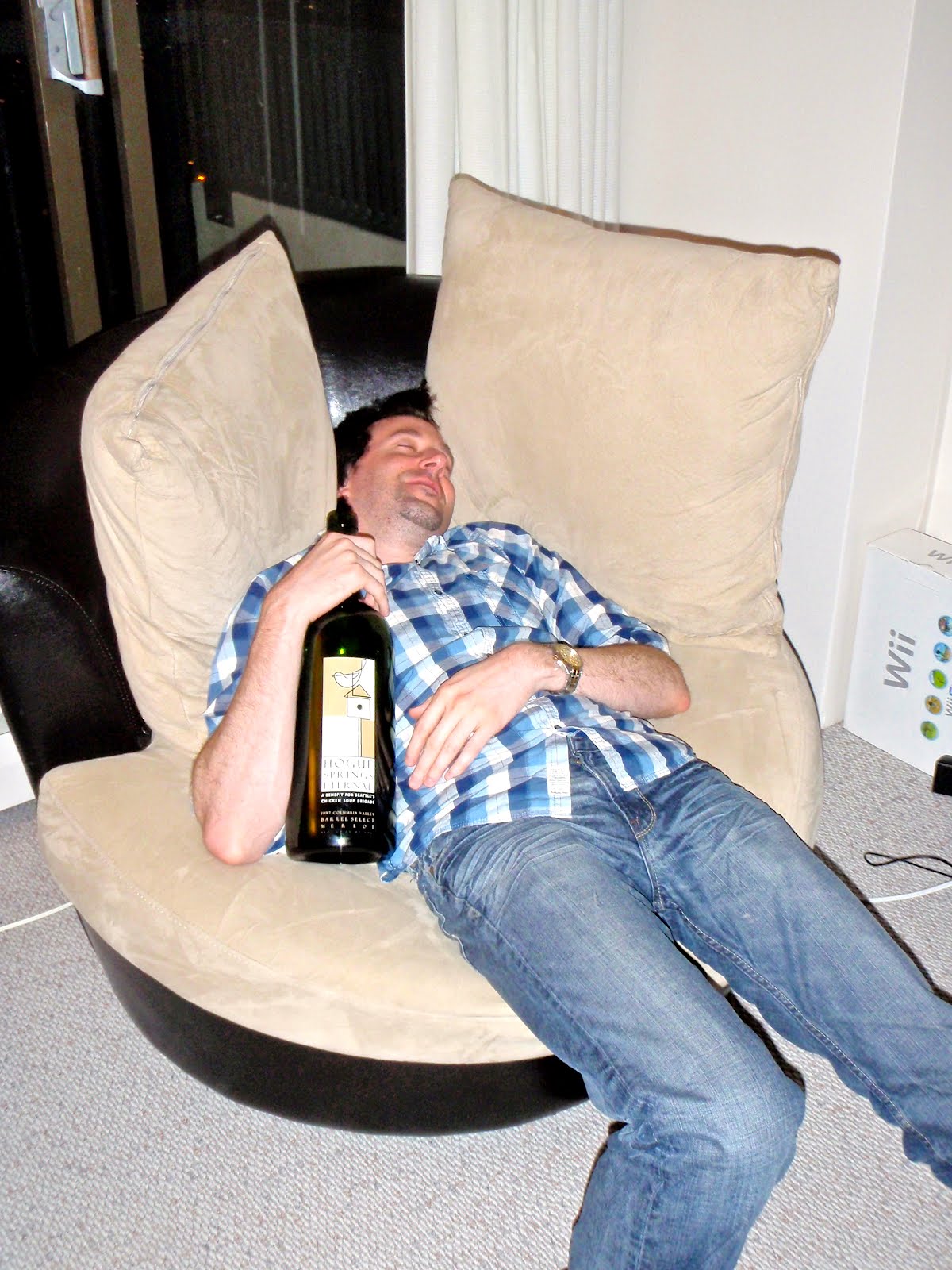
The next day or so, Brady e-mailed me to see if I'd be interested in a 3-Litre bottle of Washington Merlot that he'd been lugging around with him for the last decade or more. He'd received the Jereboam at a charitable fundraiser for Seattle's Chicken Soup Brigade all those years ago and he figured it was time to think about opening it. At first, Brady wondered if anyone might want to buy it from him - not that he knew what it'd be worth.

He didn't get off the hook that easily.

1174. 1997 Hogue Cellars - Hogue Springs Eternal Barrel Select Merlot (Columbia Valley - Washington)

Although this was an irreplaceable bottle that none of us would likely ever come across before, Brady's enquiry started with "1. Any idea if this is any good? 2. Any idea if this is still any good?" and we were left with a big question mark. I told him that the big bottle format would likely help slow down any negative effects of ageing but that the big factor was going to be how he'd been storing it.

His answer wasn't very inspiring. He basically admitted that he had no cellar of any sort and that, since he'd liked the design of the carved glass bottle and label, he'd had it standing upright in his living room through all his moves over the last decade. Summer, winter, no matter, the cork hadn't seen a lot of contact with the wine for many a year. I told him I wouldn't hold my breath for too long if he was expecting a vibrant sip o'wine.

That just piqued his interest and he decided to bring it along to a small gathering for Kaz's housewarming on the weekend. Kaz, the newest member of our team last year, had just moved into his new apartment and had invited everyone over for a look see. If the wine was still drinkable, that three litres would go a fair way in whetting our whistles.

Things didn't look all that optimistic when the cork broke as we tried to open the bottle but, lo and behold, the wine was totally drinkable. The first sips were tentative to say the least, but we were still greeted with a good shock of dark fruit. I'm sure that the tannins and acidity would have been a lot more prominent when the wine was bottled, but it really did have a nice balance. There was certainly no problem in finishing off that first glass and refilling it a number of times.

Hogue had a reserve line back in the 1997; so, this might have been one of their premium wines at the time - allowing for a little more leeway for lasting those 15 years - but it was still a surprise given Brady's shady storage facilities.

To tell the truth, we'd actually finished off the bottle long before the evening was done. It was a good thing that a many of the guests were drinking beer or cocktails; otherwise, those refills would have been mighty limited.

I don't think there were any limitations on Brady's refills though - after all it was his bottle - but I'm happy to say that the accompanying pic was staged and that he didn't really pass out after finishing that monster. I believe the picture made a few rounds on Facebook where the story of Brady's overindulgence was promoted however.

The night called for a big shout out - like in 3-Litres big - to Brady. It was an exciting bottle to open. And, unfortunately, after getting the whole bottle-opening affair started with his Wine Boyz round, Skipper wasn't even able to make it to the party to try the wine. Nasty Boyz that we are, we didn't save him any. In our defence though, at least we waited until it was clear that he wasn't going to drop by.

Saturday, June 16, 2012

Pass Me The Ripasso Per Favore

I remember that I first ran across tonight's wine at the Vancouver Playhouse International Wine Festival a few years ago. I saw the label and, at first, mistook it for a Barolo. I quickly learned that the name might be missing an "a," but it certainly wasn't missing anything in taste.

1173. 2005 Masi - Brolo di Campofiorin (Rosso del Veronese IGT - Italy)

I was advised that the name "Brolo" has nothing to do with the Barolo wines of Piedmont. Rather, "Brolo" is apparently an Italian equivalent of the French "clos" or enclosed - walled - vineyard. The winery decided to name the wine thus to differentiate it from their "standard" Campofiorin wine and identify it as a slightly premium version.

The wine is made of mostly Corvina (around 75%) and is supported by Rondinella - two of the traditional grapes used in making Amarone. The production of this wine also sees the use of the ripasso method that Masi helped pioneer where a young and already vinified wine is repassed over the skins of grapes that have been partially dried and used to make Amarone wines. That repassing creates a second fermentation of the wine and adds a more complex flavour and structure to the wine. Indeed, ripasso wines are generally marketed as wines bridging the gap between Valpolicellas and Amarones.

And, as I've written before, I'm always on the lookout for a good ripasso. This is one of them. The fact that it comes in around half the price of an Amarone in our market doesn't hurt either. I think I picked up this bottle for $25 with its introduction to Vancouver, but I see that the current vintage now goes for $30 at government stores. It's big, with lots of dark fruit and some spice and I'd definitely reach for it again for an occasion where $30 isn't out of line.

Thursday, June 14, 2012

Must Be Something about CedarCreek & Pinot

There must be something about CedarCreek and Pinot Noir that sits nicely in our household. I took a look back at the wines on The List and this is the sixth CedarCreek Pinot to be added. Boo and I have finished off four vintages of the Platinum label Pinot so far - 2002, '03, '04 and '05 - and this is the second Estate Select vintage to be added to The List, joining a 2007 that we tipped back earlier.

That may be the most Pinot Noir that we've finished off from any one producer - which is somewhat intriguing since the Pinot isn't generally my favourite wine from CedarCreek.

1172. 2005 CedarCreek Estate Select Pinot Noir (VQA Okanagan Valley)

In any event, Pinot and BBQ salmon is a house fave and we happily filled our glasses with the CedarCreek - making Boo even happier because it opens yet another somewhat older bottle.

While talking "age," one thing I quite like about CedarCreek is their posting of a Maturation Chart where they list their vintages and wines and advise on drinkability (assuming you've been properly storing the wine). Naturally, this bottle isn't listed because CedarCreek started the chart when it underwent a re-branding in 2007 and condensed the number of tiers they made and switched the new basic line to Stelvin screwcaps Having been closed with cork and being a tier that is no longer produced, the wine wasn't included on the chart.

Our bottle may have been produced prior to that change but I think we can fairly say that it still had some life in it. I do think, however, that this sip has probably seen stronger days. The wine still matched nicely with the salmon, but the overall flavour diminished as we started drinking the wine on its own.

I have a feeling it won't be the last CedarCreek Pinot to be added to The List however.