Despite having to endure an unexpected overnight stay in Chicago - with no excitement to be had following our late arrival at the hotel we were put up in (hence no wine to add to The List from Chicago) - the trip home from the 2015 Wine Bloggers Conference has me back home and looking to reach the heralded 2001st bottle and the "finish line" for this blog.
Although I would have loved to have done so, I wasn't able to bring much wine back with me from WBC15. Indeed, I was dinged for duty at Canadian Customs for the "extra" wine that I did bring back. Turned out I paid duty on a bottle that didn't even make it back to Vancouver in tact. I'd packed a bottle of Fox Run's Hedonia in my luggage - wrapped in a couple of socks - only to find broken shards of glass and some rather wet clothes when I finally opened the bag.
Not that this comes remotely close to being a silver lining, but it was pointed out to me that Hedonia is a dessert wine and that my dirty socks had never smelled so sweet.
Luckily, the other bottles made it home safely and I figured it was only fair to open one of the Finger Lakes wines for Boo since he didn't partake in any of the excitement that was WBC15.
1981. 2014 Hermann J. Wiemer Dry Riesling (Seneca Lake AVA - Finger Lakes - New York)
Among the few things that I remotely knew of the Finger Lakes before departing for WBC15 were that its winemaking history as a region was rather similar to BC's own Okanagan Valley and that it was probably best known for its Rieslings. Being the Riesling fiend that I am, I was particularly looking forward to the chance to sample some of the higher praised Finger Lakes labels.
One night while dining out in Manhattan, Boo and I started chatting with the table next to us as we couldn't help but hear that the majority of their conversation related to wine. It turned out that all three of the diners were involved in the New York wine trade. So, naturally, I wanted to canvas their thoughts on New York Rieslings and ask for a few suggestions. All three of them recommended Hermann Wiemer as one to try. Coincidentally, the proprietor of the bottle shop just around the corner from our hotel made the same suggestion. So, the quest was set.
I never actually saw a wine shop near our Conference hotel but, luckily, I'd noted that Miss Selfie, The Suje and Gone Girl were cavorting amongst the vines on their way up to WBC15. So, I asked them to pick up a bottle of Hermann Wiemer if they happened across one. Naturally, Miss Selfie made it a priority to do just that - and Boo got to be an additional beneficiary.
According to their website, "Hermann J. Wiemer is regarded as one of the pioneers of the wine industry in the Finger Lakes." Coming from a family with 300 years of winemaking experience in Germany's Mosel Valley and relying on his own winemaking and viticultural studies, Mr. Wiemer emigrated to the Finger Lakes in the 1960's, long before anyone thought that the region could support vinifera grape vines. His own experiences led him to believe that the region could realistically grow and ripen Riesling and Chardonnay grapes and that the warming effect of Lake Seneca could help the vines survive the winter chills.
Relying on "German folk wisdom" that "Riesling grapevines would flourish where black cherry trees thrived," Mr. Wiemer purchased 80 acres of land which has since become the HJW Vineyard. His wines have been lauded by magazines and critics and the winery has been named one of the top Riesling producers in the U.S. on numerous occasions.
The winery currently boasts nine Rieslings in its portfolio - ranging from dry through single vineyard to dessert wines like the cherished TBA or Trockenbeerenauslese. Our bottle is the winery's classic, signature wine and, as you might expect, it had a definite Germanic profile.
Both Boo and I thought the praise was well deserved. More nuanced than most New World Rieslings (particularly if you're thinking Clare Valley or New Zealand), the acidity was well balanced with subdued citrus notes and minerality. We were singing Miss Selfie's praises loudly.
I only wish I had more Wiemer wines in order to do a little taste comparison with some of my favourite BC Rieslings. I'll have to see if I can make that happen over the next thousand wines or so. I think it'll be worth the effort.
Showing posts with label Riesling. Show all posts
Tuesday, August 18, 2015
Tuesday, July 7, 2015
CedarCreek Platinum
Since we went Platinum Bench yesterday, why not go Platinum Block tonight? Why not, indeed.
The thing is, of course, that these "Platinums" don't really have anything to do with each other except that they're both from the Okanagan Valley - albeit opposite ends of the valley. Platinum Bench is a fairly new winery down by Oliver and Osoyoos on Black Sage Bench while CedarCreek is one of the early pioneers in the Valley and is up by Kelowna.
But, I suppose it's all in the segue between posts (as he laughs to himself, "no way I want to have to worry about transitioning that into the blog as well.")
1952. 2012 CedarCreek Platinum "Block 3" Riesling (Okanagan Valley VQA)
CedarCreek's premium line of wines is labeled under the Platinum label and this single block Riesling definitely merits the designation. I don't usually make it as far north as Kelowna when we make it to the Okanagan. As a result, I haven't seen much of this Riesling as it's primarily sold out of the winery cellar door. The 2014 BC Wine Appreciation Bus Tour visited Kelowna and Lake Country wineries and "dropped in" on the folks at CedarCreek as part of the tour. I made sure that I picked up a few bottles.
The bottle's back label calls this a "Mosel-by-way-of-the-Okanagan" Riesling. It's got a beautiful acidity racing through the flavour profile with lifted lime but it's no so shockingly acidic that you can't appreciate the flavours. At only 8% alcohol, it's also not going to knock you down or out. Too bad there were only 300 cases made in the 2012 vintage.
As I was prepping this post, I remembered that our CedarCreek visit saw us taking a late afternoon tour through the Pinot Noir and Riesling vineyards where we were treated to some hors d'oeuvres and, of all things, wine as we watched the sun set over Lake Okanagan. I "pulled out" some shots from that tour to show the magic of the moment. A wine can't help but taste great in circumstances like that, but I'm pleased to say that the Block 3 worked just as well for me at home as it did in the vineyard.
I think I might need to make it up to Kelowna a little more often.
Wednesday, July 1, 2015
Yay - A Cave Spring Classic Found in Vancouver
I probably say this every time I add an Ontario wine to The List but I'm totally confounded by the idiocy of federal and provincial laws in Canada when it comes to wine (and alcohol in general). Out west here in Vancouver, Toronto is certainly referred to as "The Centre of the Universe;" however, that's a universe that doesn't seem to include BC when it comes to Ontario wines. There never seems to be more than a handful of Ontario wines in the BC government stores and, for the most part, those few wines are more commercial than interesting.
Indeed, out of the 1900+ wines I've added to The List, fewer than 20 of them are from Ontario - and I only got my hands on some of those because a friend brought one back as a gift or because we picked them up at the Toronto Airport while passing through en route to some other vacation spot.
In any event, I was happy to find this bottle on local shelves a few months back. I've actually heard of the winery and remembered them as being a producer of consistent Rieslings.
1949. 2013 Cave Spring Riesling Estate (Beamsville Bench VQA - Niagara - Ontario)
The Pennachetti family arrived in the Niagara region in the 1920's when patriarch, Giuseppe, emigrated from Italy to work as a stone mason. Giuseppe brought his love of winemaking with him to Ontario although it, admittedly, involved homemade wine made from the then local labrusca grapes that aren't known for producing quality wines. That hobby resonated with his son John and grandson Leonard and they acquired their first farmland on Niagara's Beamsville Bench in 1973. They realized that, if the region was to ever make a name for itself as a winemaking area of note, it would have to focus on the more traditional vinifera vines from Europe. The family was among the first to plant Riesling and Chardonnay on the Niagara Peninsula.
Cave Spring, the winery, was established in 1986 and, since that time, it has specialized in producing white wines, particularly Riesling. Their Riesling wines currently account for over half of the winery's total production and, at present, they make six Riesling table wines together with a Sparkling Riesling and both a late harvest and icewine version of the variety.
The winery's website proudly announces that Cave Spring "has established itself as one of Canada's most acclaimed wineries." Indeed, this Estate Riesling itself garners plenty of kudos. Canadian wine website, Wine Align, wrote that "This is perennially one of the best Riesling buys in Ontario!...It's light hearted, super fresh, yet penetrating with a fine line of firm acidity running throughout."
The wine is made from single vineyard fruit, the estate's home vineyard being located on limestone-rich clay till soils on the Niagara Escarpment overlooking Lake Ontario. It is made from some of the vineyard's "oldest, lowest-yielding vines." The website refers to the Estate Riesling as being made in an off-dry style but I found it to be awash in bright acidity and lime flavours. I actually found it to be quite reminiscent of Australia's Clare Valley Rieslings where I often find the acidity to be a tad too pucker-inducing (and not necessarily "puckers" that are in preparation for a kiss).
Being the Riesling aficionado that I am, I wish the various levels of government could pull their collective heads out of prohibition-era like legislation and provincial protectionism and just facilitate more trans-border exchange of wines. I'd be more than happy to throw some cash Niagara's way if they'd simply find a way to give us a chance (without having to buy a whole case and pay big shipping costs).
Such a dreamer, eh.
Indeed, out of the 1900+ wines I've added to The List, fewer than 20 of them are from Ontario - and I only got my hands on some of those because a friend brought one back as a gift or because we picked them up at the Toronto Airport while passing through en route to some other vacation spot.
In any event, I was happy to find this bottle on local shelves a few months back. I've actually heard of the winery and remembered them as being a producer of consistent Rieslings.
1949. 2013 Cave Spring Riesling Estate (Beamsville Bench VQA - Niagara - Ontario)
The Pennachetti family arrived in the Niagara region in the 1920's when patriarch, Giuseppe, emigrated from Italy to work as a stone mason. Giuseppe brought his love of winemaking with him to Ontario although it, admittedly, involved homemade wine made from the then local labrusca grapes that aren't known for producing quality wines. That hobby resonated with his son John and grandson Leonard and they acquired their first farmland on Niagara's Beamsville Bench in 1973. They realized that, if the region was to ever make a name for itself as a winemaking area of note, it would have to focus on the more traditional vinifera vines from Europe. The family was among the first to plant Riesling and Chardonnay on the Niagara Peninsula.
Cave Spring, the winery, was established in 1986 and, since that time, it has specialized in producing white wines, particularly Riesling. Their Riesling wines currently account for over half of the winery's total production and, at present, they make six Riesling table wines together with a Sparkling Riesling and both a late harvest and icewine version of the variety.
The winery's website proudly announces that Cave Spring "has established itself as one of Canada's most acclaimed wineries." Indeed, this Estate Riesling itself garners plenty of kudos. Canadian wine website, Wine Align, wrote that "This is perennially one of the best Riesling buys in Ontario!...It's light hearted, super fresh, yet penetrating with a fine line of firm acidity running throughout."
The wine is made from single vineyard fruit, the estate's home vineyard being located on limestone-rich clay till soils on the Niagara Escarpment overlooking Lake Ontario. It is made from some of the vineyard's "oldest, lowest-yielding vines." The website refers to the Estate Riesling as being made in an off-dry style but I found it to be awash in bright acidity and lime flavours. I actually found it to be quite reminiscent of Australia's Clare Valley Rieslings where I often find the acidity to be a tad too pucker-inducing (and not necessarily "puckers" that are in preparation for a kiss).
Being the Riesling aficionado that I am, I wish the various levels of government could pull their collective heads out of prohibition-era like legislation and provincial protectionism and just facilitate more trans-border exchange of wines. I'd be more than happy to throw some cash Niagara's way if they'd simply find a way to give us a chance (without having to buy a whole case and pay big shipping costs).
Such a dreamer, eh.
Sunday, June 28, 2015
Dinner Club - Vancouver Meets Bretagne
Due to member travels, our Dinner Club takes an annual winter break until our snow birds have returned to roost - except, of course, unless the gang all heads off together like we did last year to Antigua when Jeaux and Matinder hosting a once-in-a-lifetime St. Patrick's Day dinner.
J&M were hosting this time as well and, once again, they took us "on the road." However, their theme for this round wasn't Caribbean based. Rather they focused on all things Bretagne since they had just returned from a sailing regatta in that northern province of France. Luckily, it was a gorgeous day and we were able to start dinner up on Jeaux and Mutineer's rooftop deck. It was if we'd been transported off to a sunny après-midi en France.
1942. N.V. Henriot Rosé (Reims - Champagne - France)
As is only befitting a culinary trip to France, we started off with a little bubbly. Although Bretagne isn't exactly next door to the Champagne region of France, it's certainly a lot closer than Vancouver is.
Henriot refers to themselves as one of the last independent and family owned houses in Champagne and they've been making Champagne for over two centuries, having been established in 1808. Their Brut is made with all three classic Champagne grapes: Chardonnay, Pinot Noir and Pinot Meunier and their hint of rosé colour is achieved by adding a bit of the Pinot Noir wine prior to the final bottling.
Along with our bubble, Matinder and Jeaux served up a cider spritzer along with a bevy of hors d'oeuvres as we lounged on the roof. The spritzer is common to the apple growing region and we also had a quartet of mousse/pâtés that Jeaux proclaimed were omnipresent throughout the region. She'd also made some savoury pâte à choux, blood sausage tarts and filled crisps. We probably could have filled up on just the nibblies but, bien sûr, there was plenty more to come.
Our first step to happiness, once we'd arrive at the dinner table was an assortment of salads - particularly featuring beets and noodles. The course was accompanied by a duo of boutique wines with a similar heritage.
1943. 2014 Mike B. Riesling Cabinett (Okanagan Valley)
2011 Kurtis Wild Ferment Semillon (Okanagan Valley)
Both of the wines were made at Okanagan Crush Pad under the mentorship program that was introduced as part of the Vancouver International Wine Festival's Sommelier of the Year award. The winner of the annual prize is provided the opportunity to make a small batch wine of their choice. The sommelier, cum winemaker, gets to choose the grape and the style of wine they'd like to tackle - and the limited production can sometimes be found on the local shelves.
Kurtis Kolt was the first sommelier to make a wine as part of the Wine Campus series and I'd hunted down a bottle some years back when it was originally released. Accordingly, it has already been added to The List as #1248 and, therefore, doesn't get another number this time around.
The second bottle was made by Mike Bernardo, of Vij's restaurant, as he was named Sommelier of the Year in 2014. He opted to make a wine along the lines of wines that he'd regularly pair with menu items served at Vij's. I hadn't seen this wine yet. So, I was particularly pleased to give it a whirl - both because of its provenance and because he'd chosen Riesling. Bright with acidity, I can see its versatility with a number of dishes.
1944. 2012 Barton & Guestier - Lobster & Shrimp Muscadet Sèvre-et-Maine (Muscadet Sèvre-et-Maine AOC - Loire - France)
I remember B&G as one of the few French labels that I'd recognize many years ago when I first started to grab the odd bottle of wine now and then. They certainly didn't go in for this mass market kind of label back in the day but, then again, there were no critter wines back in the 70's and 80's - unless you counted Baby Duck and its ilk as critter wines. This bottling is part of collection of wines that are meant to give the consumer a (none-too-subtle) hint about what meal might pair nicely with the wine. A definite bonus - I should think - considering that I very much doubt that there are many folks in our Vancouver market who would have the slightest idea what to expect from a bottle of wine made from the Melon de Bourgogne grape.
The label certainly came in handy when it came to our trying to pair the wines, brought by all of the dinner guests, with an appropriate dinner course. We might not have been dining on lobster but I think mussels weren't too far off.
1945. 2006 Domaine la Barroche Châteauneuf-du-Pape (Châteauneuf-du-Pape AOC - Rhône - France)
We normally would have served up a C-du-P with a heartier course but we seemed to have hit the dessert course before we had need to pull the cork. Unfortunately, I can't claim to have had the pleasure of knocking back many bottles of Domaine la Barroche but I can certainly say that I haven't met a bottle of their's that I haven't enjoyed. The small estate's production is difficult to find and one of their flagship wines, Pure, is generally found only on an allocation basis.
Their signature Châteauneuf-du-Pape is standardly a Grenache-driven wine and the winery, 2003 having been their first vintage, definitely steers to a more modern, fruit-laden product. I figured it could pair up to Jeaux' trio of typical Bretagne desserts. Besides, if no one else wanted to go the route of a red with dessert, that would just mean more for me.
Thinking a bit of a stretch and a flight of stairs might do us all some good, we once again retired to the roof deck to chat away the balance of the evening. Funnily enough, there were still some wines that had yet to be touched. Tyrant pointed out that we truly must be getting long in the tooth because he couldn't recall a previous dinner club where there was still this much wine left by the end of dinner. He followed that statement up with his offer to give it the old college try and drink some of the remaining juice - particularly since he'd spirited a couple of Burgundy's out of the cellar in honour of the fact that I was in my final 100 wines for the blog.
1946. 2012 Joseph Drouhin Saint-Véran (Saint-Véran AOC - Burgundy - France)
1947. 2003 Moillard Mercurey (Mercurey AOC - Burgundy - France)
Going to Burgundy and pulling out a Chardonnay and a Pinot Noir certainly added to the Gallic fare of the evening. I think Tyrant might have been right when he thought we should have been better pikers during dinner so that we'd have opened these with the benefit of food but the wines seemed to go down well enough on their own.
Then again, it was late, and the time for constructive tasting had long passed. These were simply good for propelling the conversation forward on one of the first long nights of summer.
Kremmig Crème du Plessis (À L'Eau de Vie de Cidre de Bretagne)
Our hosts trotted out one final treat as well. They'd brought back a bottle of Kremmig from their adventures in Bretagne. Kremmig is a specialty of the du Plessis distillery - a cream based, eau de vie made with Lambig. Lambig, itself, is a Bretagne specialty liquor made by distilling hard cider.
There was no going back to wine after the Kremmig. All that creaminess just coated the mouth and said "you're stuck with me now kid." Not that we needed more wine.
Jeaux and Matinder may have transported us to a corner of France for the evening but reality of needing to return to our Vancouver beds had us all bidding "au revoir" and "à bientôt" and heading off into the night. The Lady Di and She Who Must Be Obeyed are next up on the hosting schedule. Just a little something to look forward to.
Saturday, June 27, 2015
#LoveWins
Consider this is a wine blog, it's far more likely that you'd see a #LoveWine hashtag on the blog or my Twitter account. Today, however, it was #LoveWins all over the internet. It was definitely a long time coming for our American friends but, today, folks all over are celebrating the United States Supreme Court's historic ruling to allow same sex marriage.
Boo and I are already legally married here in Canada; however, Boo is still an American citizen and, before now, there was little chance of him ever returning to his country of birth on a permanent basis if he wanted me to be able to cross the border with him. I don't know that the day would ever come where we wanted to move to the States but it makes a world of difference to know that it might actually be possible.
1941. Intrigue - I Do Rosé (Okanagan Valley VQA)
It only seemed fitting that we celebrate the Court's ruling with some bubbles. It also seemed appropriate to pop the cork on a bottle of I Do, Intrigue's sparkling wine that's aimed (shall we say rather blatantly) at the wedding market.
The folks at Intrigue might be aiming for the traditional wedding market but that's about all that's traditional about their I Do. The wine is a sparkly Riesling that utilizes a splash of Merlot to add the pink colour. It's also opted for a fruitier profile, particularly strawberry, as opposed to the yeast-heavy, traditional method sparkling wines that are being delightfully produced in the Okanagan.
An easy sipper. Sure. But I'm all for easily accessible bubblies to draw the great unwashed into the joys of sparkling wines on an everyday basis. It was quite the surprise when Boo and I found out just how popular bubbles are Down Under. They don't need a special occasion - any occasion that involves wine is special enough for bubbles. We could use a little more of that sparkling attitude here in North America.
Today's ruling and celebrations certainly didn't hurt that cause. I trust there were all sorts of corks popping.
Now to get the Aussies to go the route of allowing same sex marriage. After all, they already know how to pop the cork in celebration.
Boo and I are already legally married here in Canada; however, Boo is still an American citizen and, before now, there was little chance of him ever returning to his country of birth on a permanent basis if he wanted me to be able to cross the border with him. I don't know that the day would ever come where we wanted to move to the States but it makes a world of difference to know that it might actually be possible.
1941. Intrigue - I Do Rosé (Okanagan Valley VQA)
It only seemed fitting that we celebrate the Court's ruling with some bubbles. It also seemed appropriate to pop the cork on a bottle of I Do, Intrigue's sparkling wine that's aimed (shall we say rather blatantly) at the wedding market.
The folks at Intrigue might be aiming for the traditional wedding market but that's about all that's traditional about their I Do. The wine is a sparkly Riesling that utilizes a splash of Merlot to add the pink colour. It's also opted for a fruitier profile, particularly strawberry, as opposed to the yeast-heavy, traditional method sparkling wines that are being delightfully produced in the Okanagan.
An easy sipper. Sure. But I'm all for easily accessible bubblies to draw the great unwashed into the joys of sparkling wines on an everyday basis. It was quite the surprise when Boo and I found out just how popular bubbles are Down Under. They don't need a special occasion - any occasion that involves wine is special enough for bubbles. We could use a little more of that sparkling attitude here in North America.
Today's ruling and celebrations certainly didn't hurt that cause. I trust there were all sorts of corks popping.
Now to get the Aussies to go the route of allowing same sex marriage. After all, they already know how to pop the cork in celebration.
Wednesday, June 10, 2015
A Celebratory Tantalus Dinner
Being members of both the British Columbia and the Australian Wine Appreciation Societies, Boo and I get the opportunity to attend at least a couple winemaker dinners a year. There are very few dinners that have succeeded in getting my juices flowing as much as the promise of combining Tantalus wines with Hawksworth cuisine. Not only is Tantalus one of my favourite BC wineries but I can definitely say that I'm not a regular at Hawksworth, one of Vancouver's most celebrated restaurants. In fact, I've only ever been there once before and, if memory serves, it was for an AWAS dinner.
The dinner was being held in celebration of Tantalus' 10th Anniversary and it certainly lived up to expectations. Boo and I were particularly fortuitous in that we were seated in direct proximity to winery principals David Paterson (winemaker), Jane Hatch (general manager) and Warwick Shaw (vineyard manager). Opportunities to discuss the nitty-gritty of wine and winemaking with such seasoned hands are rare occasions for a piker like me.
I found the conversation riveting but the food and wine wasn't too shabby either.
The courses revolved around dungeness crab, sablefish, risotto and duck breast - any one of which could be a pick of mine off of any menu. Add a bit of wine to these tasty morsels and the evening was set.
The Tantalus gang poured a mix of new and old that was worthy of the anniversary celebration. Starting with a 2010 Old Vines Riesling Natural Brut during the reception gathering, we settled into dinner with two mini-flights of Riesling. The dungeness crab, avocado and grapefruit salad was accompanied by a 2005 and 2014 Riesling. I can't recall having tried such an aged Okanagan Riesling before. Indeed, I doubt many local wineries would want to try ageing their Rieslings to such an extent. Although many see this label as Tantalus' more approachable - or heaven forbid the term - entry level Riesling, it held its own against the fresher, current vintage.
The sablefish saw '08 and '12 pouring of the Old Vines Riesling - a BC Riesling that likes food if ever there was one - and the richness of the fish just killed it with the acidity of these babies. My glasses seemed to be empty far too soon. I'm sure I must have been short-poured.
A roasted cauliflower risotto was paired with the 2010 and 2012 Chardonnays and the duck breast - surprise, surprise - saw two Pinots (again 2010 and 2012) alongside. I've generally been drawn to Tantalus for their Riesling but the Chard and Pinot Noir are definitely showing signs that they are developing into contenders as well as the more recently planted vines start to see more age on them.
1933. 2014 Tantalus Syrah Icewine (Okanagan Valley VQA)
As has been my habit with the blog, I only add one wine to The List at these dinners since our table or small gang never polishes off an entire bottle of any one wine - as much as we might like to. So, tonight's wine for The List is one that I'm not sure I've even tried before - let alone have in our cellar.
I may be adding the Syrah Icewine to The List but we were actually tempted by a pouring of an aged 2005 Riesling Icewine as well. Thankfully, there was no call for a straw poll to see who favoured which over the other. I'd have been hard-pressed to pick. One thing was clearly evident though and that's that Icewines can still pack plenty of punch after a decade's ageing. A hallmark of fine icewine is that there still be plenty of acidity in the wine so that it doesn't become cloyingly sweet. The '05 was certainly an unctuous sip, yet it still didn't veer into pure sweet as its acidity must have waned over the last decade.
All told, this was a winemaker's dinner for the ages. I'll have to mark the 20th Anniversary dinner in my calendar as soon as they announce one.
As we would have liked the whole experience to continue, the next night, Boo and I opened a bottle of the 2012 Tantalus Rosé. I'm not adding that bottle to The List though as we'd already polished off a bottle and it sits on The List at #1659.
Thankfully, whether there's a List or not, I know there'll be plenty more Tantalus wines filling my glass down the road.
Sunday, February 22, 2015
Another High School Musical
First it was Zombie Prom. Then Urinetown. Now, it's time for In The Heights.
Yes, it's time for another high school musical. This time around, Melmo, the youngest niece, has a featured role in the Broadway hit. Unlike the others, I've actually heard of this show. Don't know anything about the songs or the story but I did know it was a hot ticket on the Great White Way the last time Boo and I were in the Big Apple.
It's a little tough taking an obvious glass of wine to the high school gym; so, we had a quick pre-show dinner at my sister's place before heading off to the school.
1867. 2007 Saviah Cellars - The Jack Red (Columbia Valley - Washington)
I'm pretty sure that this is the first time that I've tried a wine from Saviah Cellars. I don't recognize the winery and I don't tend buy many US wines up here, north of the 49th Parallel, because of the additional taxes and currency exchange. So, I think I probably grabbed this during a Costco run during a naughty weekend in Seattle.
A little visit with Mr. Google shows that Saviah Cellars was established in 2000 as a very small boutique winery of only 300 cases. It has since grown to the point where it produces around 18,000 cases annually and was named "One of the Rising Stars in Washington" by Wine Spectator in 2010.
The Jack brand of wines is Saviah's entry label and it has also enjoyed success, having been named one of the Top Value Brands of the Year in 2013 by Wine & Spirits Magazine. The 2007 vintage of The Jack Red was primarily Merlot (89 percent) that is fleshed out with small additions of Cab Sauv, Cab Franc, Syrah and Petit Verdot.
Although the wine was big-bodied, it was still fruit forward and approachable enough to fill our travel coffee mugs to take with us to the show. We hadn't finished the bottle during dinner and you never know the kind of "support" you might need to get through a high school production.
1868. 2012 Fort Berens Riesling (British Columbia VQA)
When looking for a white to take to Vixen's, I was glad to see that I had a bottle of the 2012 Riesling in the cellar because I hadn't realized that I'd picked up a bottle before it won one of the twelve Lieutenant Governor's Awards given out in 2014. Once a wine is given one of the prestigious awards, it can be next to impossible to find a bottle.
What was quite exciting about the award was that this was the first vintage where the Riesling was made 100% from fruit that was estate grown at the winery's Lillooet vineyard. Being the first winery to set up shop in the Lillooet region, the winery is justifiably proud of the fact that they were able to execute such an award-winning wine so early in the winery's venture. It should certainly turn some heads in the direction of BC's newest wine-producing region.
Even with this vintage's bright lime and minerality, Fort Beren's story should only get more exciting since the home estate vines are still very young and the enterprise has, within the last year, opened a new winery with facilities large enough to make all its wines, cellar them and open a tasting room to help draw wine-loving folks away from the Okanagan for a spell.
There was no Riesling left for the theatre however.
As exciting as the wine was, we were told that Melmo was to have a big solo number in the show. Now, that would be exciting! Terrifying perhaps, but exciting all the same. We were also told, however, that Melmo's character dies six minutes into the show. Naturally, we asked if we could leave after she dies. Turned out that she didn't die until the second act; so, we stuck it out until the end in order to give our little diva her bouquet of roses. After all, she managed to pull off her performance without any cringe-worthy notes.
Guess we'll have one more production to look forward to as Melmo definitely has the stage bug and she doesn't graduate until next year. Given the variety of shows the school drama department comes up with, I'll be intrigued to see what that performance is going to be. Think a high school could get Spamalot? Whatever the show is, I'm sure we'll be there - wine in hand.
Labels:
Lillooet,
Lt. Gov. Awards,
Merlot,
Red Blends,
Riesling,
United States,
Washington
Thursday, February 19, 2015
Surprise. An Ontario Riesling
Chinese New Year and the Year of the Sheep has arrived and I arrived home from work to find that Boo had hit the local Asian supermarket and fashioned an inspired meal (inspired in that probably only he could come up with some of the combinations involved).
As can often be the case with me and white wines, I grabbed a Riesling - although this wasn't one that I was familiar with at all. Ontario wines aren't exactly common place out here on the West Coast. I know that I've said it before but it bears saying again: It confounds me that it can be easier to find wines from Hungary, Uruguay or Tasmania than it is to find wines from other parts of our own country. Canadian liquor laws have to be as antiquated as they come. C'mon people, rise up. Let's see some direct action and demands for better access to our own Canadian products.
Thank you. I will now leave the ranting to Rick Mercer.
1864. 2011 Thirty Bench Riesling (Beamsville Bench VQA - Ontario)
Although I can't say that I know much about Ontario wines, I do know that the regions there are known for Riesling and Thirty Bench is, at least, a winery name that I've heard before. When I saw the bottle in one of our government stores, I eagerly reached for it. With the help of Mr. Google, I found out that Thirty Bench is under the Andrew Peller umbrella and - given the size of that group and their heavy presence in our province - that likely explains why one of Thirty Bench's wines made it to a shelf out here in BC.
Ontario's winemaking regions are divided into various appellations and, according to the back label of our bottle, Beamswille Bench is a "narrow strip of land near Lake Ontario that boasts sloping vineyards and deep, dry soil" where Riesling is a standout grape. Thirty Bench, itself, started out as a boutique winery in 1981, producing no more than 10,000 cases annually. The winery was purchased by Andrew Peller in 2005 but the winery has continued its smaller scale of production.
The winery is particularly known for its Rieslings, especially its series of single-block Rieslings. The bottle I found is the winery's blend from its various vineyards and it is primarily sourced from the winery's younger vines. Being the Riesling fiend that I am, I won't say that I'm going to go cross country to find another bottle. It was a touch off-dry - which may have paired better with dinner if Boo had spiced up his dishes a bit more - but, more than that, I found the palate to be a bit thin. There was nice acidity but the fruit just didn't sing at all.
I think I'd be more inclined to keep an eye out for one of the small lot bottlings.
So, inspired combinations of food and wine or not, I'll readily admit to the tastiness of the dinner. I could have refilled my plate all over again with Boo's appetizing fare. Luckily though, I remembered that I already get "Gang Way Fat Boy" at work instead of the traditional New Year's greeting "Gung Hey Fat Choy" and I thought it better to pass on seconds. Funny, there was no leftover wine however.
As can often be the case with me and white wines, I grabbed a Riesling - although this wasn't one that I was familiar with at all. Ontario wines aren't exactly common place out here on the West Coast. I know that I've said it before but it bears saying again: It confounds me that it can be easier to find wines from Hungary, Uruguay or Tasmania than it is to find wines from other parts of our own country. Canadian liquor laws have to be as antiquated as they come. C'mon people, rise up. Let's see some direct action and demands for better access to our own Canadian products.
Thank you. I will now leave the ranting to Rick Mercer.
1864. 2011 Thirty Bench Riesling (Beamsville Bench VQA - Ontario)
Although I can't say that I know much about Ontario wines, I do know that the regions there are known for Riesling and Thirty Bench is, at least, a winery name that I've heard before. When I saw the bottle in one of our government stores, I eagerly reached for it. With the help of Mr. Google, I found out that Thirty Bench is under the Andrew Peller umbrella and - given the size of that group and their heavy presence in our province - that likely explains why one of Thirty Bench's wines made it to a shelf out here in BC.
Ontario's winemaking regions are divided into various appellations and, according to the back label of our bottle, Beamswille Bench is a "narrow strip of land near Lake Ontario that boasts sloping vineyards and deep, dry soil" where Riesling is a standout grape. Thirty Bench, itself, started out as a boutique winery in 1981, producing no more than 10,000 cases annually. The winery was purchased by Andrew Peller in 2005 but the winery has continued its smaller scale of production.
The winery is particularly known for its Rieslings, especially its series of single-block Rieslings. The bottle I found is the winery's blend from its various vineyards and it is primarily sourced from the winery's younger vines. Being the Riesling fiend that I am, I won't say that I'm going to go cross country to find another bottle. It was a touch off-dry - which may have paired better with dinner if Boo had spiced up his dishes a bit more - but, more than that, I found the palate to be a bit thin. There was nice acidity but the fruit just didn't sing at all.
I think I'd be more inclined to keep an eye out for one of the small lot bottlings.
So, inspired combinations of food and wine or not, I'll readily admit to the tastiness of the dinner. I could have refilled my plate all over again with Boo's appetizing fare. Luckily though, I remembered that I already get "Gang Way Fat Boy" at work instead of the traditional New Year's greeting "Gung Hey Fat Choy" and I thought it better to pass on seconds. Funny, there was no leftover wine however.
Sunday, February 1, 2015
Middle Kingdom Meets The Seven Kingdoms
Boo is an unabashed Games of Thrones fan - and he's pulled me into all the intrigue hook, line and sinker as well. So, it was a bit of a no-brainer that we'd take in Season's 4's final two episodes when they were shown at one of the local IMAX theatres. The only theatre in Vancouver's Lower Mainland region to screen the episodes was in Richmond - a bit out of our normal stomping grounds but there really was no choice in the matter. We just made the best of the trek by grabbing dinner in one of Richmond's myriad of top notch Chinese restaurants.
Not that we'd know where to go.
Luckily, Boo has a number of Chinese colleagues who are well acquainted with the Richmond dining scene. We tried one of the higher end Chinese seafood restos but it was already full to capacity because of a wedding. Boo made a quick call to one of the girls at work and she recommended that we simply cross the street and try another - which we did. Admittedly, we weren't all that adventurous with our choices - salt & pepper squid, Peking Duck and house seafood noodles - but they all sounded good and we hadn't been there before.
The wine list was on the short side but we went with an Aussie white, thinking it could go with anything that came out of the kitchen.
1851. 2012 De Bortoli Family Selection Traminer Riesling (Riverina - Australia)
De Bortoli is the largest producer (by some margin) in Australia's Yarra Valley outside Melbourne. Part of the sizeable production is based on the fact that the winery does source a good percentage of its fruit from other regions. Bottle in point, this blend of Traminer and Riesling was made with fruit from the more commercial Riverina district. Traminer can be the name for a couple of grapes in Oz - as it is used interchangeably with Gewürztraminer but can also be used in its more genetically distinguishable form which would be Savagnin Blanc or White Traminer. Although the website doesn't state it, I'm guessing this is a Riesling/Gew blend as it is the far more prevalent grape.
At $13 in the Vancouver market, I consider this to be an entry level (if not commercial) wine. We found it to be a bit on the sweet side - which normally might have been okay with Chinese food but, on this occasion, our meal choices didn't really have enough spiciness or heat to match up with the wine.
We had more important fish to fry than to try and spice up our meal though. The Seven Kingdoms were calling and our change in restaurant plans had left us rather tight for time. So, we hastily retreated from our visit to the Middle Kingdom and made our way to Castle Black and Westeros. It would appear that the finish on our wine was a fair bit sweeter than the end met by many of those in the Game of Thrones.
I can live with that.
Not that we'd know where to go.
Luckily, Boo has a number of Chinese colleagues who are well acquainted with the Richmond dining scene. We tried one of the higher end Chinese seafood restos but it was already full to capacity because of a wedding. Boo made a quick call to one of the girls at work and she recommended that we simply cross the street and try another - which we did. Admittedly, we weren't all that adventurous with our choices - salt & pepper squid, Peking Duck and house seafood noodles - but they all sounded good and we hadn't been there before.
The wine list was on the short side but we went with an Aussie white, thinking it could go with anything that came out of the kitchen.
1851. 2012 De Bortoli Family Selection Traminer Riesling (Riverina - Australia)
De Bortoli is the largest producer (by some margin) in Australia's Yarra Valley outside Melbourne. Part of the sizeable production is based on the fact that the winery does source a good percentage of its fruit from other regions. Bottle in point, this blend of Traminer and Riesling was made with fruit from the more commercial Riverina district. Traminer can be the name for a couple of grapes in Oz - as it is used interchangeably with Gewürztraminer but can also be used in its more genetically distinguishable form which would be Savagnin Blanc or White Traminer. Although the website doesn't state it, I'm guessing this is a Riesling/Gew blend as it is the far more prevalent grape.
At $13 in the Vancouver market, I consider this to be an entry level (if not commercial) wine. We found it to be a bit on the sweet side - which normally might have been okay with Chinese food but, on this occasion, our meal choices didn't really have enough spiciness or heat to match up with the wine.
We had more important fish to fry than to try and spice up our meal though. The Seven Kingdoms were calling and our change in restaurant plans had left us rather tight for time. So, we hastily retreated from our visit to the Middle Kingdom and made our way to Castle Black and Westeros. It would appear that the finish on our wine was a fair bit sweeter than the end met by many of those in the Game of Thrones.
I can live with that.
Monday, January 26, 2015
A New Generation of Riesling
Considering all the Riesling I drink and add to The List, there should probably be more 8th Generation already recounted on this blog. Bernd and Stefanie Schales' Riesling is - that should be "Rieslings are" - right up there with wines I'm always on the look out for. Given that both of the Schales have German heritage and their respective families have had eight and ten generations of grape growing and winemaking back in Germany, it's should come as no surprise that they have a bit of experience with the Riesling grape.
1848. 2011 8th Generation Riesling (Okanagan Valley)
An 8th Generation Riesling appeared on The List as early as #294 but I've added just as many of their Rosés and bubblies as Rieslings since then. There are more because there just isn't a lot of 8th Generation wine made. Case in point, only 270 cases of this 2011 vintage were made (as it wasn't the greatest of growing seasons) and, furthermore, there's a little problem in that I only seem to get an opportunity to stop in at the winery every other year or so.
I remember I picked up this bottle following the 2013 Wine Bloggers Conference that was held not too far from the winery (Summerland vs. Penticton). The tasting room wasn't overly busy and Stefanie was gracious enough to walk me through all of their wines and spend as much time with me as was needed to answer as many questions as I could throw at her.
If memory serves, 2011 was the first vintage that the winery got to keep all of its Riesling grapes for itself. They had previously contracted out a healthy percentage of their grapes to other wineries. That allowed them to play around a bit with their fruit and they began making two (or more) versions - primarily a "Classic" and a "Selection" - where they can work with residual sugar levels, skin contact and even a bit of fermenting a percentage of the juice at a warmer temperature to add some heft to the weight of the wine.
I like the fact that this bottle had a touch of sweetness to it - while still showing bright acidity - as it allows some interesting pairings with food - particularly if you like a bit of spice to act as a counterpoint to the wine.
Luckily, I think I have a few more vintages tucked away somewhere around here but, more than that, I'm quite looking forward to the vintages yet to come.
1848. 2011 8th Generation Riesling (Okanagan Valley)
An 8th Generation Riesling appeared on The List as early as #294 but I've added just as many of their Rosés and bubblies as Rieslings since then. There are more because there just isn't a lot of 8th Generation wine made. Case in point, only 270 cases of this 2011 vintage were made (as it wasn't the greatest of growing seasons) and, furthermore, there's a little problem in that I only seem to get an opportunity to stop in at the winery every other year or so.
I remember I picked up this bottle following the 2013 Wine Bloggers Conference that was held not too far from the winery (Summerland vs. Penticton). The tasting room wasn't overly busy and Stefanie was gracious enough to walk me through all of their wines and spend as much time with me as was needed to answer as many questions as I could throw at her.
If memory serves, 2011 was the first vintage that the winery got to keep all of its Riesling grapes for itself. They had previously contracted out a healthy percentage of their grapes to other wineries. That allowed them to play around a bit with their fruit and they began making two (or more) versions - primarily a "Classic" and a "Selection" - where they can work with residual sugar levels, skin contact and even a bit of fermenting a percentage of the juice at a warmer temperature to add some heft to the weight of the wine.
I like the fact that this bottle had a touch of sweetness to it - while still showing bright acidity - as it allows some interesting pairings with food - particularly if you like a bit of spice to act as a counterpoint to the wine.
Luckily, I think I have a few more vintages tucked away somewhere around here but, more than that, I'm quite looking forward to the vintages yet to come.
Saturday, December 27, 2014
A Little Boxing Day Bubble
Mistletoe, World Junior Hockey and bubbly. How great of a combination is that?
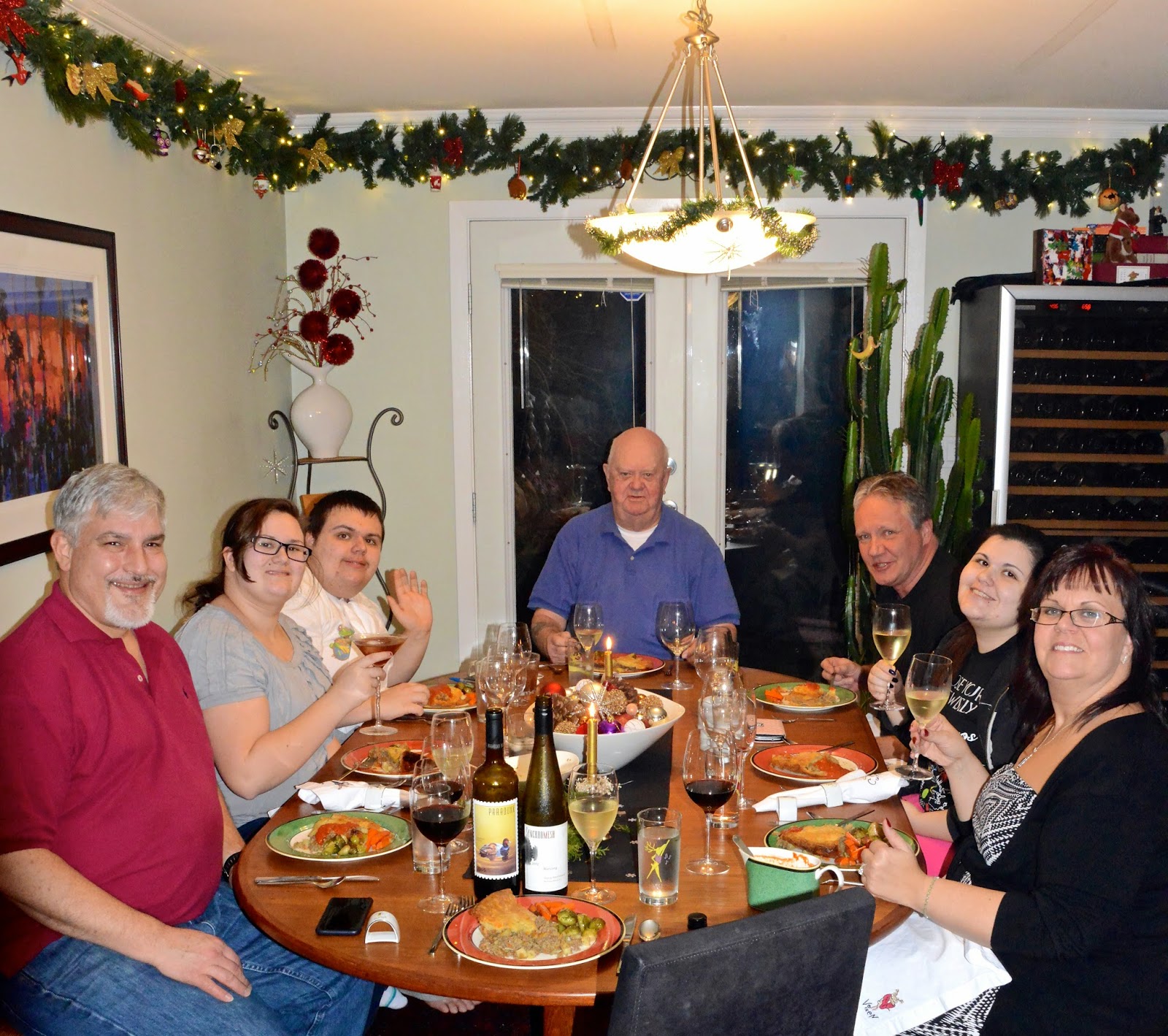
Feeling sorry about the fact that Boo had to miss last night's Christmas dinner because he was working, I invited Dad, Vixen, Big Trucker and the kids to come over to our place for a Boxing Day dinner the next night. The dinner was going to be much lower key but I did decide to pop the corks on some pretty special wines.
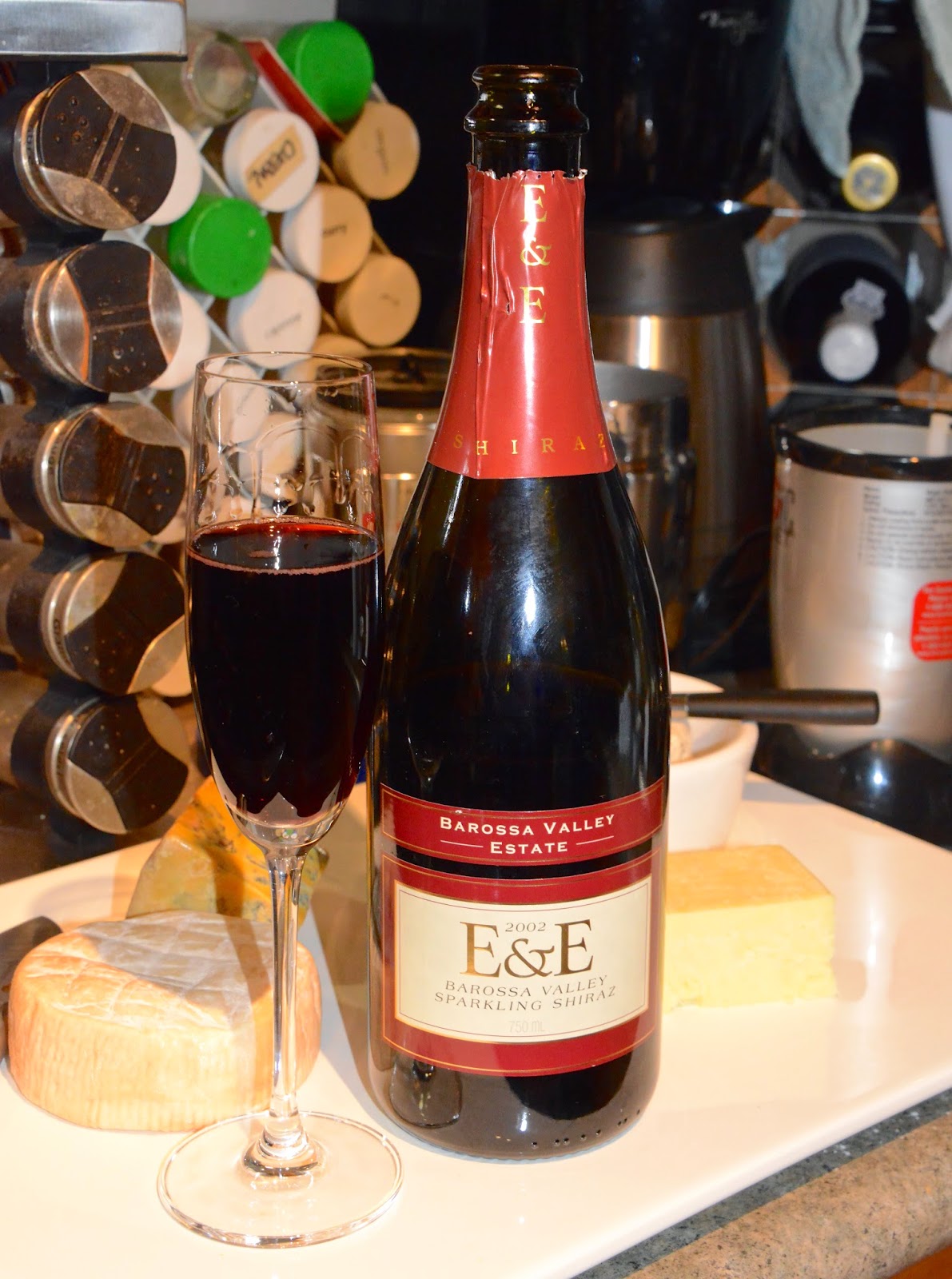
1836. 2002 Barossa Valley Estate E&E Sparkling Shiraz (Barossa Valley)
One of the more perplexing questions I've run across while drinking all these bottles of wine is why a bottle of E&E Sparkling Shiraz costs two-thirds the price of a regular bottle of E&E Black Pepper Shiraz. The same premium wine is used and the process of making sparkling wine is way more intensive and costly, but the still wine is the costlier of the two. Go figure. I suppose the idea of Sparkling Shiraz is still mostly a novelty sip outside of Oz.
The end result is that our's is not to question why, our's is just to take advantage of the bargain pricing - "bargain," of course being a relative term when we're still talking $65 bottle - when you can even find it. I haven't seen the sparkling Black Pepper on local shelves for years now. Too bad since this is our last bottle.
This bubbly red isn't likely going to be the first choice of a traditional Champagne lover. Even though the wine is made in the traditional Méthode Champenoise, there's not a lot of mousse filling your mouth and any expected biscuit-y notes are subdued by the bold, dark fruit that's still evident on the palate but I thought it was an interesting start to the evening and was big enough to carry us through until the hockey game ended and Dad was willing to sit down to dinner.
I don't make tourtière very often - indeed, it seems to have become a bit of a rarified, seasonal treat for every second or third Christmas. Tonight's pie - aided by yet another perfect crust from Boo the CrustKing - proved to be a popular treat, even for the picky eaters that the nieces and nephew have become. It certainly didn't hurt that the homemade tomato jam really did taste darned fine with the tortière. Turns out "tomato jam" is just a fancy name for ketchup, but this was the best ketchup I'd ever had.
1837. 2012 Synchromesh Thorny Vines Vineyard Riesling (Naramata Bench - Okanagan Valley)
1838. 2005 Duckhorn Paraduxx (Napa Valley - California)
Being a mix of pork, beef and veal mince, I figured we could likely get away with both a Riesling to cut through richness of the crust and fat and a Napa blend to match up with the meat. When both wines are as good as these two were, I think I could have gotten away with serving a couple pieces of salami with a boiled potato and the wines still seen everyone leave the table happy.
I'd discovered Synchromesh and its racy Rieslings back at the 2013 Wine Bloggers Conference that was held in the Okanagan. They were part of the Okanagan Falls Wine Association gang that took a gaggle of us bloggers hiking up to a spectacular viewpoint and wine tasting. Synchromesh is only a couple of vintages into its production but they're already a label that I'd go out of my way to find. Problem is they just don't make very much. When we drove by the winery early last September, they had already sold out of their 2013 vintage.
While the Synchromesh winery and home vineyard is just outside of Okanagan Falls, this Riesling is made from purchased fruit that is grown on the Naramata Bench - half an hour or so up the road. The vineyard is planted with a single German clone (218) of Riesling and bright with citrus and apple, pear flavours. I haven't seen many Okanagan winemakers marketing the clonal background of their fruit. Maybe this is a sign of a growing sophistication among BC wine drinkers. This was only the third fruit on these vines; so, I'd be really hopeful that the wines to come will be even more complex and tasty.
Paraduxx, on the other hand, has had some time to master its wines and I think it's pretty safe to say that they've done so. The '05 vintage is a Zin dominant (60%) blend with Cab Sauv (32%), Merlot (6%) and Cab Franc (2%) filling out the glass. Although I've had the odd chance to taste Paraduxx at various events, I don't think I've ever had a full bottle before. Even when Boo and I visited Duckhorn, we visited the Anderson Valley vineyards and not Napa. So, they were serving up Duckhorn Pinot Noirs there. It may have take awhile to finally pull the cork on one of these bottles, but I'll just consider it to be a bit of Christmas present to myself.
1839. 1978 Kopke Colheita Port (Portugal)
As fond as I am of Ports and stickies, I can't say that I was familiar with the term "Colheita" when this bottle more-or-less dropped into my lap. A client of our firm was downsizing his home and he needed to divest himself of some Persian carpets. Having a spouse who is an avowed Carpet Queen, I was given the head's up and we visited the client. Boo came away with two carpets.
The downsizing also included the divestment of a good portion of the wine cellar. So, in lieu of a carpet, I picked out a mixed case of Ports. Having married a Portuguesa, our client had an extensive collection of Port wines. This is the first of our dozen to be opened.
Like the term "Colheita," the Kopke winery was equally unfamiliar to me. Founded by a German diplomat in 1638, Kopke has been declared the world's oldest Port house, having celebrated over 375 years of continuous wine production. (Compare that to Synchromesh's five years or so of production). Kopke is also a market leader in Colheita single year tawnies. After a little reading, I've come to learn that Colheita Port must be aged for a minimum of seven years in oak casks before bottling and that the extended time in wood can result in a richer, more viscous wine due to evaporation over the years. That additional ageing also leads to Colheita's distinctive tasting notes, including raisiny fruit, caramel, honey, toasted nuts and oak.
Colheitas are considered mature at 20 years and the bottles should feature two dates on them: the harvest year and the year the wine was bottled. Our bottle's old school, hand stencilled label declares the 1978 vintage and the back label stated that the wine wasn't bottled until 2002.
Tasty stuff - and if the rest of our dozen bottles are just as fine, Boo and I are going to have some rather delightful endings to a few more special dinners. Hopefully, we won't have to wait until next year's holiday season to find reason to pull a few more corks - and an even bigger hope is that Boo will be able to actually join us on Christmas day next year.
Friday, December 26, 2014
Dreaming of a White (Wine) Christmas
I don't think that it was the result of an over-abundance of Bing Crosby's or Michael Bublé's crooning, but my holiday dinner turned out to be an all-white wine Christmas. As is our family tradition, my sis, Vixen, hosted Christmas dinner for the gang. Other than to spoil the nieces and nephew, my job is to bring along the wine. Funny that.
1833. N.V. Bailly Lapierre Réserve Brut (AOC Crémant de Bourgogne - France)
I was tipped off to this bottle following a bubbly tasting held at Marquis Wine Cellars awhile back. I wasn't able to make the tasting but this Crémant was apparently one of the hits of the tasting. Crémant wines, simply put, are Champagne-style wines that can't be called Champagne because they don't come from the Champagne region. The Crémant de Bourgogne (or Burgundy bubbly) was the first Crémant appellation to be authorized - along with Crémant d'Alsace - in 1975.
Bailly Lapierre is a cooperative of 70 families growing fruit around the town of Bailly in the northern part of Burgundy. Their sparkling wine is made from the region's permitted grapes: Chardonnay, Pinot Noir, Gamay Noir and Aligoté. in reading about the cooperative, I was intrigued that the wines are aged in the old, underground quarries for the town, especially since the quarry work extracted from Bailly provided stone for some of France's best known architectural triumphs - Notre-Dame de Paris, Chartres Cathedral and the Pantheon Paris.
The limestone-based soils lend themselves to a minerality that the bubbles cut through and elevate. A nice balance between subtle tree fruit and the biscuit-y notes so typical of Champagne doesn't hurt either.
And to add to the celebration, with the bucks you save by buying Crémant instead of Champagne (generally a half to a third of the price), you can spend more on presents for the family. This is a particularly enjoyable aspect of this wine to the young'uns who don't care to join in with the toasting and sipping.
1834. 2013 Sea Star Siegerrebe (Gulf Islands - BC)
When picking the turkey wine, I thought I'd forego the classic Gewürztraminer and take one of the wines I was lucky enough to pick up during our Thanksgiving visit to Axel and English Doc on Pender Island. I say, "lucky" because all of Sea Star's wine have been totally sold out for some time now. Quite the feat for a first vintage release, especially when you produce varietal wines like Siegerrebe and Ortega - grapes that most folks have never heard of before.
As it was, I didn't stray too far from the "tried and true" since Siegerrebe is a cross of the Madeleine Angevine and Gewürztraminer grapes. I also knew there's wasn't much risk - even for the family Christmas dinner - since the wine was awarded a Gold Medal at the 2014 Northwest Wine Summit - one of the wine competitions I actually pay some attention to. Plenty of aromatics, with great acidity and some nice soft fruit, along with that bit of Gew spice, coming through on the palate.
I'll definitely be on the lookout for some more of this in vintages down the road.
1835. 2012 Red Rooster Riesling Icewine (VQA Okanagan Valley)
To close out the dinner, I grabbed a bit of a treat - for both those gathered and for me. Admittedly, it might have been a tad selfish, but knowing my family's inclinations for various wines, I was pretty sure that only Vixen and I would think about seconds. Choosing an icewine was also a conscious choice though to try and build on the nieces' introduction to wine. As newbies to the wine scene, a little - or in this case a lot of - sweet never hurts.
I think this is the first icewine that Red Rooster has released and, even then, this was a limited production of 547 half bottle cases. Boo and I grabbed some bottles during our last visit to the winery for an Adopt-A-Row event. As one of the treats the winery pulled out for the adoptive parents, we tried a barrel sample of the Riesling Icewine. Nabbing a couple of bottles was a no brainer.
I also figured that, since it was once again my responsible to bring bread pudding, the Icewine would be a grand match to the dessert - especially since I remembered to add the sugar to the pudding this year. The Icewine likely would have still paired nicely with last year's more savoury bread pudding but I think the match was a little more traditional this year.
An interesting note on the wine was that the folks at Red Rooster started picking the grapes around 2 a.m. on January 1, 2013. You've got to wonder about being out in the vineyard in -8 to -14°C weather to pick frozen grapes on the first day of the year. That's either one helluva way to finish your New Year's Eve celebration or quite the start to the year to come - a 2 a.m. wake-up call.
I'm glad they bit the bullet for us though - because that Icewine was a far nicer "end" to the dinner than the end the girls were subjected to once the table was cleared. I'm not entirely sure what prompted this display but it was hardly in tune with the joy of Christmas and suiting up in your onesie to watch Mama Mia.
Except to say that it was one "mother" of a way to end the dinner.
Labels:
Alternative Whites,
Burgundy,
France,
Icewine,
Okanagan,
Riesling,
Sparkling,
Vancouver/Gulf Islands
Wednesday, June 25, 2014
Aussies in the House
We've been anticipated their arrival for months now but Merlot Boy and Margarita have finally arrived on our doorstep - and I'm thinking there's going to be a wee bit of booze playing a role in our lives as long as the Two Kangaroos are gracing our Vancouver shores.
Since neither wine nor I was involved in their initial day touring the town, I was lucky enough to arrive home with both dinner and thirsty tourists front and centre when I arrived home from work. Boo had made that most Canadian of dishes for dinner: butter chicken. So, we took advantage of the good weather and our guests and dined al fresco in the garden. A simple luxury that we don't do nearly enough.
I'd been waiting for an opportunity to open a trio of 2012 Orofino Rieslings for some time now - and, yes, that was "trio." John and Virginia Weber of Orofino decided, with their 2012 vintage, that they'd highlight the different terroirs of the three vineyards where their Riesling grapes are grown and take a slightly different approach to the production of each of the three wines.
I pointed out to Merlot Boy (who, despite his name, will drink other types of wine - or beer or vodka or whatever else you're serving) and Margarita (same side note for her drinking habits as well) that three different versions of the same varietal from a boutique, BC producer is extremely rare. Indeed, I can't think of any other similar production.
It also didn't hurt that Orofino is one of my favourite local wineries.
Normally, I'd tell a few tales about the winery and the folks behind it, but I've already added enough Orofino wines to The List that I can just point you to the post I wrote leading up to the 2013 Wine Bloggers Conference. I think it's safe to say that it's as comprehensive as I get in the blog and there's no need in repeating myself here.
1645. 2012 Orofino Home Vineyard Riesling (VQA Similkameen Valley)
1646. 2012 Orofino Scout Vineyard Riesling (VQA Similkameen Valley)
1647. 2012 Orofino Hendesbee Vineyard Riesling (VQA Similkameen Valley)
Regular visitors to the blog know that Riesling and I are the fondest of friends. So, the opportunity to see how a favourite producer ventured to take three different approaches is a godsend. It's the rare occasion where Boo and I open three bottles of wine for one dinner; so, I'll admit that waiting for an occasion such as this was quite the task to hold off on pulling the cork on at least one of the bottles. Thankfully, that occasion arrived with our two antipodeans.
In talking with John at the winery, he emphasized that he's looking more and more to emphasize the single vineyard aspect of his production. Previously, Orofino's Rieslings were blended to make a single wine - and, even then, there wasn't a whole lot of it. John's practice had always been to ferment the different vineyard fruit separately but he found himself short of space with the three Rieslings; so, he aged the home vineyard fruit in used French oak (and one acacia barrel) while the other two Rieslings remained in stainless steel. He found that the three wines were different enough from each other that they warranted separate bottlings - even though that meant there'd only be 300 cases of Hendsbee, 250 cases of Scout and 100 cases of the Home Vineyard wine.
We found those different profiles to be telling as well. I often find that it's hard enough to differentiate between varietal wines from different producers, let alone wines from the same producer, but that wasn't the case here. Each wine had a telltale profile. The Hendsbee jumped out of the glass with its racy acidity, while John had left a bit of residual sugar on the Scout Riesling - not that this was a sweet wine in any sense of the word. Interestingly enough, it was the Home Vineyard that proved to be a slight favourite at the dinner table and that was the wine that saw some barrel ageing. John has talked about this wine seeing a fair bit of lees stirring (lees being the spent yeast cells and the stirring of those lees often resulting in a richer, fuller feel to the wine) and maybe it was that extra note of complexity - that cut the acidity just a touch - that made the difference.
It was no surprise that all three wines disappeared without problem, however - and I can only hope that we sip on a whole whack of other treats while the Aussies are gracing us with their presence.
Monday, June 16, 2014
The Germans Arrive at the World Cup
Another World Cup match. Another wine to celebrate a big win. Today's game featured two of the early favourites - Germany and Portugal - but I don't think anyone would have come close to predicting a 4-0 win for Germany. There may be a whack of Portugese fans drowning their sorrows tonight but the German win calls for a German wine.
It's likely a good thing that Germany won because the wine needed to pair with the chirashi sushi bowl that we were serving up for dinner. Something tells me that a German Riesling is an infinitely tastier match to the evening's seafood than a big Portugese red or Port could ever be. To further complicate the flavour profile needed, our chirashi bowl was uncharacteristically loaded with uni (sea urchin gonads for the uninitiated) - not that I'd have any concept of what goes best with uni. Other than to guess that maybe sake or beer would work since those are the most common beverages in the Japanese restaurants I've been to.
Why sea urchin? You may ask. While at the Steveston docks the other day, I ran across a fisherman selling live urchins at the bargain price of three for $10. I don't think I've ever seen live sea urchin for sale before. Despite the fact that uni would not the first dish I order in a restaurant, I pretty well had to buy them.
What I didn't know is that the little guy's spines keep moving even after you cut into the shell. I can definitely tell you now though - should you be so inclined to try this at home - that digging out the gonads is not the easiest or cleanest kitchen activity, but it was certainly an interesting hour or so.
Luckily, the wine was much easier to open.
1632. 2012 Dönnhoff - Höllenpfad Riesling (Trocken - Nahe - Germany)
A buddy of mine, Bug Boy, has been making regular trips to Germany lately for family reasons and I asked him how he's enjoying all the Rieslings that he must be bringing home. He'd looked at me and said that it hadn't dawned on him to bring back a single bottle because he doesn't drink the stuff. A couple weeks later, he showed up on my door step with a couple bottles - this baby included.
As much as Riesling and I are the best of friends, I don't tend to drink a lot of German Riesling - likely because I'm just not familiar with the producers and I assume that the majority of German Rieslings found on Vancouver shelves are generic brand wines - unless they're priced well in excess of a Tuesday night. I knew nothing of tonight's wine before opening it.
It would appear that the Dönnhoff family has owned a modest estate in the Nahe region for over 250 years. Helmut Dönnhoff, the current owner, has been at the helm of the winery since 1971 and is renowned in the region - and country - to the point of being named "German Winemaker of the Year" in 1999.
Despite the pedigree behind the winery, the Höllenpfad vineyard is a recent addition to the family's holdings and this 2012 is only the second vintage for Dönnhoff. I quite liked reading that "Höllenpfad" translates to "path to hell" in English. The winery website notes that the name appears to have originated from all the hellishly hard work involved in growing and harvesting grapes on the very steep slope and/or from the fact that the vineyard soil is largely made up of red sandstone and, in the evening, it reflects the setting sun, casting a red glow as you look back upon the vineyard.
The wine was all minerality and lime and was austere enough that I might have taken it for one of the many Aussie Reislings I've thrown back over the years. This was far from your mother's Blue Nun or Black Tower (which I think might still be around although I doubt the flavour profile is the same as it was back in the 80's). The website states that a portion of the wine sees some ageing in oak barrels as well as stainless steel. I didn't catch any notes of the oak myself but I understand Orofino, one of our favourite BC wineries, ages one of its Rieslings with some oak exposure as well. So, I suppose ageing Riesling in oak isn't necessarily all that foreign of a concept after all.
The Riesling might not have been the perfect match for uni but I still figure it was a far better accompaniment than Port. So, bravo for the German win and to the German wine it prompted. If this match is any indication of the tournament to come, there should be plenty more opportunities for German wines.
Tuesday, June 3, 2014
Calling All Acid-Loving Riesling Fiends
As a rule, I don't generally think of the Oliver Osoyoos region or the Golden Mile when I think of BC Rieslings - which is actually quite often. However, I ran across a couple Road 13 Rieslings a year or so when we stopped in at the winery while passing through the area. I see that the label suggests this vintage could age 5-10 years. I couldn't wait that long.
1621. 2011 Road 13 - Home Vineyard Riesling (VQA Okanagan Valley)
The first thing that struck me was the blast of acidity that shocked my senses. No one will mistake the lemon and lime that jump out on the palate. I often grab BC Riesling to pair with butter chicken, partially because there can be a touch of sweet fruit to counteract the spice of the curry. That wasn't exactly the case with this Road 13, but another good thing with Riesling is that the acidity can cut through the creaminess of butter sauce. Plus, it drinks beautifully on its own on a hot afternoon or evening.
Win win, I'd say.
I didn't see how much of the Home Vineyard Riesling was produced in this vintage, but I did see that only slightly more than 100 cases were made in 2012. So, my guess is that there would have been about the same amount made in 2011 - making it not the easiest wine to get ahold of. The fruit is grown on one small block of older vines on the Golden Mile. That might explain the limited production. The vines were likely planted years ago while viticulturists were trying out all types of grape varieties to see what would work best in the new region. I don't think there are many Riesling vines being planted this far south in the Okanagan nowadays - except in very particular plots that aren't as well suited for the bigger reds that tend to dominate in Oliver-Osoyoos.
I think this was the only bottle of the Home Vineyard Riesling that I picked up on that trip. I'll have to keep my eye open for more next time we're in the area.
1621. 2011 Road 13 - Home Vineyard Riesling (VQA Okanagan Valley)
The first thing that struck me was the blast of acidity that shocked my senses. No one will mistake the lemon and lime that jump out on the palate. I often grab BC Riesling to pair with butter chicken, partially because there can be a touch of sweet fruit to counteract the spice of the curry. That wasn't exactly the case with this Road 13, but another good thing with Riesling is that the acidity can cut through the creaminess of butter sauce. Plus, it drinks beautifully on its own on a hot afternoon or evening.
Win win, I'd say.
I didn't see how much of the Home Vineyard Riesling was produced in this vintage, but I did see that only slightly more than 100 cases were made in 2012. So, my guess is that there would have been about the same amount made in 2011 - making it not the easiest wine to get ahold of. The fruit is grown on one small block of older vines on the Golden Mile. That might explain the limited production. The vines were likely planted years ago while viticulturists were trying out all types of grape varieties to see what would work best in the new region. I don't think there are many Riesling vines being planted this far south in the Okanagan nowadays - except in very particular plots that aren't as well suited for the bigger reds that tend to dominate in Oliver-Osoyoos.
I think this was the only bottle of the Home Vineyard Riesling that I picked up on that trip. I'll have to keep my eye open for more next time we're in the area.
Sunday, June 1, 2014
Oh Joie! - A Shower For The Happy Couple
For the last couple of years, my sister, Vixen, has been obsessing about her upcoming wedding to Big Trucker. She didn't get that grand, old white wedding - that I understand all little girls dream of - with her previous guy. Three kids, but no walk down the aisle. So, she's making up for it this time. For months now, Boo & I have been well advised that we're throwing a shower for them. As if I'm supposed to know the difference between a wedding jacuzzi and a shower.
When asked why we're slated to throw this instead of the gals in the wedding party, she stated, quite perfunctorily, that "Mom and I threw a shower for you two, you're damned well throwing one for me." When I retorted that, "I thought Mom threw that shower," she simply glared and shot back, "Don't you kid yourself. That was all me and you will throw me the best, f*ck'n shower ever or your ass is grass!" Okay, I might have embellished the last quote a teensy bit but I swear it accurately reflects her true sentiments - even if she didn't really say that my ass'd be grass.
So, food and booze. No problem. I can even get a balloon or two but was I really supposed to know that showers traditionally involve games and cake? Who knew that Jack & Jill parties run on the same principles? Let's just say that I might have been scrambling a tad when it came to organizing the "activities," but I can confirm that having more than enough food and booze compensates for missing a few other niceties.
An example of my lack of organization? I made up a big batch of sangria and didn't even remember to take a picture of the sangria or the wines that went into making them. Boo's clean up was so thorough and quick that I couldn't even take a picture of the wine bottles (and box) after the fact. Guess I'll just have to miss out on adding those wines to The List.
Thankfully, I didn't forget to get a shot of the double magnum bottle I opened for the celebration.
1620. 2011 Joie Farm - A Noble Blend (3L bottle) (VQA Okanagan Valley)
I just happened to have the double magnum of Joie lying around after I'd picked it up at a charity silent auction awhile back. At the time, I had no idea what kind of event would prove worthy of pulling the cork. I surely wasn't going to open the bottle for a quiet dinner for two. I figure a gathering of the clan for Vixen's imminent nuptials is about as good a reason as you could ask for though.
Now, I think it's safe to say that I don't buy many oversized bottles. I pretty much need to know that I like the wine - a lot - before I'll put out the extra bucks. No problem with this wine though. I've had A Noble Blend on a number of occasions and it's a perennial fave for the folks at Joie Farm. I've actually added the 2011 vintage to The List back at #1188 but that was a standard 750ml bottle. So, I figure it's fair game to add the over-sized bottle to The List as well.
Styled after the white blends of Alsace, the 2011 wine is dominated by Riesling and Gewürztraminer (38% and 33% respectively) with Pinot Blanc, Pinot Auxerrois and Schoenberger completing the mix. Various scribes have called it "rubenesque," "lengthy, tangy and mouthwatering," "a stunner" and "magic." I just call it tasty and refreshing and a hit with the crowd at hand.
As for the games? Turned out that I had more than we needed. Our New-to-Be-Wed Game showed that the happy couple actually knew each other pretty well. But, then again, you've got a 50/50 chance of being right if your answer for any Big Trucker question involves his car or the Miami Dolphins.
There were plenty of laughs reading all the bits of relationship advice that the guests offered to the happy couple - and at least a couple surprises when folks were asked to guess who was "the better at..." or "more likely to...." It probably wasn't too much of a surprise to see that the vast majority thought Vixen would be better at making a martini (after all I taught her everything she knows) or that she'd be the more likely of the two to send a "sext" message. It might have been more of a newly learned secret, however, to find out that neither admitted to being more likely to bring the other breakfast in bed. I think their joint response to the question was "What's that?" Big Trucker upped that with a "it'd more likely be a who'd deliver nachos in the bathroom kinda thing."
Relatives - what can you say? I suppose it good to learn that the new ones are likely to be just as crazy and weird as the current ones.
I just hope to be around when Vixen opens one or two of the bottles they received as gifts.
When asked why we're slated to throw this instead of the gals in the wedding party, she stated, quite perfunctorily, that "Mom and I threw a shower for you two, you're damned well throwing one for me." When I retorted that, "I thought Mom threw that shower," she simply glared and shot back, "Don't you kid yourself. That was all me and you will throw me the best, f*ck'n shower ever or your ass is grass!" Okay, I might have embellished the last quote a teensy bit but I swear it accurately reflects her true sentiments - even if she didn't really say that my ass'd be grass.
So, food and booze. No problem. I can even get a balloon or two but was I really supposed to know that showers traditionally involve games and cake? Who knew that Jack & Jill parties run on the same principles? Let's just say that I might have been scrambling a tad when it came to organizing the "activities," but I can confirm that having more than enough food and booze compensates for missing a few other niceties.
An example of my lack of organization? I made up a big batch of sangria and didn't even remember to take a picture of the sangria or the wines that went into making them. Boo's clean up was so thorough and quick that I couldn't even take a picture of the wine bottles (and box) after the fact. Guess I'll just have to miss out on adding those wines to The List.
Thankfully, I didn't forget to get a shot of the double magnum bottle I opened for the celebration.
1620. 2011 Joie Farm - A Noble Blend (3L bottle) (VQA Okanagan Valley)
I just happened to have the double magnum of Joie lying around after I'd picked it up at a charity silent auction awhile back. At the time, I had no idea what kind of event would prove worthy of pulling the cork. I surely wasn't going to open the bottle for a quiet dinner for two. I figure a gathering of the clan for Vixen's imminent nuptials is about as good a reason as you could ask for though.
Now, I think it's safe to say that I don't buy many oversized bottles. I pretty much need to know that I like the wine - a lot - before I'll put out the extra bucks. No problem with this wine though. I've had A Noble Blend on a number of occasions and it's a perennial fave for the folks at Joie Farm. I've actually added the 2011 vintage to The List back at #1188 but that was a standard 750ml bottle. So, I figure it's fair game to add the over-sized bottle to The List as well.
Styled after the white blends of Alsace, the 2011 wine is dominated by Riesling and Gewürztraminer (38% and 33% respectively) with Pinot Blanc, Pinot Auxerrois and Schoenberger completing the mix. Various scribes have called it "rubenesque," "lengthy, tangy and mouthwatering," "a stunner" and "magic." I just call it tasty and refreshing and a hit with the crowd at hand.
As for the games? Turned out that I had more than we needed. Our New-to-Be-Wed Game showed that the happy couple actually knew each other pretty well. But, then again, you've got a 50/50 chance of being right if your answer for any Big Trucker question involves his car or the Miami Dolphins.
There were plenty of laughs reading all the bits of relationship advice that the guests offered to the happy couple - and at least a couple surprises when folks were asked to guess who was "the better at..." or "more likely to...." It probably wasn't too much of a surprise to see that the vast majority thought Vixen would be better at making a martini (after all I taught her everything she knows) or that she'd be the more likely of the two to send a "sext" message. It might have been more of a newly learned secret, however, to find out that neither admitted to being more likely to bring the other breakfast in bed. I think their joint response to the question was "What's that?" Big Trucker upped that with a "it'd more likely be a who'd deliver nachos in the bathroom kinda thing."
Relatives - what can you say? I suppose it good to learn that the new ones are likely to be just as crazy and weird as the current ones.
I just hope to be around when Vixen opens one or two of the bottles they received as gifts.
Subscribe to:
Posts (Atom)