Showing posts with label Rose. Show all posts

Tuesday, July 5, 2011

Dinner Club Like Never Before

After the "build up" of the last couple posts, it's time for the big "reveal." Over the years, our Dinner Club has seen its share of themes, holiday dinners and al fresco locales, but this is the first time that we've actually hit the road. Ever the innovator, Tyrant suggested that, if everyone was willing to hop the strait, he'd love to host his round at his new place and let everyone escape the hustle of the city for the long weekend. Coordinating everyone's availability can be a task - but there wasn't a whole lot of arm twisting required.

Boo and I arrived yesterday. Lady Di and She Who Must Be Obeyed had the tightest schedule but caught one of the puddle jumping flights from harbour to harbour and, then, Jeaux and Matinder completed the gang with an afternoon ferry arrival. There was a tiny bit of island touring and artisanal cheese shopping, but by the time Boo and I arrived back from a quick trip to the Farmers' Market and local wine shops, everyone was enjoying an early start to the cocktail hour.

847. 2009 Elephant Island - Pink Elephant (Product of Canada - Naramata Bench)

Tyrant and co-host, SYG2, started us off with a novel and refreshing twist. Pink Elephant is Elephant Island's Methode Champenoise wine that's made with Granny Smith apples and finished with a dosage of the purely fruit winery's Cassis. On its own, Pink Elephant is reminiscent of a Kir Royale - with a twist - but Tyrant also kicked it up a level with "pour your own" Vodka and an additional fruit cocktail. Knowing we were already headed for an evening long on the wine, I opted for Elephant straight from the bottle. I heard of this fairly new offering from the winery, but I hadn't tried it before. Add some warm weather and I think we'll be trying it again down the road.

When it comes to our Dinner Club, I always run into a problem of not being able to give sufficient props to, adequately discuss or even show pictures of all the wine and dishes presented. This dinner was no exception when it came to outstanding food. Seeing as how it was the Canada Day weekend, Tyrant asked everyone to bring all Canadian wines to match up with a menu of worthy Canadian products.

848. 2001 Hawthorne Mountain Gold Label Series Chardonnay (VQA Okanagan Valley)

The list of wines showed that some folks clearly pulled some bottles from the lower reaches of their "cellars" (such as they are). I very much doubt that there are many bottles of this 2001 Chardy still hanging around - and, you know, it did okay. Maybe not quite as fresh as the sunny afternoon could handle but it had the body to stand up to one of Tyrant's appies, a lamb and pesto bruschetta.

We were ever so lucky that the weather turned nice for our dinner date. Thus far, this has been a bit of a bummer of a summer, but we managed cocktails and three early courses before we had to head inside for the main course. The fountained patio was as pleasant a dining location as the Dinner Club has seen in the great many years that it's been around.

849. 2010 Dirty Laundry - Woo Woo Vines Gewurztraminer (VQA Okanagan Valley)

850. 2009 Artisan Wine - Rigamarole Rose (VQA Okanagan Valley)

Tyrant was so true to his July 1-themed dinner, but the pièce-de-resistance had to be his gazpacho with "Canada" written out in crème fraiche. As much fun as we had with the presentation of the soup, we probably had more fun with the WooWoo and Rigamarole labels. Dirty Laundry's story of the winery's location being an old brothel/Chinese laundry is always a fine tale to tell and Rigamarole's use of "legendary" animals can definitely set you to talking. Good thing both of the wines can hold their own against "worries" of marketing departments gone awry.

851. 2005 Burrowing Owl Syrah (VQA Okanagan Falls)

During our tour of the "estate," Boo had commented on the sorry state of Tyrant's rhubarb plant. What Boo didn't realize is that most of the plant had been harvested to make a palate cleansing sorbet. As we moved into the reds, the rhubarb freshened us up enough to appreciate the consistency that is Burrowing Owl. Merlot hasn't generally been my first pick of Burrowing Owl wines but the years behind this bottle hadn't hurt the integration of the wine. Hardly a big fruit bomb, but totally befitting the circumstances.

852. 2007 Howling Bluff - Sin Cera (Okanagan Valley)

853. 2008 Bonitas - Artist Series Merlot/Shiraz (Okanagan Valley)

Following in Burrowing Owl's footsteps (so to speak), Howling Bluff is gaining its own reputation as a bit of a cult wine producer. After its triumphant arrival on the scene with a Lieutenant Governor's Award for its Pinot Noir, howling Bluff has concentrated on a limited number of wines - unlike many Okanagan producers with more than a dozen offerings. The Sin Cera is Luke Smith's entry in the Bordeaux blend/Meritage stakes in the province. Merlot-dominated, the Sin Cera is one of the bottles that has survived Tyrant's and my visit to the winery a couple of years back. With only 200 cases produced in total, we'll have to consider ourselves lucky that we had the chance to savour it.

As for the Bonitas, this is yet another BC winery that I've heard of but can't recall ever having tried. Unfortunately, this probably wasn't the bottle that any of us wanted to be our introduction to the winery. Take a look at the face on the label. I think he might have tried the wine in the bottle as well. I don't think the bottle was corked but it might as well have been. Unfortunately, this was, by far, our least favourite wine of the night.

854. 2003 Stag's Hollow - Renaissance Merlot (Okanagan Valley)

855. 2007 Stag's Hollow Heritage Block Cabernet/Merlot (VQA Okanagan Valley)

Having two Stag's Hollow wines at one sitting was a rarity for me as well. Another winery that I've heard and seen more about than I've tasted, it's wines were rather more successful than the Bonitas. Jurgen Gothe, one of the local wine scribes, called the 2003 Renaissance Merlot one of "The Best Wines of the Year found close to home" in 2007. Personally, I enjoyed the '07 blend a bit more - however, I might have a completely different take on the wines after the fact. There had been a bit of imbibing by now. I just know that the wines went perfectly well with Tyrant's elk burgers. Rather fitting, I might say, given the stag on the label - not that I have the slightest idea of whether a male elk is called a "stag" or not.

856. 2001 Black Hills - Nota Bene (VQA Okanagan Valley)

The Nota Bene wasn't planned as a dessert wine - and wasn't exactly served as one. There was just no way that this bottle wasn't being opened - if only so that I could have a bit of night cap. I think this was our last bottle of the 2001 vintage and I figured the occasion called for its opening. Once again, none of us was likely at the peak of our tasting abilities by this point of the evening. But, I was pleased that the wine was definitely on queue and had aged gracefully after all these years. Much like our Dinner Club has.

All in all, it was another dinner to remember. If I could add this many wines to The List every week, I'd be through this Odyssey in no time. My liver might not survive the trip, but it would be a whole lot faster.

Big kudos to Tyrant and SYG2 for a grand evening and weekend.

Sunday, May 29, 2011

Inspiration & The Party At The Point

This Saturday was the University of BC Alumni Weekend and, perhaps for the first time since I graduated all those years ago, I decided to drag Boo out for a bit of visit. I'd really hoped to make the tour of the UBC Wine Library as it is described as "one of the most exclusive wine libraries in the world." The Wine Research Centre, in part, studies the aging of wines produced in BC. Unfortunately, by the time I tried to sign up, both tours were already full. Considering I tried on the first day after notice was sent out, those tours must have been among the very first events to "sell out."

As disappointing as that discovery was, I was pleased to be able to take in a tour of the UBC Farm. The Farm is one of those areas that I've known about for some time - especially since the Farm has hosted a farmer's market for the last couple of summers - but have never actually visited. I think my desire to visit was piqued even more when discussions were taking place to potentially convert the Farm into condos - like much of the surrounding university endowment lands. Although I'd never been to the site before, I knew that it was a unique part of the university.

It's next to impossible to take in everything that the Farm encompasses in only 45 minutes, but I was definitely intrigued by some of the projects taking place. A couple of those studies include the effective re-introduction of an increased native bee population and the interactive Urban Aboriginal Kitchen Garden. Our tour barely scratched the surface, but it made me all the more eager to come back and dig a little deeper (pun intended, sorry).

We were going to call it a day after the Farm; however, our shuttle bus made a stop at the UBC Botanical Garden. Despite our intended departure, we found ourselves jumping off the bus. Again, despite all my years at the campus, I'd never actually visited the Botanical Garden. I've been to the garden sale in the parking lot - just never inside the garden itself.

Just like the Farm tour, there was no way we were going to be able to take in the full garden, but we happened to stumble upon the Greenheart Canopy Walkway just as a tour was departing. I had no idea the Walkway had even been created but it was quite the experience to traverse the suspension bridgeway from platform to platform. At points, we were over 50 feet in the air and, for me, it was a unique way to see the upper layers of the coastal rainforest canopy.

Between the Farm and the Botanical Garden, I kept thinking of all the opportunities to set up shop for a picnic that were just staring us in the face. A little rest stop with a bottle of wine was truly alluring. Too bad I'd never considered the possibility in advance.

The tours did, however, motivate us to hightail it home and get to work in our own garden - because the neglect currently abounds. We managed to clean up and plant our plot in the community garden - although it certainly didn't look so lush after we'd ripped out all the volunteer forget-me-nots and laid down a straw mulch. After another couple hours of soil remediation, planting and clean up in our own yard and the boulevard, there was a definite need for some refreshment.

What could be more refreshing on a sunny afternoon than a cool glass of rosé?

815. 2009 Dominio Dostares - Tombú (Vino de la Tierra de Castilla y León - Spain)

This wasn't just any dime-a-dozen rosé either. It was made of 100% Prieto Picudo - a varietal that I'd certainly never heard of before. The grape is primarily grown in the province of Léon in northwestern Spain. What little I found to read about the varietal points to the fact that it was nearly extinct, but that a movement to emphasize the production of indigenous varietals has seen a revival in plantings. Domino Dostares' vineyards, however, features vines that are as old as 90 years.

Prieto Picudo is generally seen as being similar in profile to Tempranillo and is used for both blending and varietal wines. One writer, on the primarily Iberian wine blog Catavino, postured that the varietal could be seen as a Spanish Pinot Noir. Like Pinot Noir, Prieto Picudo appears to not be the easiest of grapes to grow or fully ripen. Also known for its high acidity, the varietal is also often vinified as a rosé - such as the bottle we've opened today.

Taking sips between pulling weeds and digging dirt doesn't lend itself to particularly extensive tasting notes, but I do know that it certainly hit the spot for Boo and I. I also know that this bottle brings me one step closer to making my quota for the Wine Century Club. Prieto Picudo is definitely a new varietal for my application and I think this brings me up to #94. The end is definitely in sight.

Farm and Garden canopy tours. A good bout of home gardening. A glass of wine in the sun. And a new varietal for the Wine Century Club. I think that qualifies as a rather productive day.

Tuesday, January 4, 2011

Wrapping Things Up in Cuba

One of my favourite pastimes, when abroad, is to visit markets and see what is available when shopping locally. While in Havana, I wandered across a large supermarket and naturally took a look inside. There wasn't much chance that I'd ever confuse it with a Whole Foods or a Capers but the mercado seemed to be pretty well stocked. Very few of the brands were recognizable but the basic products were extensive - to the point that there was even a freezer section of frozen turkeys. The prices even seemed to be fairly comparable to those at home - with the big exception that those prices are hardly comparable when your monthly salary is only a fraction of the wages back home. Some things aren't really all that relative after all.

I did find a little booze section though and, in amongst all the rum and liquors, there were some wines - mostly European or Chilean. No Australian, South African or Canadian wines were to be found and there were definitely no American bottles on the shelves. There was one little section of Cuban wines though. The thought of Cuban wine had never really crossed my mind; so, this was pleasantly unexpected. Given the exorbitant price of wine back in Vancouver, the fairly standard price of around $5 for these Cuban wines didn't lend itself to great hopes for the wines being sold. I really had no choice in the matter though. I had to get one.

On a shelf a little further along, I found another Cuban wine that was twice the price of the other bottles. Same winery but twice the price. For $10, it seemed a gimme to go for the "reserve" bottle. And why not open it at the first chance? After all, I don't think I'll take it home with me. If I'm only allowed one bottle, it might as well be a aged Rum. As luck would have it, the return trip from Havana arrived at the resort in Varadero right around dinner time.

687. 2005 Castillo del Wajay Tinta Reserva (Cuba)

Wine isn't all that incorporated into Cuban culture. General consensus is that it's just too expensive for the average Cuban. A Cuban-made wine is even more foreign. When I asked the waiter to open the bottle of Cuban wine that I'd found, he questioned whether we seriously wanted to drink it. In the last decade, however, it turns out that there have been two joint ventures created to set up vineyards and wineries in the Caribbean nation. One venture involves Spanish backers and experts, the other, Italian. At first, the wines were made with imported juice and I gather many of the cheaper wines are still produced that way. There are wines now, though, that are being made with grapes only grown on the island.

It's not easy finding out much about the companies or the wines, but Castillo del Wajay is one of the brands produced by Bodegas del Caribe - the venture involving Spanish interests - and its wines feature all Cuban fruit. The story goes that the partners brought in approximately 20 varietals to grow in test vineyards and they feel that they've identified several grapes that can successfully acclimatize to Caribbean conditions.

I'm not sure if I should be surprised or not, given the Spanish involvement in the winery, but the Tinta Reserva is primarily made of Tempranillo. What's more, I've had far worse wines than this. Maybe it was just the low expectations for a Cuban wine, but I found it quite palatable. It was perhaps a bit fruitier than most Spanish Tempranillos I'm used to, but there was a nice, basic structure and I'd have no problem trying it again if I ever saw a bottle for sale back home. Who'd a thunk it?

The next wine was all about location. I had to have at least one bottle next to the Caribbean. No chance of a romantic little sunset sip with Boo on this trip. So, I grabbed my sis, Vixen, my Dad and Vixen's gal pal, Lola, and we hit the beach. Not exactly the sunniest of occasions, but with this crowd, the wine wouldn't last long anyhow.

688. 2009 Strut Risque Rose (VQA Okanagan)

Obviously, this was one of the bottles that I'd brought along with me. The chances of finding an Okanagan wine for sale in Cuba is pretty far-fetched I'd say. I didn't even grab this wine because it was anything extraordinary; I just figured a Rose might come in handy on a Caribbean afternoon. Indeed, I can't say that I'd fall for the obvious marketing ploys behind this wine. "The Wine with Legs" bit might appeal to Vixen though. Rather, this was the bottle that I won at the Pink Broom curling bonspiel for being named Miss Congeniality. Pink Wine. Pink Broom. I'm sure you get it.

Made with Gamay Noir, Riesling, Viognier and Sauvignon Blanc grapes, there's a fair bit of fruit going on here. There was still enough acidity to make it a reasonable sip though. It's okay for drinking at the beach. I might stick to the Cuban Tempranillo when it comes to dinner though.

Speaking of dinner, we were scheduled to dine in the French restaurant tonight. So, I grabbed another of the bottles that I'd brought along. In fact, I grabbed this bottle while passing through the Duty Free shops at the Toronto Airport. We don't see much in the way of Ontario wines in BC, so I thought this might be a great chance to grab one. Not that duty-free shops necessarily have the best wines available.

689. 2009 Trius Merlot (VQA Niagra Peninsula)

Although I've seen this winery name in various Canadian wine magazines, I know nothing about it. I grabbed it at the Airport precisely for that reason. The other wines were the big names that even have Okanagan counterparts. Although it is associated with Hillebrand winery, I believe Trius is strictly situated in Ontario. Trius' claim to fame appears to be its Bordeaux blends and its sparkling wine but they have a line of straight varietal wines as well.

At under $20, it was a decent enough wine, but my guess is that this doesn't represent the best that Ontario has to offer. I don't know that I'd grab a bottle if it showed up on BC shelves. Not when compared to BC Merlots. Between our glasses and some of the cousins that paid a visit from the neighbouring table, the bottle didn't last long though. We needed to ask for more wine from the waitress. Surprisingly, she even left the bottle with us at the table. So, I was able to get a shot and find out a little bit of info for the blog.

690. Senorio de la Antigua Tinto (Cuba)

Unfortunately, the emphasis has to be on "a little bit of info" with this wine. I couldn't find much reference at all to the winery, even after the fact. I see that the wine is "made for" Bodegas del Caribe, the same company that makes the Cuban grown wine we tasted last night, but I think this may be one of the wines that is made from imported juice. The back label says that the varietals used are Mencia, Prieto Picudo and Garnacha (Grenache). I couldn't find any reference to any of these grapes being successfully grown on the island.

No matter. We actually thought this wine was rather enjoyable. In fact, most of us preferred it to the Ontario Merlot. Not something that Ontario winemakers would likely want to hear. No doubt they'd just blame it on BC prejudice against Ontario wines.

So, after havin'a bit of a "wine free" trip to Havana (pardon the pun), I've made up a bit for it with four quick wines. Only one more day in Cuba though - and that may just have to be a mojito by the pool kind of day.

Sunday, November 28, 2010

A Seasonal Dinner Club

Normally, Jeaux and Matinder's Annual Christmas Cookie Fest is the definitive start to the holiday season. I've lost count of the different types of cookies and treats that Matinder has offered over the years on that first Friday of December. Unfortunately, Boo and I won't be able to make it this year. So, all the more reason to celebrate the fact that it's their turn to host the Dinner Club and that they wanted to fit their dinner in before the silly season of parties and commitments kicks in and prior to their departure to the Caribbean - particularly since they're going to be gone for the first so many months of 2011.

As mentioned in previous postings of Dinner Club gatherings, Jeaux and Matinder are the theme-masters. I haven't got the slightest idea where the concept for this meal came from but, for the evening, we were taken away to the tropics. Be it Antigua, Barbados or the Virgin Islands, we just had to sit back and let our captain sail away into uncharted culinary waters - even with our "Dark and Stormy" cocktail start.

654. 2009 Domaine Houchart Rose (AOC Cotes de Provence)

655. 2009 Red Rooster Rose (VQA Okanagan Valley)

Any dish featuring saffron and mussels is likely going to strike a chord with me and this soup starter did just that. Jeaux' pre-dinner request for Rose was a great call and it was nice to see the contrast of the BC wine with the French wine. Rose wines are enjoying a popularity that has likely never been seen before (unless you count California's White Zinfandel as an actual Rose wine) and it can be made with seemingly unlimited profiles and from countless grape foundations. Case in point - the Red Rooster is all Cab Franc, while the Provencal is a blend of Grenache, Cinsault, Syrah and Cab Sauv. Both wines passed the muster with this dinner crowd, although I'm sure that the soup had a good part in our enjoyment.

656. 2009 Desert Hills Viognier (VQA Okanagan Valley)

657. 2008 Ruby Tuesday Viognier (Okanagan Valley)

Next came the Viogniers to be matched up with a tuna ceviche that had mango and Asian overtones featured prominently. Both the Viogniers were from BC which was interesting. Had any of the guests gone into the bottle shop to pick up a Viognier a couple of years ago, even if they'd have been able to find one, it's not too likely that they'd have had a choice of BC wines.

I hadn't tried the Ruby Tuesday before - although I've seen the farmgate entrance on the Naramata Bench a number of times. This wine didn't strike a favourable chord though. I think everyone at the table had a distinct preference for the Desert Hills.

658. 2009 Joie Farm Chardonnay (Okanagan Valley)

My guess is that Lady Di brought along the Joie Farm. I think that girl must have stock in the winery. She must be one their biggest fans. Good thing their wines, as a rule, are more than worthy of her praise. Joie produces two Chardonnays - one oaked, one not. This is the latter, un-oaked version. It made its opening debut at the dinner table in between courses and it didn't last long enough to really be tried with any food. Funny that.

Top presentation marks were awarded for the crown roast pork, complete with a pineapple tiara. Served up with a tropical rice and salsa, the lighter body of a couple Tempranillos was, again, a good call by our hostess.

659. 2007 Ercavio Mas Que Vinos Roble (Toledo - Spain)

660. 2006 Bodegas Palacio Glorioso Crianza (Rioja - Spain)

Both of the reds were new to all of us. I leaned towards the Ercavio but Tyrant liked the Glorioso so much that he went out and picked up a case for his own party that was pending.

661. 2000 Paradise Ranch Merlot Icewine (VQA Okanagan Valley)

The icewine was an interesting treat that was matched up to a tropical tarte tatin and to a retreat to the living room. While an icewine made from a red varietal isn't unheard of; it's still far more common to find icewine made from white grapes. Despite being a 2000 vintage, it held up nicely in terms of a balance of sweet and acidity.

Seeing as how it was going to be months before we're going to be able to pull off another Dinner Club, tonight's gathering of the gang was a perfect way to start the upcoming holiday season. No doubt, Jeaux and Matinder's trip to the Caribbean is going to give them a whole new set of inspirations for the next time they host. I can't wait.

Sunday, November 21, 2010

A Thanksgiving Transplant

We missed out on turkey dinner this year for Canadian Thanksgiving. I think we were likely dining on guinea pig, alpaca, blood sausage or the like in South America at the time. So, it was a welcome invite when Mimster and Mr. Cool announced that they had a turkey with Boo's name on it - not that they were calling him a "turkey" or anything. They just remembered his American roots and thought a gathering of the vacation photos was in order. We had South America. They had Cuba and the other guests, Spartacus and Diana, had Paris.

Mimster is known for her dinner table spreads and there was no disappointment on that front tonight Not only was there Boo's turkey, but Mimster had thrown in ham, sauteed brussel sprouts, baked and mashed potatoes and all sorts of other trimmings. Plenty o' food to give thanks for - and plenty o' spirits as well.

Mr. Cool and Spartacus are both known to like their specialty beers and scotch, but the evening's pours on that front, unfortunately, won't get more than a passing mention here. I'm having enough problem trying to keep up with the wine - let alone adding in all the other possible ways there are to pass an evening. We still managed to work our way through three wines though - all three from wineries that have seen at least one wine already added to The List.

647. N.V. Mionetto IL Prosecco (DOC Treviso - Italy)

Is there a more traditional way to celebrate, toast the good times and give thanks than with a little bubble? Things don't get much easier going than with Prosecco and this one from Mionetto is gentle, fruity and all about being good for almost any occasion. Not meant to compete with traditional Champagne, this wine is fashioned from the Prosecco grape in Northern Italy (above Venice). The winery uses the Charmant method to produce the sparkle in the wine - meaning that the second fermentation, that results in all the bubbles, takes place in a pressurized tank instead of individual bottles. Being a faster and easier process, it also allows you to buy more bottles than you could for the same price of Champagne. All the more to celebrate with.

648. 2007 Joie Re-Think Pink Rose (Okanagan Valley)(1.5 l)

It's not too often that the opportunity to open a larger format of bottle presents itself. Boo and I had this magnum (double bottle) of Joie Rose and figured a Thanksgiving dinner is about as good an opportunity as one can get. Rose, turkey, ham - sounds great to me. The winery's website states that they feel the Rose is likely their most versatile wine when it comes to matching it up with food.

You can tell that the folks at Joie take their Rose seriously. Not just a simple addition to a portfolio, made from excess grapes or juice, their Rose is predominantly a blend of Pinot Noir and Gamay Noir, with some Pinot Meunier and a bit of Pinot Gris added to flesh out the structure and flavours. A lot of thought goes into the wine. Indeed, Jurgen Gothe, one of Vancouver's most prominent wine writers wrote that he figures Joie Rose needs to be ranked as one of the best pinks in the world. Good thing we had twice as much as we would have normally had in a bottle.

We must have been enjoying the first wines just fine because I never even got around to taking a close-up picture of the evening's third wine. If you look carefully on the table in the accompanying picture, you can identify the bottle if you can get past the goofy look and the Joie.

649. 2007 Peter Lehmann Clancy's Legendary Red (Barossa Valley - Australia)

Believe me, it's not a deliberate slight on my part to give the Clancy's the short shift. I figure that, by the time we opened the red, we were already fully ensconced in dinner and there were more important things going on than a picture - like drinking the wine.

Lehmann wines have previously made The List and there are, no doubt, more to come. So, I won't go on about the winery or the man this time around. Continually referred to, in the wine press, as a "great value" or a "smart buy," Clancy's is well-known in our circles as a crowd pleaser if you're looking for an approachable red that still packs a punch. A take on the Australian tradition of blending Shiraz with Cab Sauv, the folks at Lehmann have added in some Merlot to soften the wine on the palate a touch.

So, all in all, it was a wine of good food, good company and good wine. Sounds like something worth giving thanks over.

Sunday, November 14, 2010

Pink Wine at the Pink Broom

Each year at the start of the curling season, our league holds the Pink Broom, a fun bonspiel (or funspiel as we dyed-in-the-wool curlers call them) as an opportunity to meet'n'greet other curlers in the league. Since the PRCL is one of the biggest leagues in the Vancouver area - 40 teams of gay curlers (who knew?!) - there can be a lot of faces that you never play against or even meet. Even if you religiously head up to the bar after your game.

There has been a Pink Broom, in one form or another, for more than 25 years and it is likely the most social - and least competitive - event of the year. Everyone is encouraged to Think Pink - from costumes to prizes - and that call is taken to heart. All curlers play four shortened games (only four ends) and the teams are completely re-mixed after every game.

The curling rink is NOT generally associated with a lot of wine consumption - even with a crew like our league. It's a different story when talking beer, but I doubt the rink goes through a case of wine a week. If that.

I thought, however, that, to keep in theme, this was the perfect opportunity for a pink wine.

643. 2009 Kim Crawford Pansy! Rose (New Zealand)

If a Rose was the perfect wine for this event, the Kim Crawford was going to be the perfect pink. Their website even announces that "this wine was made for our friends in the gay community in thanks for their support of our wines." Originally conceived and marketed for the Sydney Mardi Gras and its known inclination for imbibing (much like the Pink Broom), I've had a soft spot for Kim Crawford and its Pansy! from the first time I saw and tasted it. It also doesn't hurt that it's a nice little wine as well.

In fact, Pansy! was the only non-BC wine that we served at Boo's and my 10th Anniversary/Wedding Party a couple of years back. It made perfect sense to me. Hot summer day. Fresh, cheeky wine.

Since I was blogging the wine this time, I checked the website and was intrigued to learn that Merlot is the base varietal for the wine (with a bit of Cab Franc and/or Malbec also thrown in) and that the winery uses the saignee method. That's where they "bleed" or run off up to 25% of the crushed juice before it starts to ferment. The winemaker stated that, because of New Zealand's cool climate they often need to intensify their Bordeaux red varieties. After this process, the original juice develops into a fuller wine and the juice that is bled off results in a whole new Rose.

Method aside, I say "Bravo!" to the marketing department and "Cheers" to the Pansy!" I have a feeling the winery would see our event as a good fit.

The wine must have done me some personal good on the day. I got quite the big surprise when they were announcing the awards and prizes. My curling didn't exactly earn me "top skip" marks at the bonspiel, but my Pansy!-enhanced play did win me the "Miss Congeniality" trophy for the event. And, guess what, the prize was another bottle of pink wine. It wasn't Pansy! but that bottle will no doubt make The List in short time as well.

Thursday, October 14, 2010

A Day on the Road in Mendoza

In a way, I'm kind of dreading these next couple of posts. Touring Mendoza has been one of the most highly anticipated portions of our vacation and we're throwing ourselves full bore into the experience. There's just a lot of day to condense into one post.

It took no time to determine that I really knew very little of the Argentina wine scene. Sure there's Malbec and I've even tried Torrontes, but it was abundantly clear that we were barely going to scratch the surface of the Mendoza scene. Perhaps the best bit of trip planning we did was to just leave it up to a travel agent to set all the wheels in motion. I'd advised our agent of a couple of wineries that I specifically wanted to visit because of contact I'd had at this year's Vancouver Playhouse Wine Festival - but, then, I left it up to them to pick interesting wineries that we likely wouldn't see much up here in Vancouver. I wasn't particularly interested in just visiting the big, export driven producers. When I saw the list of nine wineries, I actually questioned some of the picks because I couldn't find much information about them. We were asked to trust them. So we did.

Visiting wineries in Mendoza isn't exactly the same as Napa or our Okanagan Valley where you simply drive around, locate a winery that looks interesting, pop in, try a couple of wines and move on. Most of wineries that receive tourists regularly require reservations and revolve around tours that are followed by a more thorough tasting. Our decision to fit three wineries in a day's itinerary was considered ambitious if nothing else.

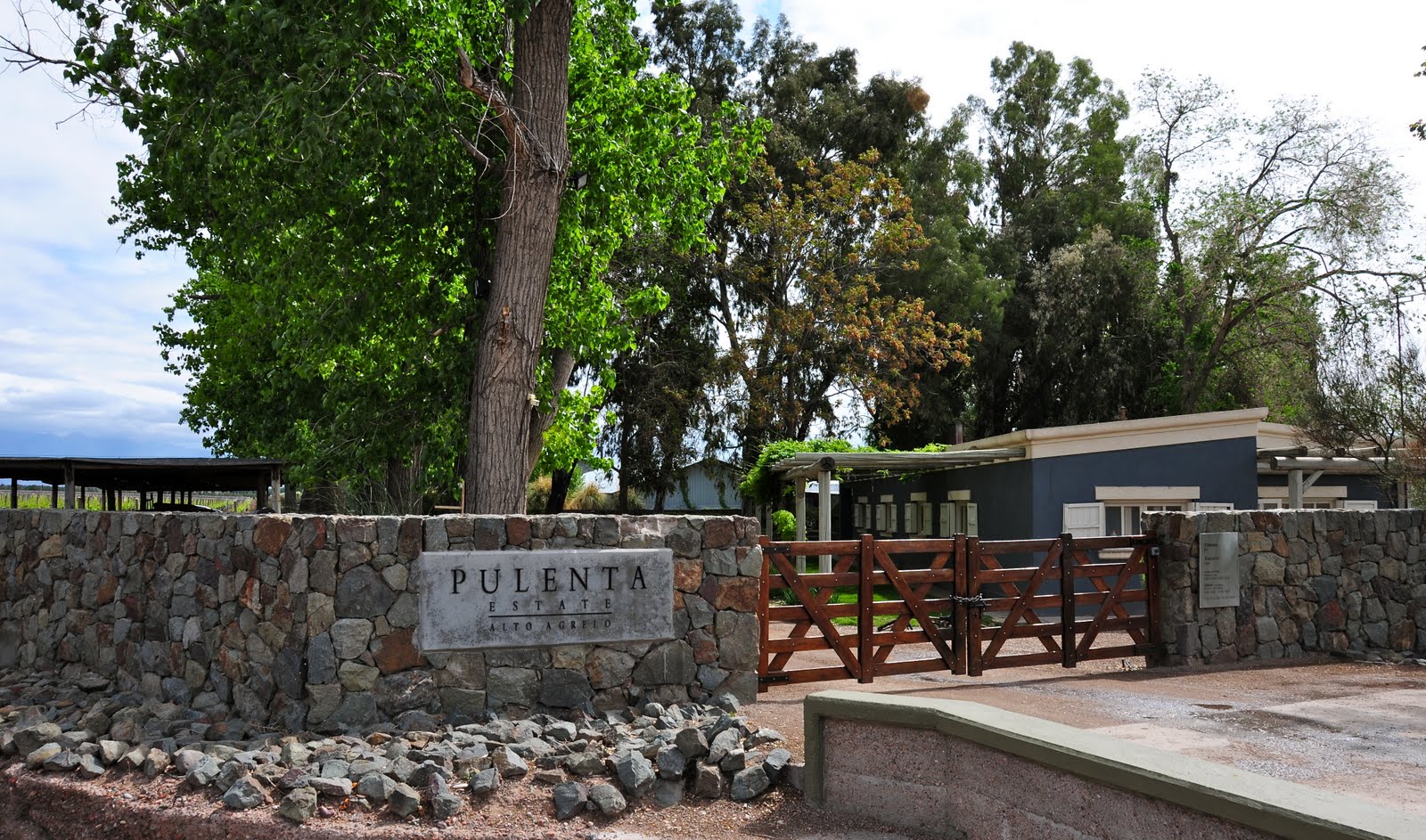
Our Day One tour kicked in when we were met at Club Tapiz by Ricardo, a local guide who's background included acting as a translator. Since 2005, however, he's been specializing in eno-tourism. The first stop was to be Pulenta Estate in the Lujan de Cuyo district and Ricardo was a font of knowledge about the region and its wine during our drive to Pulenta. It would turn out that, during our three days with Ricardo, he'd prove to be as patient, responsive and friendly a guide as we could ask for. The fact that he seemed to be on best terms with every person we ran across in any winery was simply a bonus.

I'd wanted to include Pulenta Estate on our itinerary largely because of the wonderful bottle of their Gran Corte VII that we shared at Daveyboi's a couple of months back (#557). It proved to be a good choice. After being greeted with a glass of Sauvignon Blanc (not the first varietal I associate with Argentina), we embarked on what was to become a recurring pattern - a quick tour of the immediate vineyards, followed by a visit to the winery facilities and cellars - where a quick history of winery and its approaches to winemaking were discussed. As similar as the tours were, the stories behind the wineries and the equipment was always different.

The Pulenta family has been active in Argentine viticulture for three generations. The family, like many in Mendoza, immigrated from Italy in the early 1900's and persevered in the growing of grapes and making of wine to the point where, by the end of the century, the family operated and had a majority share in Penaflor, one of Argentina's leading wine consortiums and the producer of one of the country's best-known international brands, Trapiche.

When the family sold its Penaflor holdings, the various branches of the family took different paths to the future. Two brothers, Eduardo and Hugo, started up Pulenta Estate in 2002 and set out to be part of the new, leading edge of Argentine wine - the production of lower yielding vineyards and higher quality wines. Their desire to develop praise worthy wines was clearly evident in the impressive facilities - that included our first exposure to the ubiquitous concrete fermentation containers and to some costly, French oak casks that were being used to experiment with some of the vineyards very best grapes.

Pulenta Estate produces between 40,000 and 50,000 cases annually and markets their range of wines under two labels - Pulenta Estate and La Flor, with the latter featuring younger, more approachable wines. Each of the higher level varietals or blends is identified by a roman numeral - with the Malbec I being the first wine produced by the winery. Accordingly, our much-loved Gran Corte VII was the seventh wine to be offered. We were told of one exception to this marketing program and that's a special bottling of a Cayenne label. The brothers are avid car enthusiasts and Porsche had Pulenta commemorate the launch of the Cayenne in South America with the special bottling. Drop a bundle on a sport utility and get a case of wine thrown in. No drinking and driving though.

The winery cellar features two barrel rooms that converge in a glassed-in tasting room. With so many of the region's wineries being newly constructed, this was just the first of some incredible settings we'd be tasting in. Luckily, we didn't have to drive at all because we were treated to pours that were substantially larger than are standard at home and we were neither spitting nor leaving much (if anything) behind in the glass. I'm fairly certain that we'd have left with a case of wine had we been back home. The thought of Customs and alcohol duties forced our good behaviour however; we simply grabbed another bottle of the Gran Corte VII and mosied on. And this was just our first stop.

Next up was Bodegas Salentein - a relatively new entrant on the Mendoza wine scene. An example of the foreign investment capital finding its way into Argentine wine, this Dutch based winery is known for its spectacular design. The approximately 1100 acres of vineyards was originally an estancia (ranch) operated by Jesuit missionaries as far back as the 17th Century and, in a tip of the hat to that past, the winery building was designed in the shape of a cross. The four wings of the gravity fed cellar converge in a circular, central chamber that was inspired by ancient, classical temples. Many internet sites refer to Salentein and its "cathedral of wine." Indeed, you can't help but be struck by the impressive structure.

Salentein's production is on a much larger scale than Pulenta. The "temple" has a cellar capacity of 5000 barrels each capable of holding 225 litres of wine. However, like many of Argentina's new breed of wineries, Salentein has a special program - and its own separate mini-winery in the winery - for its Primus line of wines. Like Pulenta, it has a series of temperature controlled French oak fermentation vats - the likes of which I haven't seen in our Okanagan wineries.

It seems that wherever we go, the altitude of the vineyards is one of the most prominent information points that the wineries want to emphasize. It seems that there's serious attitude about altitude in Mendoza. Most of the vineyards in the region are planted at altitudes of 1000 metres (3,2880 feet) or more and, as such, are some of the highest altitudes for wine production in the world. The move to higher altitudes was almost unwittingly started - it became a question of the land around Mendoza city becoming too expensive and the best lands remaining were at higher elevations. One of the benefits was that the farmers and winemakers found that a greater assortment of varietals proved to be well-suited to new microclimates.

Salentein is fortunate in that its vineyards - 80% of which are planted with red varietals - sit at an altitude that ranges from 1,050 to 1,550 metres (about 3,440 to 5,085 feet) above sea level and that range results in a full assortment of microclimates, soils and sunlight orientation. Accordingly, the winemakers have a range of varietals, taste characteristics and profiles to choose from when producing their wines.

The winery also incorporates a cultural centre, called Killka, which houses a collection of contemporary Argentine art and of 19th and 20th Century Dutch artists. Both the interior of the winery and the immediate grounds also feature large sculptures from nationally known artists.

Salentein was one of the wineries that I knew nothing about. Apparently, they participated in this year's Playhouse Wine Festival, but, as was the case with Bodegas Tapiz, I never made it around to their table. Makes me wonder what I was doing there.

Our third and final stop for the day was Bodega Altus. Funny thing about this stop was that we never actually visited the winery. Rather, we were escorted to a small out-building amongst the Cabernet vines to be treated to a lunch that will be long remembered. Restaurants being connected to wineries is becoming a common component of Mendoza's wine tourism and, unbeknownst to us, we were about to experience regional cuisine at its finest.

In my humble opinion, the rustic La Tupina restaurant is a definite must for anyone visiting the area. The chef and creative force behind La Tupina is Lucas Bustos - who we've since found out is heralded as one of the local stars in Mendoza's culinary ranks. Ricardo was clearly on good terms with our chef and, as such, we were given the opportunity to stand around in the Sala del Fuegos (Fire Room) - where the cooking in tupinas or cast iron fire pots takes place - and watch as Chef Bustos worked his magic with an assortment of tapas.

After just a couple of bites of blood sausage, sweetbreads, empanadas and pate, I jokingly asked where his cookbook could be found for sale. Chef turned to Ricardo, chuckled and replied that he actually has one that is currently with the editors and that he hopes that it'll be available in the near future - in both Spanish and English. We NEED this book!

Following an initial nine appetizing tapas and a couple healthy pourings of Altus' Rose, we retired to the main dining room for our actual lunch - another three courses, all matched up with offerings from the winery's portfolio. I can't tell you a darned thing about the winery - except that it's located in the Tupungato region of the Uco Valley. They displayed a full range of wines, but, for our purposes, the winery was completely overshadowed by the lunch and the restaurant.

617. 2009 Bodega Altus Rose (Mendoza - Argentina)

This will also simply have to go down as one bottle that I didn't do my homework on. I can't recall whether Ricardo advised us of the varietal used in this wine at all or not. My guess might be that it was Malbec, but we were so engrossed in the food that I didn't ask to look at the bottle or ask anything about it. It went wonderfully with the tapas and our introductory course of grilled eggplant, prosciutto and tomato sauce though. Once the heavier reds and meat arrived, it didn't really matter.

This was definitely one of the wineries that I'd questioned our Vancouver agent about before we left. Good thing I never overruled them. Guess there's some reason behind trusting the locals and their recommendations.

Our ride home to Club Tapiz may not have been as adventuresome as the truck we passed, but we were definitely as ready for a rest as those passengers were. Day one was done and so were we.