1895. 2011 Blue Mountain Pinot Blanc (Okanagan Valley)
Barbara Phillip, Western Canada's first Master of Wine and the country's first female MW, may sing the praises of Pinot Blanc as a potential grape variety for the Okanagan Valley to champion and take to a world level. I, on the whole however, generally liken Pinot Blanc to Pinot Bland - definitely more so than seeing it as being the varietal wine that's going to put BC on the world wine map.
That being said, Blue Mountain has been producing its Pinot Blanc for many a vintage and its version is bound to be one of the Pinot Blancs that has Barb singing the variety's praises. Unfortunately, I think we might have held onto this bottle a little too long though. I obviously thought it was tasty enough to buy a bottle while visiting the winery but both Boo and I found tonight's glasses to be a bit past their prime. There was no real fruit to speak of on either the nose or the palate and, for me, that seems to be a necessity if Pinot Blanc were ever to be a signature BC varietal wine.
Sigh.
Didn't stop us from finishing the bottle though. Funny that.
Showing posts with label Pinot Blanc. Show all posts
Sunday, April 12, 2015
Monday, June 30, 2014
Finally, A Married Lady
"Sadie, Sadie, married lady
See what's on my hand
There's nothing quite as touching
As a simple wedding band."
I don't remember there being a brother-in-law featured on the Brady Bunch but it would appear that I'll be playing that role with our family's new real life Brady Bunch. There are six of them but the kids in this family will just be a tad older than on the TV show. Thankfully. I won't say how long my sis, Vixen, has been waiting for her big wedding day but shall we say that she's been planning it (in theory) long before Big Trucker appeared on the scene and fell into the main squeeze role with such gusto.
Since the wedding was being held outside of Vancouver proper, we booked hotel rooms in the Valley and set up shop for what promised to be a memorable evening.
1654. N.V. La Jara Organic Prosecco Extra Dry (Treviso DOC - Italy)
We arrived at the hotel with a bit of time to spare before the ceremony was slated to start. So, Boo and I invited our little gang over for a cocktail and to catch as much of the Costa Rica v. Greece World Cup playoff game.
I figured a bit of bubbly would suit the occasion and brought along the Aperol to stretch out the Prosecco. After all, can there ever be enough Spritz at a wedding?
I didn't know anything about La Jara when I grabbed the bottle but I knew it was one I hadn't added to The List yet and it can be difficult to find new Prosecco's to add since most of them are non-vintage and I can only add a particular bottle once - unless it's a different vintage (who made these rules?). Anyhow, this little sparkler - traditionally made from 100% Glera grapes (which are probably unknown to almost all wine drinkers) - is just another bit of celebration on a day already full of celebration.
Despite all of Vixen's planning, however, we had to finish our cocktails and head to the ceremony just as the soccer game was heading into overtime. Some planning.
I know Vixen was saddened by the fact that our Mom passed away before the wedding but she rejoiced in the fact that Mom knew the date - and knew how happy Vixen was - before she passed on. Having Dad and Vixen's three kids all participate in the wedding procession was a small way of ensuring that Mom was in attendance in spirit all the same.
Unlike Boo's and my ceremony (ceremonies) where we could serve whatever booze we wanted to bring in - at cost (can you say 30 Litres of vodka for martinis?) - Vixen and Big Trucker had to choose from a very limited - and costly - wine list. Facing a burgeoning budget, they opted for more economical bottles so that they could order more of them.
1655. 2012 Peller Estates Family Select Pinot Blanc (VQA British Columbia)
1656. 2012 Cupcake Red Velvet (California)
I thought the Pinot Blanc was an interesting choice. We don't tend to see many people choose it as a varietal wine - despite the fact that there are those in the know (cue Barb Philip MW) who would argue that Pinot Blanc could well be a varietal wine for BC winemakers to concentrate on as a signature grape. It was the easy sipper it needed to be for the wide selection of food in the buffet dinner - and for a guest list that didn't include a whole lot of wine afficionados.
I think the Cupcake was a sentimental favourite for Vixen since girl loves her red velvet cake. The Zinfandel, Merlot and Petite Sirah blend is the big, fruit forward red that a beer-loving crowd just might go for.
Despite it being my sister's wedding and there being a good assortment of relatives present, I didn't know a hefty portion of the guests. Luckily, a few of our best friends have become friends of Vixen as well over the years. Consequently, Elzee, Merlot Boy, Margarita, Lady Di and She Who Must Be Obeyed were all with us to share in the event.
One couple I did recognize was Guru and Bride of Frank'n'wine. I wandered by their table to catch up and to reminisce about their wedding - and all the special wines they'd pulled corks on at their special day. Indeed, their wedding was one of my early posts on the blog. I probably shouldn't have been surprised that they had a bottle upgrade or two waiting at their table.
1657. 2011 Ravenswood Lodi Old Vines Zinfandel (Lodi - California)
Like the Cupcake, this (predominantly) Zin was rounded out with a healthy shot of Petite Sirah but I don't think it's too much of a surprise to learn that the Ravenswood packed a more nuanced punch. Ravenswood, in the Vancouver market, is known for its approachable wines - especially at the entry level - but this Lodi Old Vines is the first step above the Vintners Blend. I could have stayed a whole lot longer with Guru and Bride-y but I had to simply accept a refill and schmooze some more with the other guests.
I did invite them to come by our table later though because I had a bit of a treat to bring out as the evening wore on as well.
1658. 2006 Langmeil - Valley Floor Shiraz (Barossa Valley - Australia) (1.5L bottle)
Langmeil's Valley Floor Shiraz is a definite favourite of mine and I've had this magnum lying around for awhile. I thought my little sis' wedding was a pretty decent opportunity to pull the cork. I'm not kidding myself with this Shiraz. It's definitely bold and fruit forward in that New World Aussie style that many have come to dial back from but Langmeil definitely hits the spot with me. I can still remember the first time I tried a Valley Floor Shiraz - it was at a fundraiser for Ronald MacDonald House many years back and I played "plus one" for Elzee. The event was being held in house worthy of the Real Housewives of Vancouver and the rep for Langmeil was serving up his new entry off to the side in the kitchen. We ignored the sponsor's wines from then on and just kept heading back for more of the Valley Floor.
And from the Valley Floor (perhaps thanks to the Valley Floor and other wines), there was eventually a fair bit of action on the dance floor. Once the DJ's arm was twisted to play It's Raining Men, there was no turning back. I had at least three people come up to me and smile as they told me that they remembered my Mom at Boo's and my wedding where she was out on the dance floor throwing her arms into the air singing along to It's Raining Men.
Guess there was no mistaking that Mom was at Vixen's wedding after all.
By the time our crowd was singing "Red Wedding" to Billy Idol, it was time to call it a night and to send our married couple off on their honeymoon.
Here's wishing Vixen and Big Trucker many happy trails as they move forward in life together. I know there'll be more than a couple of bottle added to The List with them as drinking buddies. Cheers.
Wednesday, May 28, 2014
A Return to Okanagan Roots
The family has been growing grapes since the 1920's and their plantings over the years tell a good part of grape growing history in the Okanagan. Starting with the hybrid and labrusca grapes that were prevalent in days of yore, those vines eventually yielded to quality wine and Sovereign Coronation grapes (the latter being a table grape developed in a local breeding program). In more recent years, the vineyard has been converted to largely Riesling, Gewürztraminer, Pinot Gris, Pinot Noir and Chardonnay - although the property still includes a 45-year old planting of Maréchal Foch and some of the oldest Riesling vines in the valley - 35 years and counting.
While Ann's family has been operating Pioneer Ranch for decades, Ann herself has learned the wine trade and honed her skills working and consulting for a wide range of wineries from the Okanagan to Ontario to Nova Scotia (with acclaimed sparkling wine house, Benjamin Bridge). She even has an interest in an Argentine venture to add to her busy schedule.
1618. 2011 Sperling Vineyards - The Market White (VQA Okanagan Valley)
With Ann's return to her roots in the Okanagan, her attention has been directed primarily at the white varieties that have become synonymous with the northern Okanagan. While Sperling offers a number of varietal wines, The Market White is a blend of primarily Pinot Blanc and Bacchus. I couldn't find an exact breakdown of the varieties incorporated in the 2011 version; however, I see that the 2012 vintage also includes a good chuck of Gewürztraminer and a touch of old vine Perle of Csaba (a variety of Muscat). I haven't seen any confirmation of those additional grapes in the 2011 though.
Regardless of the wine's make-up, it was deemed tasty enough to make Wine Diva's Annual Under $20 Top 100 Wines for 2012.
The off-dry notes might have been a touch much for our stuff and roasted pork but that's all the more reason to have added a bit of spice to the seasoning on the meat and accompanied the dish with a hefty pepper jelly.
Although I've certainly been aware of Ann's return to the Okanagan, this is the first of her wines to be added to The List. I doubt it will be the last. Indeed, I'll run across some of her handiwork when the BC Wine Appreciation Society hosts a tasting with Clos du Soleil in June. As if she doesn't have enough on her plate, Ann is winemaker for this award winning winery as well. "Welcome back," I say.
Labels:
Alternative Whites,
Okanagan,
Pinot Blanc,
White Blends
Monday, April 1, 2013
An Easter Bonnet Failure
Time to get some catch up blogging done. The whole 2013 Wine Bloggers' Conference and Boo's and my California Road Trip threw for me a bit of a loop. I wish this were an April Fool's heading and post but it's true. Even though this has an April 1 publishing date, it is actually being posted in July. Unfortunately, I'm still writing about adding bottles to The List back in March. My sister, Vixen, is convinced that my schedule isn't preventing me from publishing this post. Rather, she's announcing to all that I'm simply afraid to announce that her Easter Bonnet was a runaway "best" at this year's annual paper plate Easter Bonnet extravaganza and family dinner. On the other hand, it's true. My stab at creating a winning bonnet this year was a bust. After last year's birthday cake-inspired winner and the year before's playoff hockey inspired piece, the juices just weren't flowing this Easter.
Good thing there was still plenty of wine to soothe my battered ego.
1276. N.V. Stoneboat Piano Brut (VQA Okanagan Valley)
I was introduced to this bubbly at the recent Vancouver International Wine Festival. It was nice to taste the wine shortly after I'd heard about Stoneboat receiving a loan from the Federal Government to assist in the purchase and installation of equipment that has resulted in the re-introduction of Charmat method production in Canada. Sparkling wines produced in Charmat style undergo secondary fermentation and carbonation in stainless steel tanks. It is the same production method used to make Prosecco in Italy. Member of Parliament Dan Albas announced the federal involvement as a mean of promoting innovation and new Canadian products into the market. There are plenty of bubbly Canadian wines made but they largely use the traditional méthode champenoise where the second fermentation takes place in the bottle that the consumer ultimately buys. Piano is the first modern Canadian wine made in the Charmat manner and the hope is that it will be well received in the local market as an alternative to imported Prosecco, as well as result in an entry point to international markets - particularly China.
John Schreiner has written a nice post - and a thorough one to boot - on Stoneboat and the story behind the production method's history in Canada. So, I'll just refer you there rather than go into everything all over again.
Piano is blend that pairs mostly Pinot Blanc with a bit of Müller-Thurgau. It was a pleasant sip with a slightly off-dry taste that showcases Okanagan fruit and is definitely a contrast to the more "serious" bubbles that we generally see from the Okanagan. Too bad it's currently a non-vintage wine. As such, I'm only able to add the one bottle to The List. That likely won't stop us from buying another bottle though.
1277. 2010 Meyer Family Vineyards - Tribute Series - Sonia Gaudet Chardonnay (Okanagan Valley)
Each vintage, the Meyer family releases a Chardonnay as part of its "Tribute Series" whereby the wine is a "dedication to a Canadian for an outstanding achievement in their field." The 2010 wine is dedicated to Sonja Gaudet, a Canadian, world and two-time Paralympic champion in wheelchair curling (it looks like the spelling of "Sonja" on the label was a typo). Reading up a bit about Ms. Gaudet, I was intrigued even more by the wine when I realized that I was actually in the crowd cheering her on in the Gold Medal game at the 2010 Vancouver Paralympics.
As part of the Tribute Series, the Meyer family also donates $5,000 to a non-profit foundation, endowment or scholarship to "encourage" and "honour" the legacies of the outstanding Canadians chosen for the label. Ms. Gaudet requested that this vintage's donation be awarded to a student graduating from her hometown, Vernon's, high schools "who, regardless of the challenges in their own life, continues to strive for excellence and role models that giving up is not an option."
Thankfully, the wine not only has a great background story but it also tastes mighty fine. It stood out for Boo and I while we were on the 2012 BC Wine Appreciation Society Bus Tour. During our group's tasting at Meyer, we were advised that the winery strives for a Burgundian style that is crisp with flavour. The grapes are sourced from their Old Main Road Vineyard on the Naramata Bench - a vineyard that is unique for the Naramata in that it slopes up the hill and then dips back to the north-east, providing more shelter than many of the Bench's vineyards. Little did we know when we picked up this bottle that it would later be chosen as the Number One BC Wine in the 2012 Wine Access Magazine Canadian Wine Awards.
Note to self. If I'd read up more on this wine before I started designing my bonnet, Maybe I'd have found a little more inspiration for this year's design.
1278. 2006 Alderlea - Fusion (Vancouver Island)
Our final wine of the dinner held some surprises of its own. Alderlea is perhaps our favourite Vancouver Island winery. I have to say "perhaps" because we don't get a lot of opportunity to try their wines over on the Mainland. Alderlea doesn't send any wine over to the Vancouver market and we have to be content to bump into it on the rare occasions that we make it to the Island or, if by chance, we run across it in one of the wine shops on Salt Spring Island if we're visiting Tyrant.
This is the only bottle of Fusion that I've run across. I don't know how much of it is produced but it is rather unique in that it is varietal wine made from Cabernet Foch - one of the Valentin Blattner grapes that were developed in Switzerland as heartier alternative varieties for colder climate vineyards. I've written about Blattner varieties somewhat in other posts; so, I won't go on here, but I have to note that this is the first time that I've tried the Cabernet Foch and, as such, that means I get to add another grape to my Wine Century Club tally. This is a bit of benchmark grape as well since I'm hitting the 150 mark with this grape - and that has to make up a bit for a lacklustre bonnet this year.
As you might guess, Cabernet Foch is a cross of Cabernet Sauvignon and Maréchal Foch. No sane winemaker would try to grow Cab Sauv on Vancouver Island and expect it to fully ripen. That's enough of a challenge for the Okanagan. On the other hand, no one is going to make a name for themselves in today's market basing much of their marketing on Maréchal Foch. Granted, there are some cult classics out there for Foch lovers but, realistically, being able to incorporate "Cabernet" into your wine is going to be a much savvier route to go.
Alderlea's 2005 vintage of Fusion was the first commercial release in BC of a Blattner wine. This 2006 bottle, however, was the last year that the wine was labeled as Fusion. The Argentine producers of mass market FuZion purchased Alderlea's trademark for the name in Canada and, from 2007 on, Alderlea's Cabernet Foch varietal wine has been released as Matrix.
After this initial tasting, I'm not convinced that Cab Foch is going to gain a foothold in the Canadian (or world) market but it will be interesting to see how the vines are producing with a bit of age on them. I'll also look forward to an opportunity to maybe try a tasting that compares Cab Sauv, Cab Foch and Maréchal Foch. Indeed, it sounds like a good idea for a future blog post.
So, you see, my creative juices haven't completely abandoned me. I might not have had the best of bonnets this year but there's still the odd idea left to be processed by this old mind of mine. Alternatively, next year, I could just drink a little more wine prior to starting my bonnet to get those idea flowing. Just hope I never become quite as creative as Boo's new Papal Celebration Bonnet or Big Trucker's Easter Fountain. Some things - as creative as they might be - should just never see the light of day.
Good thing there was still plenty of wine to soothe my battered ego.
1276. N.V. Stoneboat Piano Brut (VQA Okanagan Valley)
I was introduced to this bubbly at the recent Vancouver International Wine Festival. It was nice to taste the wine shortly after I'd heard about Stoneboat receiving a loan from the Federal Government to assist in the purchase and installation of equipment that has resulted in the re-introduction of Charmat method production in Canada. Sparkling wines produced in Charmat style undergo secondary fermentation and carbonation in stainless steel tanks. It is the same production method used to make Prosecco in Italy. Member of Parliament Dan Albas announced the federal involvement as a mean of promoting innovation and new Canadian products into the market. There are plenty of bubbly Canadian wines made but they largely use the traditional méthode champenoise where the second fermentation takes place in the bottle that the consumer ultimately buys. Piano is the first modern Canadian wine made in the Charmat manner and the hope is that it will be well received in the local market as an alternative to imported Prosecco, as well as result in an entry point to international markets - particularly China.
John Schreiner has written a nice post - and a thorough one to boot - on Stoneboat and the story behind the production method's history in Canada. So, I'll just refer you there rather than go into everything all over again.
Piano is blend that pairs mostly Pinot Blanc with a bit of Müller-Thurgau. It was a pleasant sip with a slightly off-dry taste that showcases Okanagan fruit and is definitely a contrast to the more "serious" bubbles that we generally see from the Okanagan. Too bad it's currently a non-vintage wine. As such, I'm only able to add the one bottle to The List. That likely won't stop us from buying another bottle though.
1277. 2010 Meyer Family Vineyards - Tribute Series - Sonia Gaudet Chardonnay (Okanagan Valley)
Each vintage, the Meyer family releases a Chardonnay as part of its "Tribute Series" whereby the wine is a "dedication to a Canadian for an outstanding achievement in their field." The 2010 wine is dedicated to Sonja Gaudet, a Canadian, world and two-time Paralympic champion in wheelchair curling (it looks like the spelling of "Sonja" on the label was a typo). Reading up a bit about Ms. Gaudet, I was intrigued even more by the wine when I realized that I was actually in the crowd cheering her on in the Gold Medal game at the 2010 Vancouver Paralympics.
As part of the Tribute Series, the Meyer family also donates $5,000 to a non-profit foundation, endowment or scholarship to "encourage" and "honour" the legacies of the outstanding Canadians chosen for the label. Ms. Gaudet requested that this vintage's donation be awarded to a student graduating from her hometown, Vernon's, high schools "who, regardless of the challenges in their own life, continues to strive for excellence and role models that giving up is not an option."
Thankfully, the wine not only has a great background story but it also tastes mighty fine. It stood out for Boo and I while we were on the 2012 BC Wine Appreciation Society Bus Tour. During our group's tasting at Meyer, we were advised that the winery strives for a Burgundian style that is crisp with flavour. The grapes are sourced from their Old Main Road Vineyard on the Naramata Bench - a vineyard that is unique for the Naramata in that it slopes up the hill and then dips back to the north-east, providing more shelter than many of the Bench's vineyards. Little did we know when we picked up this bottle that it would later be chosen as the Number One BC Wine in the 2012 Wine Access Magazine Canadian Wine Awards.
Note to self. If I'd read up more on this wine before I started designing my bonnet, Maybe I'd have found a little more inspiration for this year's design.
1278. 2006 Alderlea - Fusion (Vancouver Island)
Our final wine of the dinner held some surprises of its own. Alderlea is perhaps our favourite Vancouver Island winery. I have to say "perhaps" because we don't get a lot of opportunity to try their wines over on the Mainland. Alderlea doesn't send any wine over to the Vancouver market and we have to be content to bump into it on the rare occasions that we make it to the Island or, if by chance, we run across it in one of the wine shops on Salt Spring Island if we're visiting Tyrant.
This is the only bottle of Fusion that I've run across. I don't know how much of it is produced but it is rather unique in that it is varietal wine made from Cabernet Foch - one of the Valentin Blattner grapes that were developed in Switzerland as heartier alternative varieties for colder climate vineyards. I've written about Blattner varieties somewhat in other posts; so, I won't go on here, but I have to note that this is the first time that I've tried the Cabernet Foch and, as such, that means I get to add another grape to my Wine Century Club tally. This is a bit of benchmark grape as well since I'm hitting the 150 mark with this grape - and that has to make up a bit for a lacklustre bonnet this year.
As you might guess, Cabernet Foch is a cross of Cabernet Sauvignon and Maréchal Foch. No sane winemaker would try to grow Cab Sauv on Vancouver Island and expect it to fully ripen. That's enough of a challenge for the Okanagan. On the other hand, no one is going to make a name for themselves in today's market basing much of their marketing on Maréchal Foch. Granted, there are some cult classics out there for Foch lovers but, realistically, being able to incorporate "Cabernet" into your wine is going to be a much savvier route to go.
Alderlea's 2005 vintage of Fusion was the first commercial release in BC of a Blattner wine. This 2006 bottle, however, was the last year that the wine was labeled as Fusion. The Argentine producers of mass market FuZion purchased Alderlea's trademark for the name in Canada and, from 2007 on, Alderlea's Cabernet Foch varietal wine has been released as Matrix.
After this initial tasting, I'm not convinced that Cab Foch is going to gain a foothold in the Canadian (or world) market but it will be interesting to see how the vines are producing with a bit of age on them. I'll also look forward to an opportunity to maybe try a tasting that compares Cab Sauv, Cab Foch and Maréchal Foch. Indeed, it sounds like a good idea for a future blog post.
So, you see, my creative juices haven't completely abandoned me. I might not have had the best of bonnets this year but there's still the odd idea left to be processed by this old mind of mine. Alternatively, next year, I could just drink a little more wine prior to starting my bonnet to get those idea flowing. Just hope I never become quite as creative as Boo's new Papal Celebration Bonnet or Big Trucker's Easter Fountain. Some things - as creative as they might be - should just never see the light of day.
Monday, February 11, 2013
Gang Way Fat Boy
Living in Vancouver, I think it's safe to say that I'm fairly well versed in Chinese culture - at least for a gwai lo. I can rattle off a "Gung Hay Fat Choy" with the best of them when Chinese New Year rolls around. Indeed, it's gotten to the point where some of my colleagues at work have jokingly adapted the traditional Cantonese greeting into "Gang Way Fat Boy" should we pass in the hallways.
At least I'm hoping that it's all in good fun.
I think I'm safe though because it's usually me saying the "Fat Boy" bit.
1258. 2010 Wild Goose - Mystic River Pinot Blanc (VQA Okanagan Valley)
Since the actual New Year's Day fell on a weekend this year, I grabbed some Szechuan take-out and we celebrated at home. Hoping for a bit of bite in the ginger beef and salt and pepper squid, I figured an easy going white - maybe even with a touch of residual sweetness - would fit the bill. Little did I know at the time that the Wild Goose Pinot Blanc I grabbed was one of only eleven wines to win a Lieutenant Governor's Award in BC in 2011 or that their take on Pinot Blanc emphasizes crisp acidity to go with the big tree fruit flavours.
Wild Goose is well known for its aromatic whites and wines sourced from their Mystic River vineyard are particularly sought after. The 2010 vintage was a challenging one in the Okanagan. The growing season featured a cool spring, a wet June and a questionable start to the critical month of September. Luckily for the winery's owner/operator Kruger family, their decades of experience in the Okanagan resulted in their dropping a larger portion of the crop than usual. That green harvest and a nice finish to September and October resulted in a proper ripening of their fruit - with a nice concentration of flavours. It showed in the wine but their volumes were noticeably smaller.
I was fortunate to have this bottle on hand because Lt. Gov Award winners are often next-to-impossible to find after the awards are announced.
I likely could have done a better job matching it to our dinner but we were lucky that it drank just fine on its own all the same. And an easy drinking, award winner is never a bad thing when celebrating a new year.
At least I'm hoping that it's all in good fun.
I think I'm safe though because it's usually me saying the "Fat Boy" bit.
1258. 2010 Wild Goose - Mystic River Pinot Blanc (VQA Okanagan Valley)
Since the actual New Year's Day fell on a weekend this year, I grabbed some Szechuan take-out and we celebrated at home. Hoping for a bit of bite in the ginger beef and salt and pepper squid, I figured an easy going white - maybe even with a touch of residual sweetness - would fit the bill. Little did I know at the time that the Wild Goose Pinot Blanc I grabbed was one of only eleven wines to win a Lieutenant Governor's Award in BC in 2011 or that their take on Pinot Blanc emphasizes crisp acidity to go with the big tree fruit flavours.
Wild Goose is well known for its aromatic whites and wines sourced from their Mystic River vineyard are particularly sought after. The 2010 vintage was a challenging one in the Okanagan. The growing season featured a cool spring, a wet June and a questionable start to the critical month of September. Luckily for the winery's owner/operator Kruger family, their decades of experience in the Okanagan resulted in their dropping a larger portion of the crop than usual. That green harvest and a nice finish to September and October resulted in a proper ripening of their fruit - with a nice concentration of flavours. It showed in the wine but their volumes were noticeably smaller.
I was fortunate to have this bottle on hand because Lt. Gov Award winners are often next-to-impossible to find after the awards are announced.
I likely could have done a better job matching it to our dinner but we were lucky that it drank just fine on its own all the same. And an easy drinking, award winner is never a bad thing when celebrating a new year.
Tuesday, January 10, 2012
Award Winning Neighbours
In the cause of brevity and catching up, I'm going to add the next two wines to The List on the same post. They might not have been opened on the same night but they are neighbours on the Naramata Bench and both appear regularly in this blog.
1043. 2005 La Frenz Merlot (Naramata Bench - Okanagan Valley)La Frenz is definitely one of our favourite "Go To" wineries. Consistent quality is a hallmark for La Frenz, but that being said, I think we might have been better off had we "gone to" this bottle a little while ago. Boo's tightening of the "No Buy Leash" is going to see our opening more bottles like this - ones that have seen a bit of ageing - and maybe that's a good thing. As much as I enjoy La Frenz on the whole, I think the integration of fruit, acidity and structure that we're used to with their wines had passed us by with this bottle.
On the other hand, our slight disappointment in the wine might just show how little Boo and I know when it comes to fine wine. The 2005 Merlot won Gold at the All Canadian Wine Championships and won "Best Wine of Show" and "Best Red Wine" at the 2007 Northwest Wine Summit. Awards don't get much bigger than that for BC wines.
What the heck do I know anyhow? Guess it's a good thing that we have one more bottle to give it another go.
1044. 2010 Red Rooster Pinot Blanc (VQA Okanagan Valley)
1044. 2010 Red Rooster Pinot Blanc (VQA Okanagan Valley)Red Rooster's home estate vineyard and winery is located less than a mile down the road from La Frenz and, as often noted in this blog, winemaker, Karen Gillis, and team have been raising the bar year after year of late. Karen's had a banner year of awards herself in 2011. Her Chardonnay was named one of the top five in the world at the Chardonnay du Monde competition in France; the Pinot Noir won Best New World Pinot in California; her Syrah was named Best Red at the 2011 BC Wine Awards and a recent Meritage won one of eleven Lieutenant Governor's Wine Awards given last summer.
The Pinot Blanc hasn't garnered huge press and hardware yet; but, boy, were Boo and I ever pleasantly surprised when we opened this bottle! As participants in the Adopt-A-Row program, we receive a mixed case of wine every year and this year's case recently arrived. (Thankfully, it doesn't contravene the No Buy Leash.) We simply grabbed the Pinot Blanc as an easy weeknight wine. I could easily have opened a second bottle right then and there.
Most folks go right past Pinot Blanc on the wine shelves. It generally doesn't tend to stir much in the way of flavourful emotions. This bottle proves that such a statement doesn't have to be the case. I know that Barbara Philip, Canada's first female Master of Wine, feels that Pinot Blanc could be the best choice of a varietal for the Okanagan Valley to adopt as a signature grape and help the region make a splash on the world wine scene - much along the lines that Sauvignon Blanc became synonymous with New Zealand.
This is a prime example of a wine that can turn heads. It did just that for us. With its partial exposure to a bit of French oak and 6 months of ageing on its lees, the wine was rich and complex in a way that I don't usually associate with Pinot Blanc. There was plenty of Okanagan tree fruit front and centre and a real nice, but bracing, acidity and citrus note on the finish.
A $17 price tag isn't going to hurt at all either.
I'm going to look forward to another bottle of this one.
Labels:
Adopt-A-Row,
Favourites,
La Frenz,
Lt. Gov. Awards,
Merlot,
Naramata,
Okanagan,
Pinot Blanc
Tuesday, October 11, 2011
A Much Welcomed Spa Day
For me, one of the best parts of taking a bit of a break is that you can often just get up when you want to. No alarms. No deadlines. Just a case of getting up when it feels right.
There wasn't much chance that Boo was getting up any time soon. So, I took a bit of a tour of the spa facilities that were open prior to brunch - and happened upon my cousin, Centreman, our groom du jour, who was taking in the pool and hot tub with a couple of his groomsmen. I didn't get an immediate response when I asked if they ever made it to bed last night, but I gave him the benefit of the doubt (but hoped that he could at least take a nap before the ceremony).
Following brunch, Boo and I took a bit of tour on the trails surrounding the resort. We noted more than a couple of locations - with incredible views - that would be perfect for a picnic or for cocktails and a bottle of wine. The trouble was always going to be finding any time to take advantage of those great spots.
The wedding was an afternoon ceremony out on the resort deck and there was a bit of a break between the ceremony and the reception. Just enough time, as it turned out, to take in the series of steam and sauna rooms - and an extremely cold ice wall - to try and relax a bit. And, then, to grab a bit of wine.
We chose to just relax in our room - instead of heading outside to one of those wonderful viewpoints though. Sometimes, ease and comfort just make a little more sense.
952. 2009 Sandhill Pinot Blanc (VQA Okanagan Valley)
952. 2009 Sandhill Pinot Blanc (VQA Okanagan Valley)Part of the delay in arriving on time yesterday afternoon was a quick stop at the Sandhill tasting room. Despite all the Sandhill wines that have made in onto The List, I've never been to the Sandhill operation itself. The tasting room and wine shop are located in downtown Kelowna. So, there was no rural vineyard setting. It was, however, an upscale affair - befitting of one of the province's premier wineries.
I usually find that, with Sandhill, we gravitate to the Small Lots Program wines. The Pinot Blanc doesn't fall into the Small Lots category, but I quite enjoyed the sample we tried at the tasting room and grabbed a bottle for immediate consumption. There are BC wine savants, including Wine Master Barb Phillips, that think Pinot Blanc could be a signature varietal to help put BC on the global map. Howard Soon, Sandhill's winemaker, has certainly found a way to take the somewhat unheralded varietal and make the Pinot Blanc fruit shine through - even while exposing the wine to limited oak and lees aging.
As enjoyable as the wine and our break were, we needed to make haste and join back up with the wedding party. I was definitely interested in seeing what wines were going to be featured at the reception.
Saturday, April 16, 2011
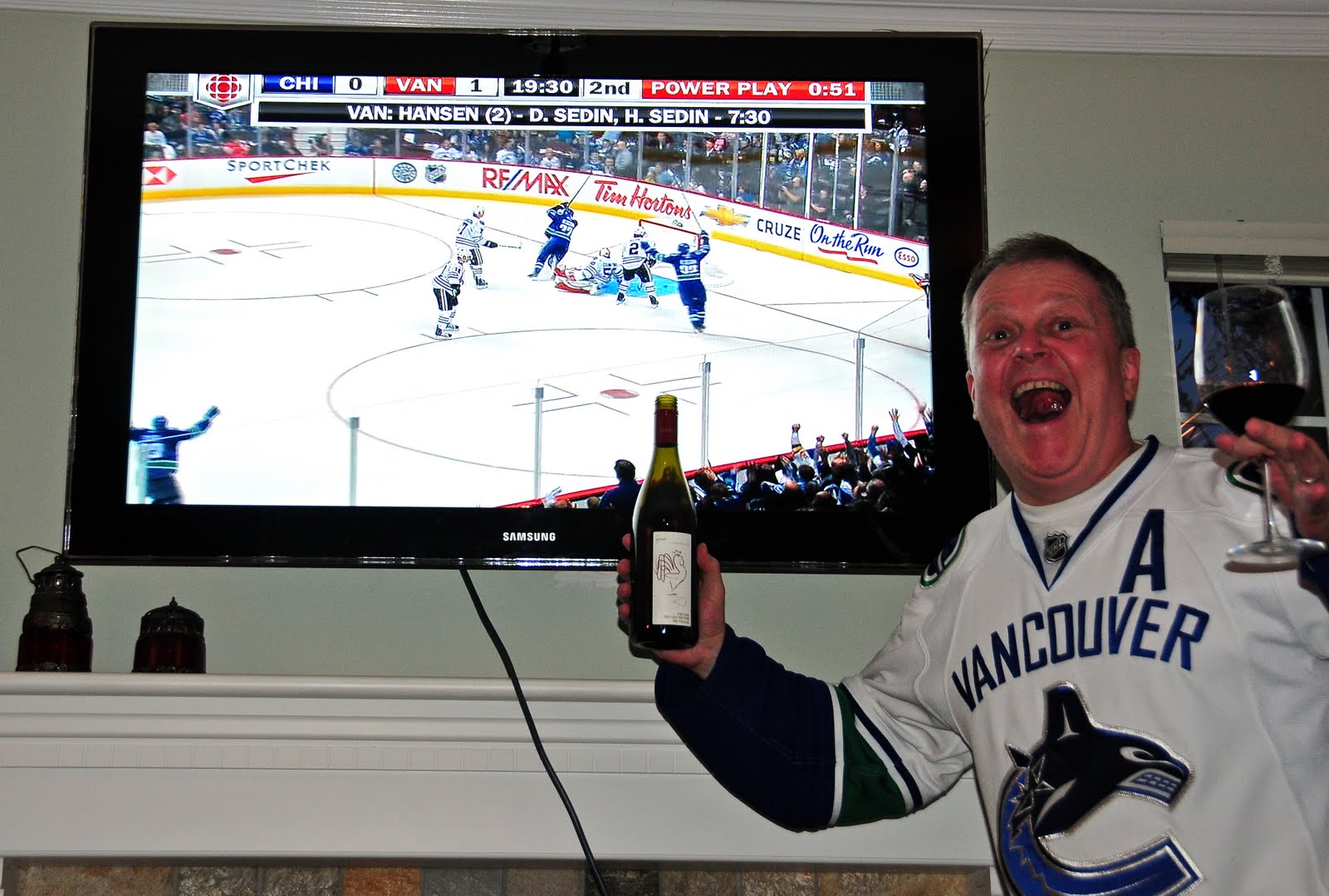
Canucks Take The Elusive Game 2 Win
Until tonight because that was then and this is now!! It was a fantastic Friday and a great start to the weekend. I went around and knocked on a couple of the neighbours' doors to see if they wanted to come over and watch the game with us. Not only was it a way to add an extra dimension of excitement to the game, it was an opportunity to open a couple different Red Rooster wines to set the mood.
770. 2008 Red Rooster Merlot (VQA Okanagan Valley)771. 2008 Red Rooster Syrah (VQA Okanagan Valley)
772. 2009 Red Rooster Pinot Blanc (VQA Okanagan Valley)
This trio of wines actually shows some of the different approaches that the winery has adopted. One of the solid reasons our hopes for a long playoff run by the Canucks is that the team is balanced and deep in talent. The team's diversity is being touted as one of its strongest attributes this year. Likewise with Red Rooster methinks. Under the guidance of winemaker, Karen Gillis, the wines are gaining more depth with successive vintages and they offer a portfolio that looks to cover all tastes.
The Merlot we opened is very approachable in both its profile and its cost - being under $20, it's more affordable than most red BC wines. It's not on the same level as Red Rooster's Reserve Merlot, but then every hockey team needs a second, third and fourth line. The Syrah is more on the reserve end of Red Rooster's portfolio, seeing both new French and American oak for aging. It's also limited in availability but, at $30, it still sports a lower price tag than most BC Syrah.
The Pinot Blanc is also a great team player at $17. A small portion (15%) of the wine sees some oak aging as well and that six months of aging on its lees (or the dead yeast cells that result from changing of the sugars into alcohol) help to flesh out the wine's body and to add a slightly creamy profile. With lots of tree fruit and balanced acidity, the visiting hockey fans were pleasantly surprised when told that it was a Pinot Blanc.
It seemed like we were working on the theory that a bottle was being opened with each Canuck goal, but even with the gang over, we didn't hit a fourth bottle when our boys scored their fourth (and the winning goal). With the Shameless Hussy celebrating goals with martinis and Marquis and Red having to ultimately behave because they had dinner plans for their anniversary, the triple tasting worked out just fine.
To keep with the sports metaphors, it was a solid team effort by the three wines tonight and, with the Canucks winning that second game, there was certainly reason to toast the team over and again.
Being up two games to nil, I'm liking this match up of Red Rooster and the Canucks.
Saturday, December 18, 2010
Neighbourhood Christmas Dine Around
Local media is always telling us about some major publication that names Vancouver as one of the most livable cities in the world - as if we need the affirmation of something that we all already know. One of the strongest arguments that Boo and I have in making such a sweeping assertion is not the water and mountains but our incredible neighbours.
We live in a trio of duplexes that were built at the same time and, accordingly, a new little neighbourhood cadre of sorts sprang up at that time. That was a full eight years ago now and we've seen a few changes in faces and addresses, but the neighbours have always stayed a great crew. To the extent that some still hang around after they've moved on and others in neighbouring houses (not one of our duplexes) do what's necessary to join the gang.
You know you've made it into our crowd when you get invited to participate in the annual Christmas Dine Around. Back in the "early days," we started an annual tradition that's carried on for eight years now. During the holiday season, we have a "dine around" where we spend between 30 minutes and an hour (when we can keep to schedule) in each of the homes. Everyone serves up nibblies and cocktails and we all get to snoop and see what changes or renovations have occurred since last year.
That last little bit about drinking "into the early hours" can prove to be a bit hazardous to the morning after. With seven households all serving up a variety of foods AND DRINKS, it's a wise man that watches that he doesn't mix too many martinis with wines with scotches that are followed up by specialty beer chasers. One thing the evening allows me is a chance to add more than a couple bottles to The List. I always enjoy seeing what wines other people choose to serve. Due to the sheer volume (and my desire to function the next morning), I didn't try all the wines but I did get to the five that follow.
670. 2008 Gray Monk Pinot Blanc (VQA Okanagan Valley)A nice little way to start off the evening with Marquis and Red's oyster bar. Not being one of the original six couples, I get the feeling that they think they're still auditioning for the crew because they always have an incredible spread. I know it's just because they love cooking and entertaining, but it might be worth it to keep up the whole "auditioning" ruse.
I don't have much time to go into the wines themselves on a post like this, but I'll have to come back to Gray Monk because there are a number of interesting stories to tell about this pioneer of BC wineries. It's one of the Northernmost wineries in the province, located just above the 50th Parallel. The grapes for this Pinot Blanc are grown in both the North and South Okanagan. It was a fine match for the oysters and a fine start to the evening.
671. 2007 Masi Campofiorin Ripasso (IGT Rosso del Veronese - Italy)
Finding out what Arty400 and Baby Mama serve up is fun because he regularly meets up with and gets wine tips from Barbara Phillips, one of Canada's few accredited Wine Masters. They didn't let us down. I'm a little surprised that this Ripasso hasn't been added to The List already since I'm always on the lookout for a fine Ripasso. It was tough not to over-indulge in the assorted gourmet pizzas and wine abounding, but it was only the second stop.
It was just as tough not to stick to the Buffalo Grass Vodka that was being sipped on at Haggis and Cupcake's place. They were last year's newest additions to the neighbourhood and we still included them this year despite their threat to serve an actual haggis last year. A sip of the vodka was interesting but I had to give the Vinho Verde its due since it allows me to add a couple new varietals to my Wine Century Club application. The winery's website says that the Vinho Verde is a blend of the "most notorious varietals of the region." "Notorious," I like that. 90% of the blend is made of Loueiro (60%) and Trajadura (30%) with the balance being Alvarinho. Adding two new varietals is a bit like being given a little Christmas present.
Our biggest "discovery" for this year though was the fact that we decided to open the neighbourhood parameters even wider and "audition" the new boys across the lane. Mr. Principal and Nature Boy seem to have what it takes to keep us amused and most of us had never been in their house yet. So, it was a good chance to enjoy their company and see their house.
673. 2008 Little Yering Pinot Noir (South-East Australia)
673. 2008 Little Yering Pinot Noir (South-East Australia)The Pinot was the red that the boys opened to serve with their seafood curry. I didn't mind seeing the bottle at all as it brought back memories of Boo's and my visit to the Yering Station winery when we last visited Merlot Boy in Melbourne. Although the winery is in the "cool" climated Yarra Valley (doesn't that show how relative "cool" is as a descriptor) and the wine is designated as such on the label, this vintage saw 14% of the grapes sourced from the Adelaide Hills to flesh out the profile. A simple, light bodied wine, it's a far cry from the bigger fruit bomb Pinots that sometime show up from Oz, I think I might stick to Yering Station's more premium label or stay with BC or Kiwi Pinots though.
The boys had the Canucks playing big and projected at their place; so, that alone likely gets them back next year in my book.
Boo and I drew one of the dessert stops this year. In my book, that calls for my old fave, a bread pudding that's been adapted from a New Orleans School of Cooking recipe. And just to show how well-behaved I was being on the booze front, we offered a red, a white, homemade eggnog and Port, but I only opted for the Port - even with another two bottles crying out to be added to The List.
I guess the redeeming points of that control were no hangover and another two grapes varietals to be added to the Wine Century Club - on top of the two from the Vinho Verde. Since the Graham's even calls this Port "Six Grapes," I should be able to add all six to my application list. Four of them - Touriga Nacional, Touriga Franca, Tinta Roriz (Tempranillo) and Tinta Barroca - have already been counted, that leaves Tinta Amarela and Tinto Cao. A little unplanned Christmas present to myself.
I don't want to go on about the bread pudding but I did have two people ask for the recipe.
We had a final stop with Rock God and Shameless Hussy, but you can't visit them and go with wine. It was a little late for a martini, but I just asked the Hussy to up the juice level in one of her trademark cocktails for me. We didn't quite last through cigars and Scotch, but the Saturday staging did allow a lot more leisure in moving from home to home.
And what more could you ask for? It doesn't get much better than this. Vancouver MUST be the best place in the world to live - or is that East Vancouver?
Saturday, December 4, 2010
It's A C&C Christmas
Did I mention in the last posts that the party season has arrived? If I didn't, I should have because this is like the third Christmas party this week. Hopefully (and I rather mean it), things are going to slow down soon. It's great to be able to continually add new bottles to The List, but I can't seem to find any time to actually blog them.
Our party this year was held at one of the local French bistros. So, it's not too surprising that all the wines were French. The wines for the evening were four in number - two whites and two reds. I never did get to the whites. It may not have been a work night, but I still had to behave. All those stories about too much at the office party can prove to be somewhat embarrassing. Best to stay away from that in my humble opinion.
665. 2008 Maison Maurel Vedeau Les Cepages Pinot Noir (Vins de Pays d'Oc - France)
I couldn't find much information on either wine; so, it might make just as much sense to serve up a mini-post on Vins de Pays d'Oc seeing as both bottles were from the that part of France. Quality wines in France are largely regulated by the appellation - or Appellation d'Origine Controllee - system. Vins de Pays wines, or "country wines," primarily find themselves in a middle ground between AOC wines and generic table wines. The VdP system allows wineries to produce wines that can be distinguished as being made from particular varietals and from a specific region; however, they neither have to comply with strict appellation rules, nor designate their wines as basic vin de table.
There are five traditional Vins de Pays regions in France and, as such, the wines produced are still associated with particular areas; however, the regions covered are much larger than standard AOC districts and are, in fact, often broken down into smaller VdP districts. The Vins de Pays d'Oc is a good example in that the region encompasses the entire Languedoc-Roussillon, which itself contains over 30 separate AOC appellations.
An immediate example of the more lenient VdP regulations is that the Maison Maurel Vedeau wine couldn't have been marketed as anything other than a table wine since the AOC rules don't allow the production of Pinot Noir in the Languedoc-Rousillon appellations. Similarly, the labelling practices are also far less regulated. Typical AOC wines would never be labeled - like these two wines - as Syrah or Pinot Noir.
Originally, Vins de Pays wines were generally seen as inferior to AOC wines; however, the last couple decades have seen producers recognizing that they need to make make a higher quality wine to meet world expectations and the burgeoning competition coming from newer regions. Those producers have also recognized that most New World winemakers and most of the global market have taken to identifying wine by varietal - not by its place of origin. Not many of today's consumers know that red wines from Burgundy will be either Pinot Noir or Gamay Noir - let alone that the Cote d'Or is home to many of Burgundy's most famous vineyards.The flip side of Burgundian restrictions is that, nowadays, there are thirty or more varietals being grown in Languedoc-Rousillon. It's, therefore, pretty much imperative that the wineries have the VdP freedom to label their wines by varietal - especially since over half of the region's wines are produced for export.
Wednesday, May 26, 2010
Who Says You Can't Drink Red with Fish?
Mr. D. was dropping by in the afternoon, so Boo and I figured what's an extra plate on the dinner table. Particularly when, after he found out he was staying for dinner, Mr. D. stopped by Granville Island and brought along a batch of swimming scallops.
So, unexpectedly, here we are having another seafood extravaganza - only a couple of days after scallops and mussels with Elzee. Boo had already pulled out the smoker to cook some salmon. Now, it was my turn to cook up the scallops so that they wouldn't taste exactly the same as the other night. The vanilla butter was out and wine, cream and chives filled in.
458. 2008 Nk'mip Pinot Blanc (VQA Okanagan Valley)Scallops are such a delicate flavour that we didn't want to overpower them with too big of a wine. We don't generally have a lot of white wine on hand but this bottle of Nk'mip looked to fit the bill. Enough acidity to cut through the richness of the scallops and cream, but still some prominent fruit with a touch of residual sugar.
The scallops went quickly, so we even had a bit of the Pinot Blanc to drink along with Boo's salmon.

459. 2006 Domaine de Fondreche Nadal (AOC Cotes de Ventoux)
The white wasn't going to get us through the rest of dinner though, so I figured that, since the salmon was seeing some smoke, it could handle a red with a bit more body. I wasn't familiar with Domaine de Fondreche but they came highly recommended from Marquis Wine Cellars - and I see that there are a lot of big name critics that like what the winery is doing as well.
The Nadal blend is typical Southern Rhone - Syrah, Grenache and Mourvedre in 45/45/10 proportions respectively. I was happy that there was enough fruit on the palate and that the tannins and body didn't overpower the salmon. A little risky of my part, but the wine drank nicely on its own in any event.
Fondreche is generally seen as an example of what a new generation of French winemakers can get up to. Established 15 years ago, the winery is located in the South-Eastern Rhone in the Cotes du Ventoux section of Vaucluse departement (province). The region tends to have a bit higher elevation and a slightly cooler climate than much of the surrounding Rhone and producers, such as Fondreche, are now taking advantage of such a location to introduce a higher level of sophistication to the previously simple wines of the region. Fondreche seems to have caught the eye of the big name wine writers as providing the much sought QPR ("Quality Price Ratio") or quality for value.
Personally, I think you need to be seeking out serious wines to look at this as big QPR. At $30, it's not exactly a bargain wine. I don't know if I have the chops to discern the differences between a $30 bottle and one that costs two or three times that. Whether or not there's a big enough difference between this and a $15-$20 bottle to justify the extra bucks mid-week is a different question altogether - and I don't know that I'd answer that in the positive right now.
We had no problem finishing off the Nadal though and - since we've been talking acronyms - QPR or not, the bottle fit our "WFM" category. That's a brand new acronym on these pages - standing for "Works For Me." It also looks like I guess you can drink red with fish - at least this one.
Labels:
France,
Grenache,
GSM,
Okanagan,
Pinot Blanc,
Red Blends,
Rhone,
Shiraz/Syrah
Tuesday, March 30, 2010
Pinot Blanc Doubled
Tonight, I decided to do a bit of a mini tasting. To try and get a bit more of a feeling for varietal profiles and differences, we opened two bottles of Okanagan Pinot Blanc to drink side-by-side. I think both Boo and I were rather surprised by the result.
Same varietal. Same region. Same vintage. Quite different taste.
398. 2007 Sumac Ridge Black Sage Pinot Blanc (VQA Okanagan Valley)399. 2008 Tangled Vines Pinot Blanc (VQA Okanagan Valley)
I've written previously (albeit briefly) about Canada's (and British Columbia's) first female Wine Master, Barbara Philip and her interest in Pinot Blanc in BC and about the possibility of working towards and promoting the varietal as a signature grape for the province. In obtaining her MW designation, she wrote her thesis on Pinot Blanc and just such a possibility.
A couple of years back, Barb and her husband, Iain (an expert and fixture in the Vancouver wine scene of his own right), debated the values and detractions of Pinot Blanc being BC's star on the world wine scene. The discussions revolved around how the varietal is well suited to grow in the province and how it can result in a good wine. The big issue may be, however, that the wine-buying public doesn't tend to get excited about Pinot Blanc and, as such, wineries are loathe to stake their business models on the grape when they can just as easily produce a Pinot Gris or more marketable white.
Ironically, that being one of the very reasons that BC winemakers aren't inspired to present Pinot Blanc as a signature grape for the region could be the very reason why the grape just might be able to raise the profile of the province in the world's eyes. If no other region collectively strives to produce high end Pinot Blanc, BC's ability to do so could be the ticket.
If these two wines are indication, the varietal, like Riesling, can be successfully produced in varying styles. I don't know any details about the two wineries' differences in cropping or viticulture; however, there was a big difference in their respective vinifications. Whereas Tangled Vines went with stainless steel fermentation, Sumac Ridge chose to barrel ferment and age their wine.
Boo and I both found that we preferred what we found to be a purer fruit in the Tangled Vines. Compared to the Sumac Ridge, the Tangled Vines had just a touch of sweetness on the finish that we enjoyed over the more austere Sumac Ridge. Paired with the evening's trout, both would have passed the muster if we'd opened them separately. It was interesting though to try them side by side.
Down the road, I may have to try some comparisons of BC Pinot Blanc and the other white varietals that maybe get a bit more attention on the BC wine front. Our thoughts won't carry the weight of a Wine Master, but I wouldn't mind putting some thought towards reaching a personal conclusion on the topic of a BC signature grape.
Thursday, February 18, 2010
German Pinot
Yesterday was my day for playing hookey for hockey. In my previous post, I mentioned that Boo, my Dad and I caught a bit of hockey fever at Molson's Canada Hockey House - along with a couple thousand beer-swilling young'uns. While we were sipping suds instead of fine wine, it was Germany's day to take two gold medals - in Women's Biathlon and Women's Luge. So, for today's wine, we'll head off to one of the best-known wine-producing regions in the world - the Mosel.
367. 2007 Selbach-Oster Pinot Blanc (Qualitatswein - Germany)Funny thing about this choice of bottles is that it's a Pinot Blanc. While at work, I figured that, this evening, we'd open a German bottle and that I wouldn't have to go to a bottle shop since I knew I had at least a bottle or two of German wine at home. I just assumed we'd be drinking Riesling. We must have finished off any German Rielslings that we might have had in the cellar previously because it turned out that this is the only bottle of German wine that we had. Funnily enough, I'd picked it up recently because we'd been opening a few Pinot Blancs lately and I wasn't at all familiar with German PB.
So this may not be the most representative of German wines, but it still "counts" for both The List and as a wine to celebrate Germany's gold medals.
I have no idea how this bottle even ended up over here in BC, although Selbach-Oster is a well-known producer with a great track record for Riesling, their website says that only 2% of their production is Pinot Blanc. The family may have been in the wine business since 1660 and they may own some excellent vineyard sites in a famed region, but their portfolio consists almost entirely of Riesling - through the grape's varying levels of ripeness and the winery's various properties.
There's not much written about their Pinot Blanc (at least not that I could find) but it's definitely full of tangy acidity - it actually seemed more like a Clare Valley Riesling (from Australia) to me than a Pinot Blanc from BC. It would be interesting to hear how the winery came to plant this small amount of the varietal.
I wonder what the German gold medallists would have thought had I served this up as their victory wine?
Monday, February 1, 2010
UW 100th
The big do that I was heading to Seattle for was a banquet celebrating the 100th anniversary of the University of Washington Chapter of my fraternity, Delta Kappa Epsilon. There isn't actually an active Chapter of Deke at the UW currently, but there are efforts afoot to re-activate the Chapter within the next couple of years and it was felt that this was too big of an event to let it pass by.Having spent more than a couple of weekends enjoying road trips to UW in years long past, I thought it would be a grand gesture to join in with a handful of UBC Dekes that were making the trek down the I-5. Granted, there wouldn't have been much, if any, wine involved in those old Seattle sojourns. Our social lives revolved around beer in those days. I was happy, however, to get the chance to taste some more US wines this time around.
After a bit of a scare as to whether I was even going to still fit my tux (it's been awhile you know), I managed to join in with a cocktail party in the Presidential Suite of the newly redecorated Deca Hotel, just off the UW campus. Due to a light sprinkle happening outside, we didn't get to take full advantage of the 280 degree balcony and the Seattle skyline, but it was a marvelous start to the evening.
338. 2008 Coppola Sophia Blanc de Blancs (Monterey County - California)
338. 2008 Coppola Sophia Blanc de Blancs (Monterey County - California)Being such an auspicious anniversary, I figured that a little bubble sounded in order. I've seen and tried Coppola wines at the Vancouver Playhouse Wine Festival in the past, but I don't remember ever having tried any of their sparkling wines.
Being primarily Pinot Blanc with 10% Riesling and 7% Muscat, this sparkler was closer to a Prosecco than a classic Champagne - with plenty of fruit rather than biscuit. I don't know that I'd grab another bottle any time soon, but, hey, the idea of this blog is to try all sorts of wine.
We worked our way over to the Burke Museum of Natural History and Culture. Neat place for a dinner and it was funny how many of the UW alums said that they'd never actually been in the building despite having walked by its doors for years. Despite the mix of art and artifacts in the museum, the only real variety among the wines that night came from the cocktail party. There was only one white and one red being served at the actual banquet. But that's likely a good thing since I had a long drive home ahead of me the next day and I didn't need to be trying a big selection of wines.
340. 2005 Trinity Oaks Merlot (California)
339. 2006 Waterbrook Reserve Syrah (Columbia Valley - Washington)
I must have been pre-occupied with something at the cocktail party because I didn't even take a picture of the second bottle that I'd brought along. And, wouldn't you know it, it was my favourite of the night. As is often the case with American wines, I knew nothing about the winery when I picked up the bottle. It turns out that, back in 1984, Waterbrook was the fourth winery to start up in the Walla Walla area. I can only imagine how many there are now.
The winery was acquired by Precept Wine Brands (which I hadn't heard of either) in 2006 as its flagship winery. Precept is apparently the third largest producer in Washington state and the 21st largest in the US, handling 25 "brands," including Pendulum, Shimmer and Magnificent Wine Co., and they produce up to a quarter million bottles a year.
Volume like that doesn't usually make me immediately think quality, but that quarter million bottles certainly aren't all under the Waterbrook label and that label, itself, seems to have a pretty good reputation among some influential wine scribes as a high value producer. This Syrah (with a 4% touch of Mourvedre) certainly didn't come across as bulk wine to me and I'd have no problem looking for it again.
340. 2005 Trinity Oaks Merlot (California)I stuck with the red wine that was offered and it was serviceable as a banquet wine - drinkable, but not one that I'll look to buy again. When I took a look at Trinity Oaks' website, it was interesting that they spent almost as much web-space on the winery's environmental charity as it seemed to on its wines. That rather tells you something in itself.
I certainly don't mind their marketing objective of planting a tree for every bottle of wine that they sell. All the same, I can only imagine the sourcing and quality of their grapes when they've planted over two and half million trees since July 2008. That's a lot of bottles of wine in just over a year and a half. For under $10 (US) though, I'm not going to complain.

It was definitely a fun evening though and I'll look forward to more opportunities to dive into American wines at American prices.
Labels:
California,
Pinot Blanc,
Shiraz/Syrah,
Sparkling,
Washington
Saturday, January 30, 2010
Stone Boats in the Fog
Stoneboat Vineyards is yet another of the relatively new wineries that have appeared in the BC firmament over the last so many years. A family owned and run operation, the Martiniuk's started their sojourn on the Black Sage Road as fruit growers. Father, Lanny, garnered a fine reputation for both fruit and the propagation of vines in the Okanagan - particularly for some uncommon varietals that were planted for trial purposes.
In 2005, they expanded their efforts beyond just the vineyard and offered up their first vintage of wines. Despite Martiniuk's exposure to a full expanse of varietals, he focused his own vineyards on the Pinot family of grapes as he found they were best suited to the family's property. Nebbia is a white blend where the backbone of the wine is Pinot Gris and Pinot Blanc but it was the Martiniuk's way of showcasing some of the old vine Gemanic varietals that had been planted many years back. So, you'll also find the more uncommon but highly aromatic profile of Kerner, Schonburger, and Muller Thurgau in the wine.
What you likely won't find is more Nebbia on the shelves of your local wine shop. It appears that the family grew tired of explaining the story behind the name of the wine. "Nebbia" is Italian for "fog" and, in the Fall, the Stoneboat vineyards experience a mist that drifts up into their old vines vineyard from the neighbouring Okanagan River. As of the 2008 vintage, the wine has been re-branded as Chorus.
I partially grabbed the bottle because the addition of the Kerner and Schonberger would give me another two varietals to add to my Wine Century Club efforts. But, for our first try of a Stoneboat wine, both Boo and I were pleasantly surprised. I'm finding that these Pinot/Germanic blends are nice fits with curries and soups with a bit of spice.
I think we'll see a bit more of the Stoneboat.
Tuesday, January 26, 2010
Blue Mountain & Friends
Following a hiatus of a couple years, Boo and I were thrilled to be able to attend Blue Mountain and Friends - a fundraising event that, after two years, was back to celebrate Blue Mountain's current releases and to help raise over $13,000 for the BC Children's Hospital Foundation.
If I were just picking the wines alone though, I think I'd have to reach first for the 2005 Brut Rose, the Striped Label Pinot or, surprisingly(?) the 2008 Pinot Blanc. Boo preferred the Alsatian Pinot Blanc from last night, but I really enjoyed the Blue Mountain.
We had more than a couple of laughs when we bumped into the CBC Radio One's effervescent Fred Lee who was in his full-on, irrepressible gad-fly about town mode. That boy is a party on his own and I can see why folks jostle to be his plus-one for the evening.
Considering how difficult it can be to see any of Blue Mountain's wines in local wine shops, it was a marvelous way to taste everything that the winery is serving up nowadays. Too bad we didn't actually get the chance to down a whole bottle. I would have dearly liked to add another bottle to The List, but it wasn't meant to happen tonight.
You'll just have to believe me that there was plenty of wine flowing. You can also believe that I'll be talking more Blue Mountain down the road as well. I'm really going to have to put my mind to getting a bottle of that Brut Rose. Blue Mountain's wines, in general, can be hard enough to find, but the Rose has the smallest production of any of their wines. Makes me want it even more.
A thoroughly enjoyable evening. Hopefully, it will be back next year and we'll be able to make it. I might even try to figure out a way to justify adding a bottle to The List.
Labels:
Favourites,
Gamay Noir,
Okanagan,
Pinot Blanc,
Pinot Noir
Subscribe to:
Comments (Atom)