Showing posts with label White Blends. Show all posts

Thursday, August 27, 2015

A Star for the Gulf Islands

Here we are down to the final ten wines before we reach the titular 2001st bottle. To kick off these "last" wines, I'm going to the Gulf Islands and to Sea Star - a new(ish) venture of owner, David Goudge, and winemaker, Ian Baker. I was excited to see that Sea Star's initial vintage from 2013 was as well received as it was. The winery entered the 2014 Northwest Wine Summit competition and came away with two gold medals, a silver medal and a "Winery of Distinction" accolade as one of only 16 wineries to win two gold medals.

Some of my initial attraction to Sea Star stems from the fact that, off and on, I've known David for many a year, crossing paths at various community and fundraising events and even the odd party or so. To see an acquaintance "burst" onto the local wine is great thrill.

The fact that the winery is located on Pender Island was equally exciting because it means we might be able to fit in a visit every so often seeing as how Axel and The English Doc have set up house not far from the Sea Star's home vineyard. Indeed, spending Thanksgiving with the boys last year was how we managed to pick up some Sea Star wines. The winery was virtually sold out of its initial vintage but David managed to find a couple of wines for us to buy.

1991.  2013 Sea Star Stella Maris (Gulf Islands)

It's not much of a surprise that the bulk of Sea Star's limited production is white wine. Pender Island is a cool, coastal climate and - until the warming effects of global climate change have run their full course - there won't be much in the way of big, international reds. Indeed, "coastal" is as apt a descriptor as you'll find. As far as David knew at the time of our visit, Sea Star is the only winery in Canada where the vineyard actually runs down to and touches the ocean. The winery has sections of Pinot Noir planted in the warmest parts of the vineyard but the first vintage of a varietal Pinot Noir is still some time away as the vines were still maturing to a point where the fruit is deemed good enough to result in a fully representative Pinot.

Stella Maris, which is Latin for "Star of the Sea," is a blend of Gewürztraminer and (that young) Pinot Noir "with a splash of Pinot Gris, Riesling, Ortega and Schönberger" (as the winery describes the wine). Nicely dry but with plenty of tree fruit and a bit of spice, it's a wine that easily disappears from your glass and matches nicely to full array of foods.

With the "final" bottle of this Odyssey so quickly approaching, I have no idea about where the blog might head or what might be in store. I am, however, sure that I'll be making effort to pay another - and longer - visit to Sea Star.

Saturday, July 18, 2015

A Virtual Visit to the Veneto

As I've written previously in a couple of posts, I've come to know some of the wines Monte del Frá at the last so many Vancouver International Wine Festivals. If you attend the Festival Tasting Room (and its hundreds of wineries and wines), you may very well catch me this winery table as I inevitably check in to catch up with the winery's local reps, Ricardo and Lucila, and the winery's gracious owner, Marica Bonomo.

1959.  2012 Monte del Frá - Cà del Magro (Custoza Superiore DOC - Italy)

The Cà del Magro has found particular favour with local palates in that, in some ways, the wine mirrors some of BC's white blends. A blend of eight grapes, to my palate, this is definitely a case where the sum of the blends is far more interesting than the individual varietal wines. There's a richness that might be enhanced by the fact that some of the base wine is aged sûr lie (on its spent yeast cells that often adds depth and creaminess); yet, there's a freshness and fruitiness that I often don't find with the more commercial Italian whites I see in our market.

Different region. Different grapes. Similar refreshing - but with substance and flavour - sip.

While eight different grapes go into the final blend, Garanega provides the backbone of the blend at 40%. The balance is made from Trebbiano Toscano, Tocai Friulano, Cortese, Chardonnay, Riesling Italico, Malvasia and Incrocio Manzoni. This last grape seems to have escaped my Wine Century Club tally thus far. So I get to add this rare-ish variety in my stretch drive run to hit 200 different grapes. Incrocio Manzoni is apparently grown only in the province of Treviso in the Veneto region of northern Italy. The grape is primarily used in blends and is generally found to add a slight herbaceous tint to the wine. It can also add an aroma that is reminiscent of red and black fruit as the Cab Sauv grape is one of its parents (the Prosecco grape is the other component to the cross). There may have only been 418 acres of the grape planted in Italy in the 2000 agricultural census (according to Jancis Robinson's Wine Grapes tome) but I'm glad to be able to add #195.

After this tasty sip, I'm thinking we'd best start working on a visit to the Veneto. Boo and I were lucky enough to spend an extended weekend in Venice some years back but we didn't get a chance to roam around the neighbouring areas and take in some of the wineries. That needs to be remedied.

Tuesday, June 2, 2015

Coast to Coast


I've previously written on the blog that I've heard great things about Nova Scotia's Benjamin Bridge winery - particularly that they produce some bubbly that is regularly considered to be in the running for Canada's best. The unfortunate thing for those of us out here on the West coast is that we don't see much of their wine here. Boo and I recently popped the cork on a bottle of their Méthode Classique Brut that I surprisingly found in a local store and we'd tried a bottle of Tidal Bay - a white blend - that a friend brought back for us when she visited the Maritimes. But other than that, their wines have been a rarity for me.

Accordingly, I was particularly happy to see that Edible Canada was hosting Benjamin Bridge wines at a dinner featuring Nova Scotian cuisine as part of their Coast to Coast series of winemaker dinners.

Miss Jaq joined Boo and I for the Granville Island trek and we were the happiest of campers.

1929.  2013 Benjamin Bridge Véro (Nova Scotia)

I hadn't heard of Véro before but it is one the winery's white blends and, for this 2013 vintage, was made of 60% Chardonnay, 30% L'Acadie and 10% Riesling. The winery website describes Véro as their "dry classic...inviting citrus aromatics and striking minerality." I had a tough time keeping it in my glass - which I guess is a good thing - but I was trying to make it last while I salivatingly nursed the Finnan Haddie & Chorizo Chowder that was served up.

We were told that it couldn't have been called a Maritime dinner unless a chowder formed part of the menu. I don't think I could have been happier. I'm a big fan of chowders but this was one of the most memorable soups I could recall having the pleasure of enjoying. Finan Haddie is apparently cold-smoked haddock but every single bite was worth savouring. Boo and I both commented on how wonderful it would be to try and recreate this dish for the Dinner Club. I would have seriously licked my bowl clean (and Miss Jaq's as well) if I'd thought I could get away with it.

The dinner also featured scallops with the Brut. Smoked Salmon was paired with the Tidal Bay - being a blend of L'Acadie Blanc and Ortega. Butter-poached lobster followed with a Brut Rosé that I would do any number of naughty deeds to get my hands on a bottle. The dinner was concluded with a deconstructed strawberry shortcake that was served with Nova 7, the winery's now iconic, slightly off-dry blend of (largely) Muscat varieties that is popular for its light spritz - à la Moscato d'Asti - and low alcohol (around 7%).

Again, good luck trying to find some of these wines in the Vancouver market.


The great thing about this dinner is that we were introduced to some fine East Coast cuisine and got the opportunity to try a much wider selection of Benjamin Bridge wines that I'd have ever hoped to - short of paying another visit to Nova Scotia. Unfortunately, the bad part is that I likely won't get a chance to try any of these wines again - unless I know someone's who's paying a visit to Nova Scotia.

One can always hope.

Sunday, May 24, 2015

Half Corked - Again


For the second year running, Mr. Cool and I have donned our grass skirts, Hawaiian shirts and Nikes to take part in the Half-Corked Half Marathon. Along with a thousand other wine-loving crazies, we arrived at the Hester Creek start line ready for a glorious day of taking in the Golden Mile and Black Sage Bench for what is definitely one of the most celebrated runs in Canada.

We were lucky to be positioned in the first wave of runners because the day was already heating up by the 8 a.m. start time and it was promising to be a hot one. We arrived just in time to act as witnesses for a wedding of two participants. The vows were timed to finish just before the starting gun. So, naturally, there was a toast to the happy couple as we all readied to start them off on their honeymoon.

Nothing like a few first sips of wine before starting a half marathon. It's definitely part of a proven training regime when it comes to this race.


The course winds its way through the southern half of the Okanagan Valley, traversing up and down the rolling terrain (or is that "terroir" given this is wine country?), through grapevines and along service roads. Although incredibly scenic, it's quite the taxing course. No one sets out to run a personal best on this race. Indeed, it quickly became evident that grapes grow best on slopes - a fact that we can all attest to now.

Of course, one of the most appealing aspects of the run is that water stops are regularly scheduled every one or two kilometres as the course passes through or by another winery. And, funny, but for some reason those water stops all featured wine tastings and occasional bites of artisanal foods.

A few highlights of the fifteen water wine stations were Sandra Oldfield and Tinhorn Creek's Sangria party tent, Rustico's western themed BBQ (not that I ate the baked beans as a courtesy to the other runners) and, my personal fave, Stoneboat where they'd MacGyver'ed part of a crusher/de-stemmer to provide a chillingly refreshing shower and offered an icy granita of their Piano bubbly. Admittedly, I added three or four of the granitas to my pineapple water bottle for the next part of the course. Even watered down, it was just so perfect for the occasion.

Unfortunately, I starting having a problem with my left knee shortly after the race began. So, poor Cool, he had to deal with my intermittent run/walk means of tackling the race. Even after the medical tent at Silver Sage tried to jerry-rig a tape job on my knee, it was slow going at best. Cool could easily have finished the race a whole lot sooner than we did but he was good enough to stick it out with me, all the time offering encouragement like, "alright now, I figure that, if we jog it out for a couple hundred metres, there's bound to be another wine stop just around the corner."

It might have been a sad finish to the race but, lo and behold, there was a festival tasting at the end - featuring all the Oliver-Osoyoos Wine Association members that weren't encountered directly on the Half-Corked route. By then, my knee was in pretty bad shape; so, we didn't stick around too long at the race festival - just long enough to watch some Flintstones, I Dream of Jeanie gals and sock puppet monkeys join us at the finish line. As sacrilegious as it might seem, I chose an afternoon nap and a heavy dose of ibuprofen over continued wine tasting.

As soon as the nap was over, we got back to real reason for this Odyssey and added another bottle to The List.

1924.  2012 Intersection Mile's Edge White (Okanagan Valley VQA)

I first ran across Intersection and its intriguing wines at the Vancouver International Wine Festival and The Grape Debate back in the spring. The winery is a relatively new entrant to the BC wine scene - although its principal, Bruce Schmidt, is a definite veteran. As early as the late-1970's, he was a marketing executive with Calona Wines and local writer, John Schreiner, reports that Schmidt is famously known for making Calona's Schloss Laderheim Canada's largest-selling white wine of its time. Schmidt spent the better part of the '80's, 90's and 00's working in other fields but he returned to the Okanagan in 2005 when he purchased an old orchard property and packing house.

Schmidt and team worked on converting the orchard to a vineyard and the packing house into a winery and they started releasing wines in 2010. Unfortunately, the 2008 and 2009 winters were so severe that they lost almost half the vines they'd planted.  After only being able to release a couple hundred cases of wine in those initial years, they finally reached their full production goal of 2500 cases in 2012.

Having been impressed with their offerings at the earlier tastings, Boo, Mr. Cool, Mimster and I stopped in to do a tasting yesterday and we grabbed this bottle as a weekend treat. An unusual blend of 75% Sauvignon Blanc and 25% Viognier, Mile's Edge White was a great afternoon sip on our deck overlooking Lake Osoyoos. Body. Aromatics. Fruit. Acidity. It might not have healed my sore knee but at least it helped dull the pain.

Following our Intersection interlude, we made our way to Tinhorn Creek and Miradoro restaurant. The winery was hosting one of its annual Canadian Concert Series nights and Rich Hope & His Blue Rich Raiders were playing away to a lively crowd in the amphitheatre below. I don't think too many of the revellers had taken part in the Half-Corked. Catchy music or not, there was no chance that I'd be dancing the night away.

2013 Tinhorn Creek Rosé (Okanagan Valley VQA)

I wasn't sure whether it was the 2012 or 2013 vintage that we'd enjoyed recently. Turns out that it was the 2013; so, I don't get to add this vintage a second time to The List. No matter. As the last vintage of Rosé where Sandra Oldfield was at the winemaking helm, it was a welcome addition to the table. It matches with all assortment of dishes and just goes down so darn easy. A welcome thing with this gang.

1925.  2012 Tinhorn Creek Cabernet Franc (Okanagan Valley VQA)

I couldn't have a dinner in wine country, on such an auspicious day as the Half-Corked, without adding a new bottle of Tinhorn Creek to The List though. So, a second bottle just happened to get ordered. Sandra pioneered the planting of Cab Franc in the Okanagan and her perseverance is now paying off as the variety is seen as being well-suited for the region. Instead of all the Cab Franc forming part of Okanagan Meritage blends, more and more varietal Franc wines are showing up on winery lists and they're deservedly proving to be popular pours.

This is a big, dark-fruited version, well-suited for our richer main courses and for our simple sitting back and enjoyment of the concert.

With luck, the knee will recover quickly and I can think about coming back for next year's Half-Corked. After two years of knee issues, I could use a bit of "third time lucky" coming my way.

For some strange reason, Mr. Cool is all ready to suit up again. Maybe it's the wine.

Friday, May 22, 2015

A Half Corked Pasta Party


For the second year running, and that's literally "running", Mr. Cool and I have decided to lace up our runners for the Half Corked Marathon. My long distance running days may be 20 years and 30 fewer pounds ago and a half marathon may no longer be a run in the park for me, but the allure of running through gorgeous Okanagan vineyards and countryside is tough to say "no" to.

Especially when it's one of the hardest entry bibs in BC to nab.

Add to that, the fact that a healthy proportion of the runners are in costume and there are more than a dozen water, er wine, stations along the route, it's a no-brainer.

After the incredible popularity of the first couple of years - when all the spots were selling out in mere minutes - applications to run are now determined by lottery. I don't know the actual numbers but I've heard (from reputable sources, of course) that the odds are only 1-in-10 that a person will get in. When Mr. Cool and I finally wrangled our entry bibs, we were pretty stoked.

Since the run takes place through the Golden Mile and Black Sage Bench regions between Oliver and Osoyoos, Mr. Cool, the Mimster, Boo and I made the drive up from Vancouver and spent a long weekend there. It's become a tradition of the Half Corked Half to hold a pasta carbo-load - AND WINE TASTING - on the night before the race and we cottoned right on to that.

1923.  2014 Church & State Lost Inhibitions White (Okanagan Valley VQA)

Church & State hosted the Primavera dinner at their winery and they greeted us, upon our arrival, with a glass of their Lost Inhibitions White. As such, even though we tasted a great many wines from the various members of the Oliver Osoyoos Winery Association, it seems appropriate to add a bottle of Lost Inhibitions to The List.

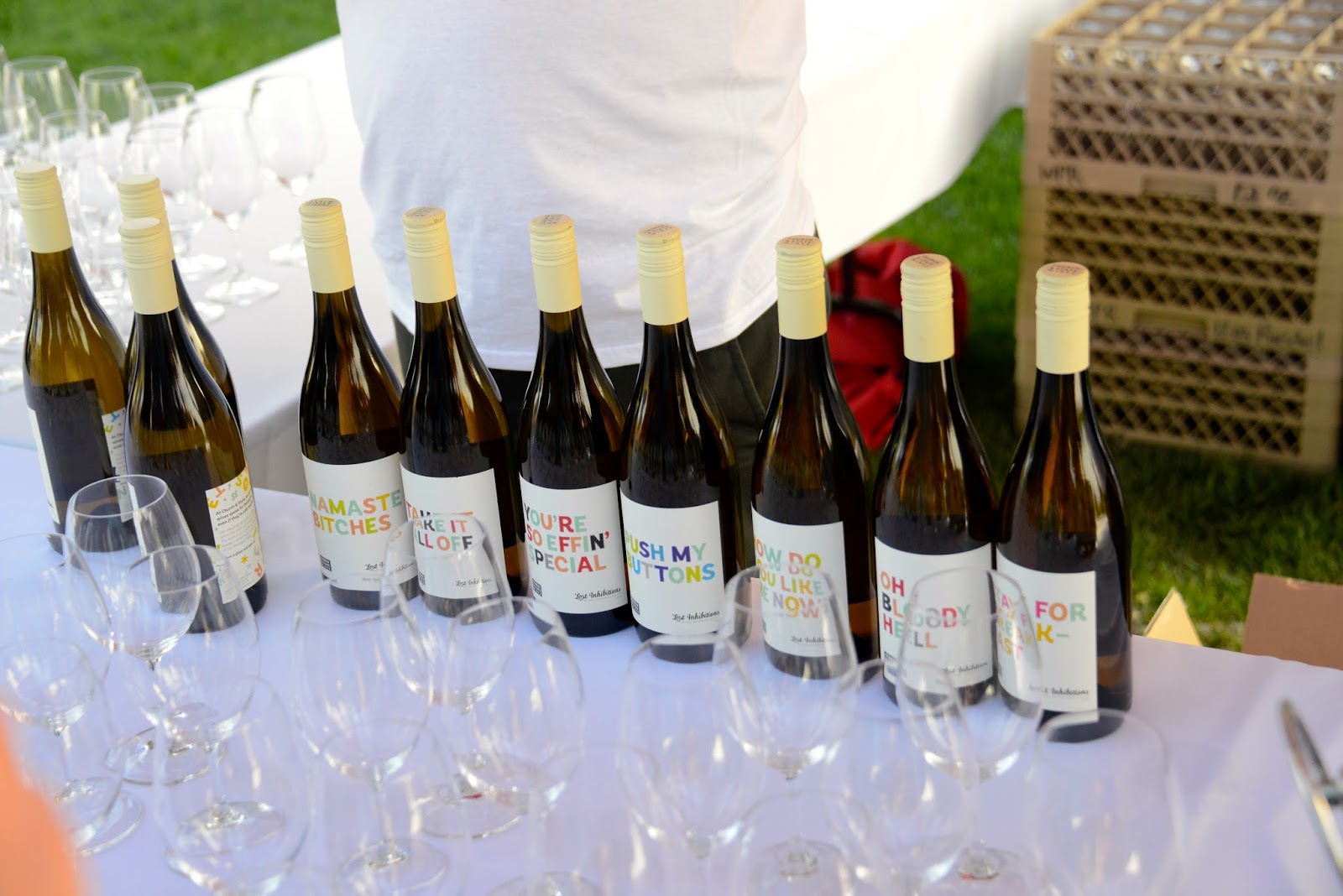
Lost Inhibitions is a new brand that Church & State has launched this year as it wanted a wine with bigger production numbers and, if nothing else, its array of labels caused a great stir amongst the local wine-buying public - especially since the wines were launched on April Fool's Day. Even though there are only a white blend and a red blend produced under the brand, the winery has started out with 96 different "Lost Inhibitions" labels. The labels are divided into two categories - Prude and Lewd. The Prude labels may be a little more "G-rated" as they were all run by the government liquor board to make sure that they could be stocked but with catchy phrases such as "Shut The Front Door," "You Little Minx" and "Carpe Diem Bitches," they'll still grab your attention.

The Lewd category of labels include such beauties as "You Bet Your Ass I Will," "Hash-Tag This Mother F#cker" and "Polite as Fu*k" and they're expected to be available at the winery itself and in private wine shops that might not be so concerned about consumer reactions. I have to admit that I bought a couple of them on the spot to give away as gifts.

Luckily, the wine in the bottle is tasty enough to get you to reach for another bottle - and perhaps a different label. The white is real "kitchen sink" blend of grape varieties - about one-half of the blend is an equal mix of Gewürztraminer, Sauv Blanc and Chardonnay, another third is Viognier and the balance is made up of Riesling, Orange Muscat and Roussanne. Not exactly a break-down you'll see on many labels or winery websites. I see, however, that a number of Okanagan wineries make unorthodox, mixed-bag blends like this on a fairly regular basis and, surprisingly or not, I tend to find that the resulting wines are often tastier than the same wineries' varietal white wines. I know Church & State more for its reds than its whites; so, I can't really comment on a comparison to the winery's whites but I think, regardless, that they might have hit on a winner with these Lost Inhibitions.

Neither Mr. Cool, nor I, could let loose with our inhibitions too much this night though. We did have our big run coming up in the morning and, tasty wine or not, that called for an early night of it.

Thursday, May 21, 2015

Terravista Fandango

Senka Tennant is one of a number of pioneers in bringing about a reputation for sophisticated wines in the Okanagan. When she (along with her husband, Bob, and a couple of business partners) worked on the launching of Black Hills Winery in 1999, she was responsible for the introduction of one of the region's most iconic wines: Nota Bene, the Bordeaux blend that quickly attained cult status and ingrained Senka's name into the minds of BC wine drinkers.

As anyone familiar with BC wines knows, Senka and Bob sold Black Hills to a investment consortium in 2007 and the Tennants took a bit of a breather.

That breather didn't last long, however, the couple purchased new property on the Naramata Bench in 2008. They also decided to blaze a trail with their new project, Terravista, when they were the first in Canada to commercially plant and harvest Albariño and Verdejo - two grapes that are associated more with the northwest of Spain and Portugal than the northern climes of the Naramata Bench.

1922.  2012 Terravista Fandango (Naramata Bench - Okanagan Valley)

Senka's penchant for blends was also seen in another of Black Hills' better known wines, Alibi - a white Bordeaux blend of Sauvignon Blanc and Semillon. The Tennants may not have continued making Bordeaux-styled wines but they have carried on in the direction of blends. They are currently only producing white wines - a Rhône-style blend called Figaro and tonight's bottle, Fandango, a blend of the Albariño and Verdejo grown on their new property. They don't make a lot of either wine either. Local wine writer, John Schreiner, has reported that Senka found the whole expansion and growth of Black Hills to be a bit overwhelming and that she and Bob intend to keep production at Terravista around a 2000 case maximum.

The 2012 is the second bottling of Fandango and it would appear that it can stand up to a bit of ageing because, after a couple of years in the bottle, this is still a fresh and vibrant - not to mention tasty - glass of wine. I'm no expert on either of the two grapes making up this wine, but I'd love to do a comparison tasting of the Terravista and a Spanish and/or Portuguese version.

As of the 2012 vintage, Fandango still couldn't qualify for VQA status - despite its pedigree and the quality of the product. To my knowledge, that still hasn't changed. Neither Albariño, nor Verdejo have been recognized by the provincial wine powers as approved varieties. Until that happens, Fandango will simply have to rely on the fact that its fans know its value - even if it doesn't have an executive stamp of approval.

I'm just glad to see Senka and Bob back in the wine business.

Saturday, May 16, 2015

Big Finish For a Wild & Wacky Week

It would seem that this bottle will our last stop on this Wild & Wacky Wine Week that I had going. It's been quite the ride with introductions to Jacquère, Grechetto, Drupeggio, Malvasia Bianco, Verdello, Mavrud, Teroldego, Callet and Manto Negro but they say "all good things must come to an end" and tonight's grapes will likely be the last stop on this train for awhile.

And where else would you stop to find some offbeat and intriguing grapes but Portugal? With over 250 different indigenous varieties in its vast array of grapes, Portugal is a helluva place to start if you're looking to join the Wine Century Club.

1917.  2011 Niepoort Diálogo - Douro Branco Snow (Portugal)

When I picked up this bottle, I hadn't realized what a find it was on the new grape front. Notes for the wine, however, says that grape varieties used in making the Branco Snow include Rabigato, Côdega do Larinho, Gouveio, Dona Branca, Viosinho, Bical and others. That bodes well for a hefty score on the Wine Century Club tally as I try to complete my second century of grapes. The only thing with some of these more indigenous varieties is that they're often found by more than one name. So, it takes a bit of workout to make my way through Jancis Robinson, et al's, encyclopedic Wine Grapes and check all the various names against my own list.

I'm tickled to say that I get to add another five new varieties. Out of the six grapes listed, I had previously sipped on and added Gouveio under another of its names, Godello. In my books, five for six isn't so bad though.

There wasn't much to find on the five new grapes but Jancis and friends pointed out a few facts that I've latched on to:

• Rabigato - almost exclusively found in the Douro in northern Portugal and is rarely used to make a varietal wine.  Rabigato is favoured for blending particularly because of propensity for high acid levels.

• Côdega do Larinho - primarily noted for intense aromas of tropical fruit but, opposite to the Rabigato, can be rather low in acidity.

• Dona Branca - or "White Lady" in Portuguese - has, confusingly, been used for a number of distinct varieties in Portugal but there is a genetically distinct grape grown under this name in the northern part of the country where it produces "soft, fruity wines without any great distinction."

• Viosinho - is a relatively rare variety. It is also found almost exclusively in the Douro region; however, unlike some of the other grapes mentioned, Viosinho is well thought of as a quality grape that has good potential for quality wines - even so far as to having been referred to as the Portuguese Sauvignon Blanc. The biggest issues limiting that undeveloped potential is that it the grape is known for low yields and for being susceptible to oxidation.

• Bical - is found perhaps a bit more extensively in Portugal as it is recognized in a number of appellations and is known mostly as an aromatic, early-ripening grape.

Being a blend, I can't really comment on the individuality of the different grapes employed. I don't even know if the characteristics of one grape stood out more than another's, but I presume this should be a case of the whole tasting better than any of the component parts. The winery has prepared a great little tech sheet on the wine and it points out that 25% of the wine sees some aging in French oak and that all of the wine - whether aged in oak or stainless steel - has contact with fine lees (or spent yeast cells). I'm inclined to associate oak and lees to fullness in body and to some longevity in the wine's life but I think this one is better drunk when fresh. We just opened the 2011 vintage - and I see that it's still the current vintage in our government stores - but I wouldn't say that I found much in the way of fruit or acidity on the palate.

On the flip-side, the winery tasting notes talk of a "very long and salty aftertaste." I didn't notice that either but I think I'm just as glad to have missed the salt.

Diálogo sports a whimsical label that, according to an article of Jancis Robinson, is different in every country to which the wine is exported. That's got to take some dedication by the marketing department.

I see that Niepoort produces a red Diálogo as well.  I may need to source some out should I find myself in the throws of another Wild & Wacky Wine Week. In the mean time though, Wine Grapes goes back on the shelf. I celebrate five new grapes for the Wine Century Club (taking me to 193) and I get to put some thought into the final 80 some odd wines I need to reach #2001.

Monday, May 11, 2015

Wild, Wacky & Abboccato

Some wines just require too much effort. Not so much in terms of quaffing them or finishing off the bottle but, definitely, in terms of finding out about the actual wine or winery. I spent far too long looking up this wine and the grape varieties. Admittedly, a healthy chunk of that time was trying to work my way through all the synonyms and different names that a single grape can have in Italy but, in the end, it appears that I get to add four new grape varieties to my Wine Century Club tally.

And, as part of this Wile & Wacky Wine Week, I'm going to count that as a win.

1913.  2012 Barbi Abboccato Orvieto Classico (Orvieto Classico DOC - Umbria - Italy)

I didn't find a whole lot written about the Barbi winery - either on their own website or by others - but I did learn that Barbi is a family owned winery that has been operating in Umbria since 1932. The company's "philosophy leans towards the use of indigenous varietals of central Italy, even though lately, in a couple of wines, two international varietals have been employed." The wine we opened is Italian all the way and is made from Grechetto (40%), Procanico (30%) with Verdello, Drupreggio and Malvasia Bianca filling out the balance.

After multitudinous trips back and forth between my Wine Century Club tally and Jancis Robinson (et al)'s Wine Grapes, I've determined that the only grape that's already represented on my tally is the Procanico - not that I'd have known that. It would appear that Procanico is the local name for Trebbiano Toscano or Ugni Blanc and I added that grape in my original century's worth of grapes.

Grechetto is grown in a number of Italian regions but particularly in Umbria where it is mostly used in blending white wines like this Orvieto Classico. As it is a thick-skinned grape, it tends to be harvested later in the season, allowing higher sugar levels and is often used in the making of dessert wines and Vin Santo. Grechetto tends to be a lower yielding vine as well which can result in more concentrated flavours. Accordingly, the grape is also starting to be seen as having potential for use as a varietal wine and for blending with Chardonnay.

The other three grapes that I can now add to my tally aren't as notable. There are a number of different Malvasia Bianco varieties and I can't confirm which one is used in this blend but it is likely Malvasia Bianca di Candia or Malvasia Bianca Lunga as both are permitted in the regional DOC blends. Both grapes are used almost exclusively for blending though as they are generally found to be quite neutral in flavour profile.

Verdello is, indeed, different from the Portuguese Verdelho grape, and is primarily found in Umbria with only small pockets of plantings elsewhere in the country. The grape is favoured for its high acidity; however, the number of plantings seem to be diminishing and Jancis and team state that "the lack of varietal examples suggest it is less successful on its own," outside of blended wines.

Similarly, Drupreggio is grown primarily as a blending grape. Also grown in Tuscany where it is known as Canaiolo Bianco, other than being a new grape for my list, it doesn't appear have much of a following or be much of winemaker's grape of choice.

The name "Abboccato," as seen on the label, apparently means that the wine is meant to be slightly off-dry. We didn't really notice much in the way of residual sugar however.

As a whole, Italian whites don't generally knock my socks off. For the most part, I find them rather bland and often flabby in their lack of acidity. While this wasn't totally lacking in flavour profile, it's not one to turn my head and make me say, "I should really be on the lookout for more Italian whites."

It is good to be able to add grapes 183 through 186 to my tally though and I'm happy with that.

Thursday, April 2, 2015

Misconduct

I can't say that I know very much about Misconduct Wine. I had heard about them and I may have seen them (and maybe even tried a wine or two) at various Okanagan tastings around town but I'm pretty sure that this is the first bottle that I've ever opened of their's. And, to give credit where credit is due, I picked up this bottle during a quick-as-you-can afternoon tour of the Naramata Bench with Bella Gianna during the Red Rooster Adopt-A-Row pruning weekend. 

Bella Gianna wanted to check out the possibility of holding a murder mystery at Misconduct's tasting room/restaurant because the winery has adopted a Prohibition era theme - evident in the winery's general release, Bootleg series where labels and names - such as Massacre Rosé and the Big Take - evoke the rebellion and misconduct of the times. To be totally frank, the obvious marketing push on the theme likely played a role in my not making a bee-line to winery earlier on. I don't generally associate big themes with quality wines but stopping here was first on Bella Gianna's list. 

1886.  2011 Misconduct - Suspect Series Chenin Blanc Viognier (Okanagan Valley VQA)

Since we were there, it only made sense to try a wine or two and we were told that the Suspect Series is a more premium, smaller production line that the winery releases. I was intrigued by the blend of Chenin Blanc and Viognier - not one that I can recall having seen before, especially for the Okanagan where very little Chenin Blanc is even grown. So, I picked up a bottle even though the tasting room wasn't pouring it that day. I'm glad to say that - for my palate at least - it worked. There was good acidity and body but, given the 30% Viognier found in the blend, I was a tad surprised by the subdued nose. All the same, it paired nicely with Boo's and my carbonara.

The back label contained a wealth of information for wine geeks such as myself. The label broke down the percentage of the blend (70/30), the variety clones, the location of the vineyards (Golden Mile and Naramata benches), elevations, yields and production style (whole cluster, medium press; 18.6C fementation temperature and 100% stainless steel).

Bravo.

I'm thinking I may just have to return to the scene of the crime and do some detective work on a few more of their wines.

Sunday, March 15, 2015

Farewell Grasshopper


A toast of wine. A whole whack of fond memories. A few faces not seen for decades. How unfortunate that it often takes a memorial gathering to bring such elements together.

Such was the case today when I joined with a whole collection of the guys (and a few gals) from university days to celebrate the sudden passing of our friend Andy. The flood of memories was a wonderful tribute to Grasshopper - as he was then called. While no one could have forgotten his cheerfulness and enthusiasm, I had forgotten his perpetual sporting of our rugby jersey and his love of food, food and more food.

Andy so enjoyed cooking and entertaining that his teenaged daughter recounted how her younger brother had asked their mom, "How are we ever going to eat now? Dad did all the cooking."

I think my favourite story of the day though was from another old university friend of Andy's. She recounted how, one day, the two of them were driving along and were cut off by some terrible driving. As they both swore, Becks joked that the driver must have been Asian. Being Chinese himself - and not about to let her get away with that - he responded, "Or a woman." In an effort to see who was right, they caught up to the other car to catch a glimpse of the driver - it was a Chinese woman - and they both laughed hysterically for the rest of the drive.

There were a whole lot of reminiscences being shared that day.

1878.  2013 Gray Monk Latitude 50 White (Okanagan Valley VQA)

Having had to pick wines for my Mom's memorial gathering a few years back, it was interesting to see what the choices were. I can't say that I would have thought of this bottle myself, but I think the Gray Monk Latitude 50 was a good pick for a large, casual gathering this this was. Predominantly Riesling with Gewürztraminer, Bacchus and Muller-Thurgau completing the blend, it's an accessible, easy-drinking wine that pairs up well with reception-style nibblies and stand-around storytelling.

It's a different - but eye-catching label - that was introduced a couple of years ago as the Latitude 50 wine was hitting its third decade of production. As winery matriarch, Trudy Heiss, proclaimed with the new label, it's the "Same great Latitude but with new attitude!" The name comes from the physical location of the vineyard. A friend of the family, knowledgable in geography, told them that the vineyard was "three minutes and nineteen seconds north of the 50th Latitude (each minute equaling one nautical mile or 1.85 kilometres)." Gary Monk is almost as far north as BC wineries currently lay down their roots but it's still at the same level of latitude as some of Germany's most famous vineyards.

During all the tales, I recalled a weekend with boys canoeing up Indian Arm. Grasshopper had a bit of an experience with some Lemon Gin. I don't know if he ever touched the stuff again. Don't think I saw any at the reception.

Here's to you my friend. Skoal!


Sunday, February 1, 2015

Middle Kingdom Meets The Seven Kingdoms

Boo is an unabashed Games of Thrones fan - and he's pulled me into all the intrigue hook, line and sinker as well. So, it was a bit of a no-brainer that we'd take in Season's 4's final two episodes when they were shown at one of the local IMAX theatres. The only theatre in Vancouver's Lower Mainland region to screen the episodes was in Richmond - a bit out of our normal stomping grounds but there really was no choice in the matter. We just made the best of the trek by grabbing dinner in one of Richmond's myriad of top notch Chinese restaurants.

Not that we'd know where to go.

Luckily, Boo has a number of Chinese colleagues who are well acquainted with the Richmond dining scene. We tried one of the higher end Chinese seafood restos but it was already full to capacity because of a wedding. Boo made a quick call to one of the girls at work and she recommended that we simply cross the street and try another - which we did. Admittedly, we weren't all that adventurous with our choices - salt & pepper squid, Peking Duck and house seafood noodles - but they all sounded good and we hadn't been there before.

The wine list was on the short side but we went with an Aussie white, thinking it could go with anything that came out of the kitchen.

1851.  2012 De Bortoli Family Selection Traminer Riesling (Riverina - Australia)

De Bortoli is the largest producer (by some margin) in Australia's Yarra Valley outside Melbourne. Part of the sizeable production is based on the fact that the winery does source a good percentage of its fruit from other regions. Bottle in point, this blend of Traminer and Riesling was made with fruit from the more commercial Riverina district. Traminer can be the name for a couple of grapes in Oz - as it is used interchangeably with Gewürztraminer but can also be used in its more genetically distinguishable form which would be Savagnin Blanc or White Traminer. Although the website doesn't state it, I'm guessing this is a Riesling/Gew blend as it is the far more prevalent grape.

At $13 in the Vancouver market, I consider this to be an entry level (if not commercial) wine. We found it to be a bit on the sweet side - which normally might have been okay with Chinese food but, on this occasion, our meal choices didn't really have enough spiciness or heat to match up with the wine.

We had more important fish to fry than to try and spice up our meal though. The Seven Kingdoms were calling and our change in restaurant plans had left us rather tight for time. So, we hastily retreated from our visit to the Middle Kingdom and made our way to Castle Black and Westeros. It would appear that the finish on our wine was a fair bit sweeter than the end met by many of those in the Game of Thrones.

I can live with that.

Wednesday, December 17, 2014

A White Blend Fit a Bishop

Finally, a slow night at home. Not that I don't enjoy all the seasonal socializing. I just need a little time for recharging now and then. A simple night of lounging in front of the TV with a new bottle from an old friend to try is just what I needed.

I say a "new bottle" because we haven't had a bottle of this white blend but, if memory serves, I picked up this il Vescovo at the Vancouver International Wine Festival earlier this year. I don't think it can normally be found in our market. I say "old friend" because the wine hails from a favourite producer in the McLaren Vale region outside Adelaide: Chapel Hill. In checking back on the blog, I'm surprised I haven't already added more bottles from Chapel Hill to The List. I suppose that must mean that we have a good number in our cellar just waiting to be opened. However, rather than go into a lot of detail on the winery, maybe I'll just refer you to my post from when we stayed at the Chapel Hill guest house a couple of years back.

1826.  2011 Chapel Hill - il Vescovo White (McLaren Vale - Australia)

The name for the wine comes from the fact that the winery is built around that historical chapel. The winery has taken to marketing some of its wines with a nod to that past and "il Vescovo" is Italian for "the bishop." The wine, itself, isn't Italian in nature but it does harken to Mediterranean roots. Chapel Hill offers both a red and a white il Vescovo and the white is a blend of Savagnin, Verdelho and Roussanne - grapes that hail respectively from Jura (France), Portugal and the Rhône.

A rather novel blend at that. It's not one that you'd likely run across and it's made all the more interesting in that, up until a couple of years prior to this vintage, most Aussie growers thought their Savagnin was actually Albariño. It appears that, rather than rip out all the faux-Albariño and starting again, a number of wineries are now serving up Savagnin, Chapel Hill included.

Knowing that Savagnin is hardly a grape variety that I sip on a regular basis, I immediately checked my Wine Century Club tally but there it was at #121. I knew I'd run across it before - while in the Barossa Valley as luck would have it, just days before we visited Chapel Hill - but I wasn't sure that I'd added it to my tally as we were only trying it as part of tasting at the time.

Much like how I tend to view Spanish and Italian whites, however, Australia is not generally my first choice for white wines. I'm a long-time Aussiephile when it comes to red but, as a rule, I'll reach for a BC white before I'll open an Aussie white (Margaret River wines being a big exception but there aren't many of those wines in our market). This was intriguing though - not so much in a fruit on the palate kind of way but because it still showed some decent acidity while offering bigger weight than we'd normally see on a BC blend.

It certainly has me looking forward to a return to Chapel Hill and to seeing what whites show up at the 2015 Wine Festival because Australia is the featured region and that might bring out some other surprises like this one. Now, that's a bit of socializing that I'm going to need to rest up for.

Tuesday, July 22, 2014

Benjamin Bridge

1694.  Benjamin Bridge Tidal Bay (Nova Scotia)

When it comes to Canadian wine stories, most feature BC (and, in most instances, Okanagan or Similkameen) wines or Ontario's Niagra region. Despite its being on the opposite side of the country and the relative obscurity of the wines on the West Coast, I know fully well that Nova Scotia is the home to a growing and often well-received region of its own. Boo and I even took a quick one-day tour of the Gaspereau Valley when we visited Halifax in 2008 (unfortunately, well before this blog was started).

We didn't hear of or visit Benjamin Bridge back then but I've since been advised to reach out and grab immediately when I run across any of their wines. If memory serves, Elzee brought us back this bottle when she found herself in Halifax for an extended weekend for work.

Not only did Elzee do us a big favour by bringing back the bottle but she introduced me to an interesting wine story that I hadn't run across before.

Nova Scotia has an even cooler climate than BC's Okanagan Valley. It's probably more along the lines of our Vancouver Island and Gulf Island wineries. As such, the variety of grapes that can reliably ripen in the region can be limited. We're generally talking high acid, slow-ripening white grapes - not that there's the slightest thing wrong with that in this world of big, ripe, sweet reds. Well, according to this article by Jessica Emin in Halifax Magazine, "in 2012, the Winery Association of Nova Scotia thought it would be a smart move on its part to have a signature style of wine evocative of the terroir and climate of Nova Scotia, and consistent from winery to winery."

The article continues, "To call a wine Tidal Bay in Nova Scotia it must be of a certain blend of grapes, all of which are grown in N.S., and each year wineries are approved by a tasting panel to see that they fit the harmony. The ideal Tidal Bay should showcase the bright, zingy, aromatic and crisp style of the province."

Benjamin Bridge's Tidal Bay is made from L'Acadie Blanc, Ortega and New York Muscat. I remember wondering why BC's island wineries didn't look into L'Acadie Blanc since it was rather ubiquitous in Nova Scotia. Well, it must be playing a worthwhile role in this wine as we were certainly captivated. My note read, "Bright Fruit. Nice acidity. Nice introduction to Benjamin Bridge."

I understand that the winery's particularly known for its bubblies. Can't wait to get my hands on one of those.


Monday, June 9, 2014

La Dolce Vita on The Drive


It's true, The Drive and surrounds might not be as homogeneously Italian as it was years ago when it was known as Little Italy. All the same, there's still plenty of pasta, pizza, Chianti, gelato and espresso to be found - all well within walking distance. Furthermore, you can still throw out a "Ciao Bella" (or "Bello") here and there and be completely understood.

Particularly on this one Sunday of the year.

After a decades long hiatus, Italian Day returned to The Drive in 2010 and it's quickly become one of the biggest community/cultural events happening in Vancouver. Naturally, we joined in with up to 300,000 of our closest friends for a stroll amongst all the regular shops as they extend out into the street and vie for attention with all the merchants that have set up kiosks just for the day.

After all, can you ever really have enough things Italian in your life?

1625.  2011 Cesconi - Prabi Bianco (Vigneti delle Dolomiti IGT - Italy)

As much as we nibbled our way along The Drive, we still opted for dinner at home - keeping it Italian, of course. A little pasta and an adventurous white from the north-eastern part of that country. The adventure in this bottle is that it features yet another grape that I can add to my Wine Century Club tally. Being a blend of Manzoni Bianco, Riesling and Pinot Bianco, you probably don't have to guess too hard to figure out which grape gets to be added as #172.

Manzoni Bianco is a cross of Riesling and Pinot Bianco created in the 1930's and has been called the "most famous among the clones created by Professor Luigi Manzoni." It is known as an early ripening grape and one that is adaptable to a variety of soils and climates. Although primarily grown in the north of Italy, it is grown throughout the country and can be found in blends - such as the bottle at hand - as a dry varietal wine or, sometimes, as a sweeter, late harvest wine or even in bubblies.

For anyone interested in reading a bit more about the grape, head off to a Fringe Wine post on Manzoni. As is often the case, Fringe Wine is a great source for material on grapes that might be a little fringier than Chardonnay or Cab.

The Cesconi winery and website can also give you a bit more information about their story and philosophy on wine. Each of the three varieties used in the blend is fermented separately in stainless steel tanks and then aged on its lees for with months. There isn't a whole lot of the Prabi Bianco produced. One source said around 5000 bottles were produced of this 2011 vintage while the website says that around 10,000 bottles were produced of the 2012 vintage.

Located in the Dolomite Mountains, the family has been working the vineyards from the early 1800's. Being as north as it is, the region primarily produces white wines.  Over the years, all of the winery's vineyards have been converted to organic farming practices and, in more recent years, biodynamic principles have started to be introduced into the vineyard.

I've said many a time in my posts that Italian whites aren't generally among my favourites (not when compared to our home grown whites), but this one was pleasantly full and flavourful. A nice end to one of my favourite days in our neighbourhood.

Sunday, June 1, 2014

Oh Joie! - A Shower For The Happy Couple

For the last couple of years, my sister, Vixen, has been obsessing about her upcoming wedding to Big Trucker. She didn't get that grand, old white wedding - that I understand all little girls dream of - with her previous guy. Three kids, but no walk down the aisle. So, she's making up for it this time. For months now, Boo & I have been well advised that we're throwing a shower for them. As if I'm supposed to know the difference between a wedding jacuzzi and a shower.

When asked why we're slated to throw this instead of the gals in the wedding party, she stated, quite perfunctorily, that "Mom and I threw a shower for you two, you're damned well throwing one for me." When I retorted that, "I thought Mom threw that shower," she simply glared and shot back, "Don't you kid yourself. That was all me and you will throw me the best, f*ck'n shower ever or your ass is grass!" Okay, I might have embellished the last quote a teensy bit but I swear it accurately reflects her true sentiments - even if she didn't really say that my ass'd be grass.

So, food and booze. No problem. I can even get a balloon or two but was I really supposed to know that showers traditionally involve games and cake? Who knew that Jack & Jill parties run on the same principles? Let's just say that I might have been scrambling a tad when it came to organizing the "activities," but I can confirm that having more than enough food and booze compensates for missing a few other niceties.

An example of my lack of organization? I made up a big batch of sangria and didn't even remember to take a picture of the sangria or the wines that went into making them. Boo's clean up was so thorough and quick that I couldn't even take a picture of the wine bottles (and box) after the fact. Guess I'll just have to miss out on adding those wines to The List.

Thankfully, I didn't forget to get a shot of the double magnum bottle I opened for the celebration.

1620.  2011 Joie Farm - A Noble Blend (3L bottle) (VQA Okanagan Valley)

I just happened to have the double magnum of Joie lying around after I'd picked it up at a charity silent auction awhile back. At the time, I had no idea what kind of event would prove worthy of pulling the cork. I surely wasn't going to open the bottle for a quiet dinner for two. I figure a gathering of the clan for Vixen's imminent nuptials is about as good a reason as you could ask for though.

Now, I think it's safe to say that I don't buy many oversized bottles. I pretty much need to know that I like the wine - a lot - before I'll put out the extra bucks. No problem with this wine though. I've had A Noble Blend on a number of occasions and it's a perennial fave for the folks at Joie Farm. I've actually added the 2011 vintage to The List back at #1188 but that was a standard 750ml bottle. So, I figure it's fair game to add the over-sized bottle to The List as well.

Styled after the white blends of Alsace, the 2011 wine is dominated by Riesling and Gewürztraminer (38% and 33% respectively) with Pinot Blanc, Pinot Auxerrois and Schoenberger completing the mix. Various scribes have called it "rubenesque," "lengthy, tangy and mouthwatering," "a stunner" and "magic." I just call it tasty and refreshing and a hit with the crowd at hand.

As for the games? Turned out that I had more than we needed. Our New-to-Be-Wed Game showed that the happy couple actually knew each other pretty well. But, then again, you've got a 50/50 chance of being right if your answer for any Big Trucker question involves his car or the Miami Dolphins.

There were plenty of laughs reading all the bits of relationship advice that the guests offered to the happy couple - and at least a couple surprises when folks were asked to guess who was "the better at..." or "more likely to...." It probably wasn't too much of a surprise to see that the vast majority thought Vixen would be better at making a martini (after all I taught her everything she knows) or that she'd be the more likely of the two to send a "sext" message. It might have been more of a newly learned secret, however, to find out that neither admitted to being more likely to bring the other breakfast in bed. I think their joint response to the question was "What's that?" Big Trucker upped that with a "it'd more likely be a who'd deliver nachos in the bathroom kinda thing."

Relatives - what can you say? I suppose it good to learn that the new ones are likely to be just as crazy and weird as the current ones.

I just hope to be around when Vixen opens one or two of the bottles they received as gifts.


Wednesday, May 28, 2014

A Return to Okanagan Roots

Although Sperling Vineyards only produced their first vintage in 2008, there is a long and storied history to the land and family behind the "new" vineyard. Sperling Vineyards may take its name from winemaker Ann Sperling but the 45-acre Sperling vineyard, Pioneer Ranch, has been in the family for over a century. The family's Okanagan narrative began in the late 1800's when Ann's great-grandfather, Giovanni Casorso,  left Italy and ventured to work with the Okanagan Mission - a new agricultural community in what would become known the Okanagan Valley.

The family has been growing grapes since the 1920's and their plantings over the years tell a good part of grape growing history in the Okanagan. Starting with the hybrid and labrusca grapes that were prevalent in days of yore, those vines eventually yielded to quality wine and Sovereign Coronation grapes (the latter being a table grape developed in a local breeding program). In more recent years, the vineyard has been converted to largely Riesling, Gewürztraminer, Pinot Gris, Pinot Noir and Chardonnay - although the property still includes a 45-year old planting of Maréchal Foch and some of the oldest Riesling vines in the valley - 35 years and counting.

While Ann's family has been operating Pioneer Ranch for decades, Ann herself has learned the wine trade and honed her skills working and consulting for a wide range of wineries from the Okanagan to Ontario to Nova Scotia (with acclaimed sparkling wine house, Benjamin Bridge). She even has an interest in an Argentine venture to add to her busy schedule.

1618.  2011 Sperling Vineyards - The Market White (VQA Okanagan Valley)

With Ann's return to her roots in the Okanagan, her attention has been directed primarily at the white varieties that have become synonymous with the northern Okanagan. While Sperling offers a number of varietal wines, The Market White is a blend of primarily Pinot Blanc and Bacchus. I couldn't find an exact breakdown of the varieties incorporated in the 2011 version; however, I see that the 2012 vintage also includes a good chuck of Gewürztraminer and a touch of old vine Perle of Csaba (a variety of Muscat). I haven't seen any confirmation of those additional grapes in the 2011 though.

Regardless of the wine's make-up, it was deemed tasty enough to make Wine Diva's Annual Under $20 Top 100 Wines for 2012.

The off-dry notes might have been a touch much for our stuff and roasted pork but that's all the more reason to have added a bit of spice to the seasoning on the meat and accompanied the dish with a hefty pepper jelly.

Although I've certainly been aware of Ann's return to the Okanagan, this is the first of her wines to be added to The List. I doubt it will be the last. Indeed, I'll run across some of her handiwork when the BC Wine Appreciation Society hosts a tasting with Clos du Soleil in June. As if she doesn't have enough on her plate, Ann is winemaker for this award winning winery as well. "Welcome back," I say.

Wednesday, May 21, 2014

Lammershoek - A New Look at South Africa

I still have a few training drinks to fit in before the Half Corked Half Marathon on the weekend. I may not be able to train on the road, but at least I can keep training with the glass.

1613.  2009 Lammershoek Roulette Blanc (Swartland W.O. - South Africa)

I don't know South African wines very well. We don't tend to buy many ourselves and, when we do run across them at events or parties, they're usually the mass commercial, entry level brand wines. Case in point, I didn't even recognize Swartland as a Wine of Origin appellation in South Africa - let alone know where it is on a map. Same thing with Lammershoek. I knew nothing about it when I picked up this white, along with a red blend, at a charity event silent auction and, while the purchase was a pure gamble, I figured the wines had to be a worthwhile sip as the bottles were donated by Marquis Wine Cellars - perhaps Vancouver's premier private wine merchant. If you can't trust them for a bit of an adventure, who can you trust?

Lammershoek is a family run and managed operation that produces three label ranges - an entry level, this eponymous label and a "project" label that pushes boundaries and plays with more unusual grape varieties and techniques. The winery added a new winemaker, Craig Hawkins, in 2010 and he's apparently upped the ante since his arrival. The experimental, "project" label - Cellar Foot - even has a Syrah that is aged in barrels under water. Never heard of that one before.

Hawkins wasn't with the winery during the vintage and pressing of the juice for the '09 Roulette Blanc but he did supervise the blending of the finished wine. He has an interesting production method for this wine (at least for the subsequent vintages) in that the juice is pressed directly into large (300L and 600L), old oak barrels and aged for 12 months on its lees (spent yeast cells) and then blended and placed in a 9500L concrete tank where it is aged for another 5 months on lees before being bottled unfined and unfiltered. The finished wine sees Chenin Blanc, Chardonnay, Viognier and Clariette Blanche combined for a rich mouthfeel that goes more for minerality and spice than for fruit - quite different from most of the whites we find back home in BC. It was definitely big enough for a pork roast - although I think I'd want to drink it more with food than just by itself for a cocktail sip.

The grapes are farmed organically on dry land (no irrigation) from well established vines and that likely adds an even bigger element to the mouthfeel on the wine.  The Chenin vines are between 45 and 50 years old, the Chardonnay and Viognier around 30 and even the newest Clairett Blanche vines are 15 years old.

A definite change of pace for my wine glass. I'll be interested to see what the red is like.

Saturday, December 14, 2013

A C&C Christmas

In what's become a bit of a tradition, the gang from work gathered for a holiday dinner party at Ciao Bello for some laughs and many a plea for everyone to "Mangia. Mangia."

It's always a bit of a surprise to find out what wines The Boss has picked for the night. I made the wine arrangements for a couple of years but Boss has taken a bit of a shine to wandering the aisles at the liquor store to come up with an array of wines - particularly when he thinks that he has some choices that will surprise me a bit. I totally appreciate the fact that he checks the blog before making a purchase so that I get the chance to add some new bottles to The List - as well as join in with the troops.

1485.  2012 Masi Masianco (Pinot Grigio e Verduzzo delle Venezie IGT - Italy)

I cottoned onto one of the whites The Boss picked - forgetting that I'd bought a bottle for home myself - because I saw that it was a blend featuring the Verduzzo grape. Since Verduzzo Friulano is definitely a new grape for my Wine Century Club tally, I'm not going to care that I could have zeroed in on a different white and saved this one for quaffing at home. When it comes to increasing my grape variety tally, sooner is always better.

Masi has been making the Masianco blend for a decade now and they refer to it as their white "Supervenetian" and a counterpart to Masi's well known red "Supervenetian" wine, Campofiorin. I gather it is the blending of these two grapes that takes this wine out of the more historically approved D.O.C. wines and into IGT territory. I understand that the wine does very well for Masi and I guess that this might just go to show that innovation can have its place even among regions caught up in centuries' worth of tradition.

Another different aspect in the production of Masianco is that the Verduzzo grapes (which make up about a quarter of the wine) undergo some additional drying out - the "appassimento" method - to enhance and concentrate the body, flavours and aromas. This approach doesn't appear to be unique to Masi as the grape is also used by regional producers to make a sweeter dessert wine. An alternative method that leads to a similar result is that the grape's growers will leave the bunches hanging on the vine to bring in for a late harvest wine. There are, apparently, some wineries making straight, dry varietal wines with Verduzzo but I don't think many of them travel much. Jancis Robinson's "Wine Grapes" states that the grape is grown primarily in North-East Italy (with a couple small pockets in Slovenia and one producer in Australia) but that overall plantings are gradually declining.

Good thing I'm adding it to my tally now.

Unfortunately, our dinner group was missing a few of our bigger personalities this year. As such, there was no Bollywood-style bhangra or dancing on the tables. In fact, there was no dancing at all. Just plenty of eating and drinking and moving from table to table in between courses.

Some of our colleagues were a little more adventurous than they might usually be with their drinks over the evening. So, I introduced a handful of them to dirty martinis, to the joy that is Prosecco and a couple braver souls to a Prosecco Spritzer when I saw a bottle of Aperol at the bar. It's getting to be common enough now to find Aperol in Vancouver bars and restaurants. Hard to believe that it was only five years ago that Boo and I came home from Venice and couldn't find a bottle anywhere in the city.

Despite making suggestions to other folks, I was good and stuck to wine though.

1486.  2010 Emilio Moro Bodegas - Finca Resalso (Ribera del Duero - Spain)

The second bottle being added to The List saw The Boss veer a bit away from his almost "all-Italian" selection for the evening - by adding in a Spanish wine that I hadn't run across before. He said that he wanted to grab it because it's supposedly a rare find in Vancouver. The wine is apparently the entry level wine for Emilio Moro Bodegas and it's made from 100% Tinto Fino (another name for Tempranillo) in the Ribera del Duero region. The wine is named for the Finca Resalso vineyard that has been in production since 1933; however, the grapes for this wine are from the vineyard's youngest vines - being between 5 and 15 years of age.

The Moro family itself has been involved in the winemaking business in Ribera del Duero for three generations now but they've only been releasing their wines under this brand since 1982.

I'm not sure that our Italian server was impressed much by a Spanish wine on the table but I think this was probably my fave for the night. Bigger and fruitier than many of the entry level Tempranillos I tend to run across, maybe the Italians should be a little worried.

1487.  2011 Barone Ricasoli - Campo Ceni (Toscana IGT - Italy) 

I was intrigued to see that The Boss brought along a Ricasoli wine as well since Boo and I had opened a bottle not too long ago. This was more of an entry level wine though. I'd grabbed a higher end bottle from (if memory serves) the Vancouver International Wine Festival and it was way bigger than this one.

Don't be fooled by the fact that I took a picture of the bottle with my tiramisu. I'd been drinking the wine earlier in the evening and I'd just forgotten to take a picture for the blog. I wouldn't exactly recommend the Campo Ceni with tiramisu though. It wasn't the worse combination ever but I think you could easily come up with a better pairing. Like the coffee I was now sipping on.

The Super Tuscan - Sangiovese, Merlot and Cab Sauv blend - didn't go over incredibly well at our table. People tended to gravitate to other options. I didn't mind it myself but entry level Sangiovese isn't generally my first wine of choice.

I think The Boss had a much bigger list of wines but I just didn't get around to checking out the others. Boo had experienced a tough day at work and he asked that we head out a little earlier than I might have usually. I likely would have been able to add another bottle to The List but sometimes a clear head in the morning is worth that lost bottle.

Besides I'd already received my early Christmas present by being able to add grape #166 to my Wine Century Club tally. The rest of the evening was all bonus.

Friday, October 11, 2013

Calamari Plus

A major component of my "little" Wine Odyssey is to discover and experience wines from all around the globe. I definitely feel a tinge of excitement when I run across wines with unusual grape varieties - regardless of where they're from. Tonight's bottle is one of those "out there" bottles for me. I can't say that I know much about Greek wines - particularly the more premium bottlings. Most of my prior quaffing of Greek wines involve one of the ubiquitous, cheap and cheerful litre bottles found at Greek restaurants along with souvlaki and calamari.

I made a special effort, therefore, to head down to Marquis Wine Cellars - one of Vancouver's premium private wine stores (if it doesn't just outright take the crown) - when they featured this is one of their Wines of the Week, particularly since the wine was going to give me another two grapes to add to my Wine Century Club tally (#'s 162 and 163).

1450. Domain Mega Spileo White (Greece)

A blend of Assyrtiko and Lagorthi (the label says 60/40 while the website says 50/50), I wasn't going to get a whole lot of information from the bottle's label. It's completely in Greek and, while I may remember my Greek alphabet from fraternity days, it sure wasn't going to help me out here. It took a bit of time on the net to figure out what was going on with this bottle - particularly since Marquis said that the wine was made from the Lagorid grape. I didn't have any luck finding that one at all.

Lagorid. Lagorthi. It's all Greek to me.

Assyrtiko is one of the best known white wine grapes in Greece and I find it hard to believe that I haven't already added it to my Wine Century Club tally. I've definitely thrown back my share. I guess I just missed adding the variety as I'd assumed it was already there. Assyrtiko may be the third most widely planted white grape in Greece but it is most closely associated with the island of Santoríni.

The Domain Mega Spileo vineyards are located farther north in the mountains of Achaia in the north-west corner of the Peloponnese. More growers are planting Assyrtiko in the north as they're finding that it will keep its acidity and offer a bit more fruit on the palate than the grape tends to on Santoríni.

Lagorthi is relatively rare - it is only grown in a limited number of vineyards and is primarily found in northern Pelopennese and some of the Ionian Islands. The grape is known (as much as it is known) to maintain higher acidity levels than most people associate with white Greek wines. It is also known as Verdeca - a traditional variety grown in Puglia in southern Italy. The grape has a relatively neutral flavour profile with a noticeable minerality. Noting these traits, the folks at New Wines of Greece see it as an intriguing variety that can be found as a premium varietal wine or in some interesting blends - generally with grapes that can add a richness to the palate.

If the average wine drinker wouldn't know what Assyrtiko is, my guess is that the folks growing Lagorthi have got a ways to go before it'll ever be a household grape.

As for the winery, Domain Mega Spileo is found on lands with official references to the monastery vineyard that date from 1550. Viticulture on the lands ceased, however, as the monks gradually left the monastery. The vineyard was revived and replanted in 1999 by the current owners. This bottle is currently the only white wine that the winery makes.

While this wine definitely had more weight to it than I generally associate with white Greek wines, it still lacked the fruit that a BC boy like me is used to with favourite white wines. The minerality did shine through and I was thrilled with the exposure to Lagorthi but I don't think this is going to be a regular match to Boo's never-ending quest for the best calamari ever.

I should think that Boo could talk me into a visit to Greece to do a little research on calamari and Greek wines though. Hint. Hint.