Showing posts with label Cab Franc. Show all posts

Tuesday, August 25, 2015

Some Intensity With That Port?

As long as Boo has been working in the same job, he's still not high enough up in the seniority rankings to rate extended vacation time during the summer. Consequently, we weren't able to join in with some of the family as they cruised to Alaska. We did get to hear some of the tales over dinner upon their return, however, and that led to a couple bottles of wine at our place afterwards.

1985.  2013 Mistaken Identity - Intensity (BC VQA - Okanagan Valley)

Mistaken Identity is an organic vineyard and winery that set up shop on Salt Spring Island and released its first wines in 2009. Although perhaps not "mistaken," the identity of this Cab Franc is a little mysterious. Boo and I visited the winery once (when cavorting with Tyrant on Salt Spring) and I know that they grow largely white grapes there. They certainly weren't trying to grow Cab Franc. Indeed, I rather doubt that any of the Gulf Islands are able to fully ripen any of the big red varieties; hence, the grapes for this wine were sourced from the southern Okanagan Valley. The wine was still produced in a manner to comply with VQA rules and the label advises that the grapes were also grown organically (so as to stay in sync with the balance of the home vineyard grapes), but the wine doesn't have much more of a connection with the Gulf Islands.

A simple search online didn't reveal much more about the wine either.  I did discover, however, that the winery has since been listed for sale and may well have been sold by now. So, we may not run across any Mistaken Identity down the road.

1986.  1997 Broadbent Port (Portugal)

Like Mistaken identity, Broadbent is also a relatively new producer - although "relatively new" in the world of Port can still be decades. There's no mistaking the identity of this wine though as the Broadbent name comes from the father and son team of Michael and Bartholomew Broadbent. The former has been the Chairman of Christie's International Wine Department and his son has made a name for himself as one of the "world's top authorities on Port and Madeira."

The first Broadbent Port was produced in 1994 and the pedigree of the Broadbent name was solidified when they asked winemaker Dirk Niepoort to do the honours for them. The Niepoort family has been in the wine business since 1842 and knows a thing or two about making wine, particularly Port.

The 1997 was only the second declared vintage for Broadbent and their overall production is limited as they only make about 500 cases a year.

We came across this bottle when a client was downsizing his home and he needed to divest himself of some of his home assets because his new house wouldn't have enough space for everything. I refer to the bottle as being part of the "Carpet Collection" because Boo wanted to buy a couple of the Persian carpets that the client was selling. That meant, however, given the nature of tit-for-tat, that I got to buy some of the Port that was up for sale. Two carpets. Twelve bottles of Port. I think I let Boo off easy - and we all get to enjoy both the carpets and the Port for many days to come.

I think it particularly comes in handy when the family just pops in for a bit a tongue-wag session. Even if we didn't get to go on the cruise, we can enjoy a little vintage time of our own.

Saturday, August 15, 2015

A Sense of Seneca


This is my third Wine Bloggers Conference and it's been the same story at all three: the surprise winery visit is a guaranteed highlight. The conference sets up a series of side trips and the delegates just board a bus without knowing what their destination will be. The toughest task is trying to coordinate your crew so that you all get on the same bus. Like herding cats I tell you.

We were likely the last bus to load and some of our folks more-or-less just ignored where they were being directed to get on our bus but the gang somehow managed to stay intact - and, as luck would have it, I think we happened on to a lovely outing.


As with the Pre-Conference Excursion, our bus wound its way back to the shores of Seneca Lake - although this time we travelled up the eastern shore to the Banana Belt that we'd previously heard about. The "tropicality" of the sub-region was manifested more as rain forest than equatorial sunshine however - at least for a brief portion of our visit to the vineyard. A little shower did nothing to dampen our moods or the vista though. Everyone's biggest concern was that the rain might be watering down the wine in our glasses.

The theme to our excursion was "Senses of Place" and we were first greeted in one of the Hazlitt 1852 vineyards by principals of four local wineries - Hazlitt 1852, Keuka Spring, Heart & Hands and Sheldrake Point - two from Seneca Lake and two from neighbouring Cayuga Lake. Much to my delight, our hosts each poured a Riesling to provide a sense of the terroir as they discussed the region and their particular directions and aspirations for their viticulture and winemaking.

The next step to happiness was a walkabout tasting at Hazlitt's dining pavilion. Each of the four wineries offered a couple of different wines while providing a chance for a little one-on-one discussion.

There were a couple of standout wines on my dance card: the Hazlitt 1853 Cab Franc and the Heart & Hands Polarity, the latter being a "unique white wine made from 100% Pinot Noir grapes" (at least that's what the winery website calls it - sounded like a Rosé to me, but a tasty one at that).

Unfortunately, I didn't have a chance to try all the hard ciders and craft beers that were also on offer before we were called to the dinner table.

1977.  2012 Hazlitt 1852 Vineyards Cabernet Franc  (Finger Lakes - New York)

Although this Cab Franc wasn't one of the wines that was served with dinner, as mentioned above, it was a favourite for the day and I certainly requested enough refills to qualify this as the one bottle to add to The List. Turns out I'm not the only person to take a hankering to the wine. Within a couple weeks of our leaving the Finger Lakes and WBC15, this wine ended up winning the Best Red Wine at the 2015 New York State Fair. Not that I had any extra room in my luggage - or on my Customs declaration - for additional bottles, but I do wish I'd have had a chance to visit the tasting room and pick up at least one bottle of this full bodied and richly flavoured wine to bring home.

A four course menu was prepared by local restauranteur, Dano Hutnick, and paired with a wine from each of the four wineries present. From chilled tomato soup and seafood stuffed cabbage to pork cheek goulash and home grown apricot napoleon, chef aimed to emphasize what was local and fresh at the moment. Our host wineries continued to show their versatility and poured Grüner Veltliner, Gewürztraminer, Pinot Noir and a Riesling Ice Wine.

As leisurely and enjoyable as our outing had been, we were corralled back onto the bus as a reception at the Rockwell Museum had been planned back in Corning. Proving that our hosts were more than just pretty faces, they kept a (by now) much livelier crowd both occupied and amused with craft beer and Riesling tattoo stickers. I tell you, there's never a dull moment at these Wine Bloggers Conferences.

Sunday, May 24, 2015

Half Corked - Again


For the second year running, Mr. Cool and I have donned our grass skirts, Hawaiian shirts and Nikes to take part in the Half-Corked Half Marathon. Along with a thousand other wine-loving crazies, we arrived at the Hester Creek start line ready for a glorious day of taking in the Golden Mile and Black Sage Bench for what is definitely one of the most celebrated runs in Canada.

We were lucky to be positioned in the first wave of runners because the day was already heating up by the 8 a.m. start time and it was promising to be a hot one. We arrived just in time to act as witnesses for a wedding of two participants. The vows were timed to finish just before the starting gun. So, naturally, there was a toast to the happy couple as we all readied to start them off on their honeymoon.

Nothing like a few first sips of wine before starting a half marathon. It's definitely part of a proven training regime when it comes to this race.


The course winds its way through the southern half of the Okanagan Valley, traversing up and down the rolling terrain (or is that "terroir" given this is wine country?), through grapevines and along service roads. Although incredibly scenic, it's quite the taxing course. No one sets out to run a personal best on this race. Indeed, it quickly became evident that grapes grow best on slopes - a fact that we can all attest to now.

Of course, one of the most appealing aspects of the run is that water stops are regularly scheduled every one or two kilometres as the course passes through or by another winery. And, funny, but for some reason those water stops all featured wine tastings and occasional bites of artisanal foods.

A few highlights of the fifteen water wine stations were Sandra Oldfield and Tinhorn Creek's Sangria party tent, Rustico's western themed BBQ (not that I ate the baked beans as a courtesy to the other runners) and, my personal fave, Stoneboat where they'd MacGyver'ed part of a crusher/de-stemmer to provide a chillingly refreshing shower and offered an icy granita of their Piano bubbly. Admittedly, I added three or four of the granitas to my pineapple water bottle for the next part of the course. Even watered down, it was just so perfect for the occasion.

Unfortunately, I starting having a problem with my left knee shortly after the race began. So, poor Cool, he had to deal with my intermittent run/walk means of tackling the race. Even after the medical tent at Silver Sage tried to jerry-rig a tape job on my knee, it was slow going at best. Cool could easily have finished the race a whole lot sooner than we did but he was good enough to stick it out with me, all the time offering encouragement like, "alright now, I figure that, if we jog it out for a couple hundred metres, there's bound to be another wine stop just around the corner."

It might have been a sad finish to the race but, lo and behold, there was a festival tasting at the end - featuring all the Oliver-Osoyoos Wine Association members that weren't encountered directly on the Half-Corked route. By then, my knee was in pretty bad shape; so, we didn't stick around too long at the race festival - just long enough to watch some Flintstones, I Dream of Jeanie gals and sock puppet monkeys join us at the finish line. As sacrilegious as it might seem, I chose an afternoon nap and a heavy dose of ibuprofen over continued wine tasting.

As soon as the nap was over, we got back to real reason for this Odyssey and added another bottle to The List.

1924.  2012 Intersection Mile's Edge White (Okanagan Valley VQA)

I first ran across Intersection and its intriguing wines at the Vancouver International Wine Festival and The Grape Debate back in the spring. The winery is a relatively new entrant to the BC wine scene - although its principal, Bruce Schmidt, is a definite veteran. As early as the late-1970's, he was a marketing executive with Calona Wines and local writer, John Schreiner, reports that Schmidt is famously known for making Calona's Schloss Laderheim Canada's largest-selling white wine of its time. Schmidt spent the better part of the '80's, 90's and 00's working in other fields but he returned to the Okanagan in 2005 when he purchased an old orchard property and packing house.

Schmidt and team worked on converting the orchard to a vineyard and the packing house into a winery and they started releasing wines in 2010. Unfortunately, the 2008 and 2009 winters were so severe that they lost almost half the vines they'd planted.  After only being able to release a couple hundred cases of wine in those initial years, they finally reached their full production goal of 2500 cases in 2012.

Having been impressed with their offerings at the earlier tastings, Boo, Mr. Cool, Mimster and I stopped in to do a tasting yesterday and we grabbed this bottle as a weekend treat. An unusual blend of 75% Sauvignon Blanc and 25% Viognier, Mile's Edge White was a great afternoon sip on our deck overlooking Lake Osoyoos. Body. Aromatics. Fruit. Acidity. It might not have healed my sore knee but at least it helped dull the pain.

Following our Intersection interlude, we made our way to Tinhorn Creek and Miradoro restaurant. The winery was hosting one of its annual Canadian Concert Series nights and Rich Hope & His Blue Rich Raiders were playing away to a lively crowd in the amphitheatre below. I don't think too many of the revellers had taken part in the Half-Corked. Catchy music or not, there was no chance that I'd be dancing the night away.

2013 Tinhorn Creek Rosé (Okanagan Valley VQA)

I wasn't sure whether it was the 2012 or 2013 vintage that we'd enjoyed recently. Turns out that it was the 2013; so, I don't get to add this vintage a second time to The List. No matter. As the last vintage of Rosé where Sandra Oldfield was at the winemaking helm, it was a welcome addition to the table. It matches with all assortment of dishes and just goes down so darn easy. A welcome thing with this gang.

1925.  2012 Tinhorn Creek Cabernet Franc (Okanagan Valley VQA)

I couldn't have a dinner in wine country, on such an auspicious day as the Half-Corked, without adding a new bottle of Tinhorn Creek to The List though. So, a second bottle just happened to get ordered. Sandra pioneered the planting of Cab Franc in the Okanagan and her perseverance is now paying off as the variety is seen as being well-suited for the region. Instead of all the Cab Franc forming part of Okanagan Meritage blends, more and more varietal Franc wines are showing up on winery lists and they're deservedly proving to be popular pours.

This is a big, dark-fruited version, well-suited for our richer main courses and for our simple sitting back and enjoyment of the concert.

With luck, the knee will recover quickly and I can think about coming back for next year's Half-Corked. After two years of knee issues, I could use a bit of "third time lucky" coming my way.

For some strange reason, Mr. Cool is all ready to suit up again. Maybe it's the wine.

Monday, May 18, 2015

Spot Prawns on the Barbee

There is no doubt that Spot Prawn season is one of my favourite times in Vancouver. Maybe it's because I can throw some "shrimp" on the barbee and tap into my inner-Aussie. In any event, this year's season is upon us and I grabbed my first couple pounds. Turns out that it doesn't take much to convince Elzee that prawns and wine is fine way to spend the evening either - even if she has to put up with Boo and I in order to collect.

1919.  2010 Blue Mountain Brut Rosé (Okanagan Valley)

A favourite entrée - and a favourite drinking buddy - cries out for a favourite tipple as well. Any Blue Mountain bubbly is worth the price of admission but I've always had a special jones for the Brut Rosé - and not just because I could never seem to get my hands on any for the longest time. Blue Mountain has long been one of the pioneers on the BC wine scene and, along with Stellars Jay, they set the bar for the introduction of true bubblies in the region. But since so many of the country's trade and wine writers review this wine, I'll just leave it to them and add the link to Blue Mountain's webpage where they've compiled a few of them.

I would appear that I'm not the only one who enjoys this Pinot Noir and Chardonnay wine made in the traditional Champenoise way.

We'd finished the Rosé long before the shrimp was ready to come off the barbee - despite the fact that it only takes a minute or so to grill these babies. One thing you definitely don't want to do with the succulently sweet spot prawns is overcook them. Or over-season them. A touch of olive oil and a bit of salt and pepper and they're good - or should I say "great" - to go.

The spot prawn season may not be long enough for me to enjoy an endless supply into the summer but I have a feeling that there's going to be a whole lot of Rosé in the months to come - whether it's bubbly or not.

1920.  2013 Tinhorn Creek - 2 Bench Oldfield Series Rosé (Okanagan Valley VQA)

Indeed, we just carried on with a still Rosé and Sandra Oldfield - and the team at Tinhorn Creek's - Rosé is a mighty fine sip to carry on with. This 2013 is the last vintage where Sandra was in full control of the winemaking at Tinhorn. She's since passed those duties on to Andrew Windsor and decided to concentrate on her obligations as President and CEO for the winery. This beauty, however, made from 100% Cab Franc, is a fine "last" effort.

The freshness of the wine paired brilliantly with the spot prawns. There was enough body and red fruit on the palate that it highlighted the sweetness of the prawns and the touch of spice on the finish simply added to the dish.

Spot Prawns, al fresco dining, a wonderful friend and lovely wines. In my book, it doesn't get much better than this. I'll definitely look forward to trying this again with the 2014 vintage.


Sunday, March 8, 2015

Elzee's New Dirty Apron


The great thing about giving a cookbook for Christmas is that there's always the potential of being invited for dinner so that the recipient can try out a new recipe on you. Not that there was any nefarious intent in Boo's and my giving The Dirty Apron Cookbook to Elzee last December. Her proposal to use us as guinea pigs as she tried out some intriguing dishes was both welcome and easy to accept. Girl knows how to cook - with or without a cook book.

The dinner was also a perfect opportunity to pop the cork on some exciting wines.

1874.  N.V. Giusti - Asola Dry Prosecco (Prosecco D.O.C.G. - Italy)

I'd met up with Elzee and her brother, Hockey Cop, for some of the Friday night grand tasting at the recent Vancouver International Wine Festival and one of the definite treats of that night was our visit to the Giusti table. Not only were all the wines as tasty as all get go but Elzee and Hockey Cop struck up an entertaining conversation with winery principal, Joe Giusti. It turns out that Elzee and Hockey Cop's dad is pretty much from the same village as Joe was from. The conversation morphed into an extra special opening of a Giusti icon - their Acquavite Riserva Grappa (much to Joe's agent's dismay).

The Grappa wasn't available for sale but I did pick up some of the winery's Prosecco and I figured there'd be no better occasion to open a bottle than at tonight's dinner.

This is not, however, a simple Prosecco to make Aperol Spritzers or Mimosas with. No. No. No. Being a D.O.C.G. wine, it is made from the traditional Glera grape but Giusti strives for an intensity that captures classic tree fruit and citrus notes but lifts it to a more pronounced level of sophistication. Our bottle didn't last longer than our hors d'oeuvres but I could easily see drinking this through an entire meal.

We definitely sipped away while trying to figure out a way to take Joe up on his offer for us to all visit him if we ever make our way to the Veneto. Travelling to Italy with Elzee has long been a bucket list item for Boo and I. I think Giusti just upped the ante.

1875.  2012 Burrowing Owl Chardonnay (Okanagan Valley VQA)

Elzee just happened to have a bottle of Burrowing Owl Chard in the fridge. So, it didn't take much arm twisting to pour it along with her Kale Caesar salad. I don't tend to buy as many Burrowing Owl wines as I used to. There's just so much choice for Okanagan wines nowadays - and Burrowing Owl is now one of many excellent producers instead of being one of a few that was head and shoulders above the others.

It was nice to try the Chardonnay though since I can't say that I buy Burrowing Owl's whites as much as I go for their reds. Regular readers will know that I'm not all that partial to Chardonnay - especially the big, oak-driven versions that can be prevalent in the market. Wines like this are simply evidence that it doesn't pay to be ABC (Anything But Chardonnay) wine drinkers. This was a full bodied Chard (being from a warmer vintage for the Okanagan) but the oak, while noticeable, wasn't overbearing and was well integrated. I'll admit I refilled my glass.


The main course of braised short ribs was paired with a bottle that I'd been holding onto for awhile. It was a bottle that Elzee had given Boo and I for Christmas a few years back. Just like our giving cookbooks can result in dinners, Elzee's gift of wine might just see us open it to share with her. What goes around, comes around - or so they say.

1876.  2007 Tawse - Laundry Vineyard Cabernet Franc (Lincoln Lakeshore VQA - Niagra - Ontario)

Unfortunately, I can count, on the fingers of one hand, the number of Tawse wines that I've had - and they've been largely white wines. I just don't see many Tawse wines available for sale in Vancouver. As I've previously lamented, that fact will hopefully change in the times to come. It was a welcome discovery, therefore, to find the Tawse Cab Franc in our cellar. Neither Elzee nor I knew of the wine or the winery's provenance when she picked up the bottle during a visit to Toronto.

Glad she did though. All three of us thought it was a standout. Full of body and vibrant fruit, every bite of short rib was simply elevated by another sip of the Cab Franc.

The Tawse website says that the Laundry Vineyard Cab Franc vines are among the oldest in the Niagra region of Ontario. Sustainably-farmed, the fruit was clearly evident in the glass and a nice touch of spice on the finish just enhanced our enjoyment.

Now to find some more Tawse Cab.

Having said that, you know there was no Tawse left by the time Elzee brought out the Sticky Toffee Pudding. Not that we need any more libation but, in honour of our Giusti tales, Elzee brought out some of her dad's own grappa preserved cherries as a nightcap to beat all others.

All told, this was one helluva a dinner: delicious food and ever-so-tasty wines. I think I'm going to have to start looking for another cookbook to give to Elzee this Christmas. No agenda of course. Just a little something to help her fill a little adventure time in the kitchen. I will bring the wine, however, if she needs another guinea pig.

Saturday, December 20, 2014

A Comfortable Chewbacca & Seasonal Shelback

After that slight hiatus and a little stay-at-home time, it's back to seasonal gatherings. Time for a little get-together with some fellow BC Wine Appreciation Society folks. The number of guests was small but the array of bottles was worthy of any Christmas party.

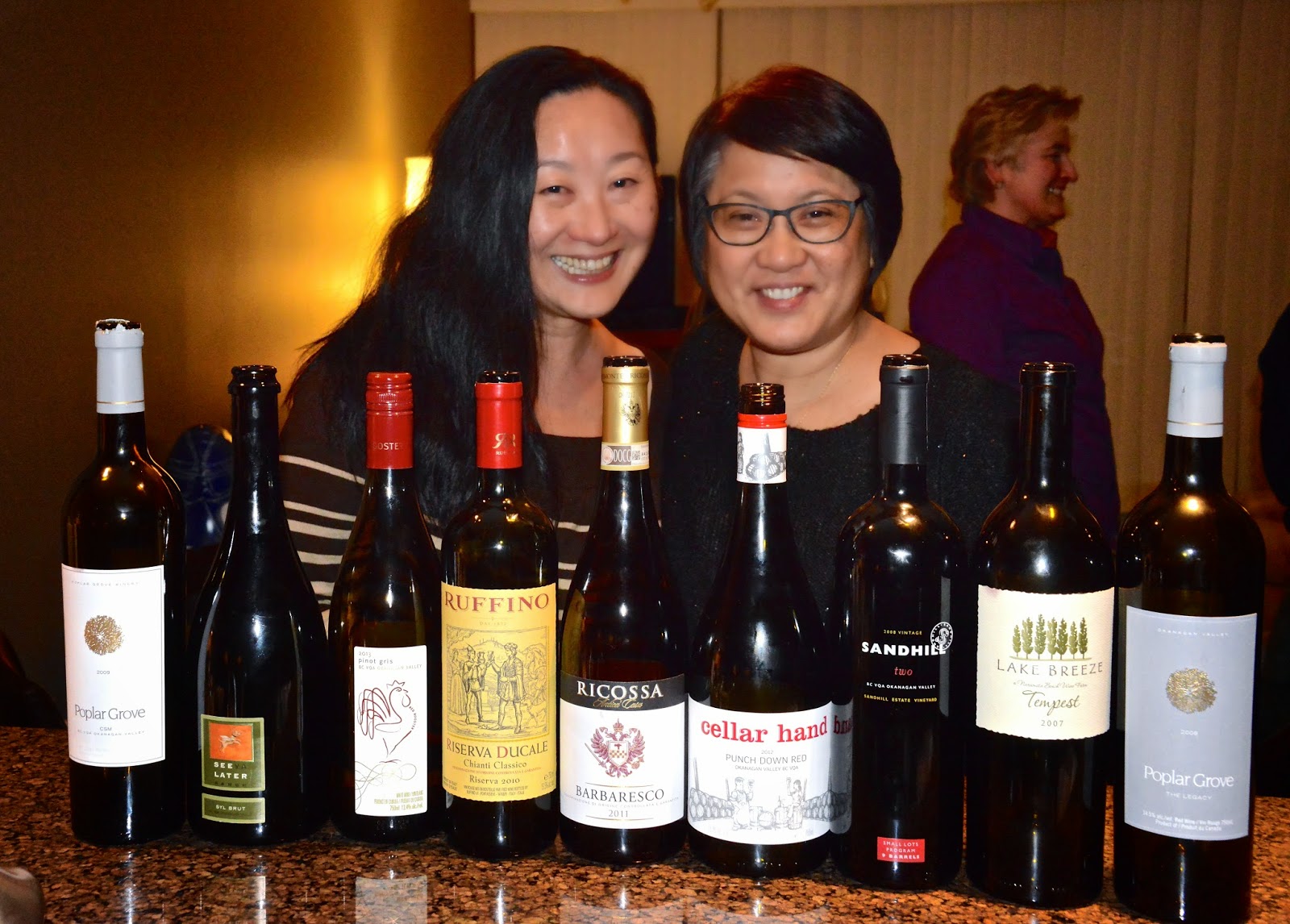
I should have known better than to head over with the intention of behaving myself. I doubt one of Shelback and Chewbacca's soirées will ever be spoken of as having had a shortage of wine - and this evening was no different, as you can tell by the collection of bottles at the bottom of the post. Thing is I'm only adding two bottles to The List because, while I had small tastes of most the wines offered, I limited my second pours to these three - and one of them has already been downed and counted.

N.V. See Ya Later Ranch - SYL Brut (VQA Okanagan Valley)

I suppose it shouldn't be too surprising that it's the bubbly that I've previously been intimate with - on a couple of occasions. The SYL Brut is non-vintage; so, the rules of this game (such as I've declared them) is that a non-vintage wine can only be added once - even if the wines themselves almost certainly came from different years. Interestingly enough, one of those earlier bottles of SYL was savoured with much of tonight's crowd a couple of BCWAS Bus Tours ago. The bottle that actually made The List, however, was at the 2012 neighbourhood Dine Around (and I just wrote about this year's party a couple of posts ago).

I don't think one should never complain about a second (or third) pour of the same bubbly though - particularly during the holiday season.

1827.  2011 Ricossa - Antica Casa Barbaresco (DOCG Barbaresco - Piedmont - Italy)

It's somewhat ironic that the Ricossa Barbaresco can also be found already on The List but that was back at #902 and it the 2005 vintage. Thus, I get to add this new vintage. Maybe it was just the setting but this Barbaresco seemed a whole lot lighter in body and flavour than that earlier bottle did. We all commented on how surprising it was that the other wines were all proving to be much bigger than the Nebbiolo-based juice. We've all been trained to expect boisterous wine when sipping Barbaresco but this seemed more like a big Pinot or Gamay.

It couldn't have been that bad, however, I did go back for a second glass after all. I suppose there's as much good to be found in red fruit as there is in brooding, dark fruit - especially when paired with salami and charcuterie.

1828.  2008 Poplar Grove - The Legacy (VQA Okanagan Valley)

The Poplar Grove Legacy was three years older than the Barbaresco but it still tasted like the much bigger wine. Being a Cab-based blend, you might think that comes into play - but we are talking 55% Cab Franc, not Cab Sauv. There is some Cab Sav being served up but it's only 19%. The remaining quarter balance of the blend is Merlot. Reading the line-up in advance, you might have expected a lighter bodied wine. Then again, it is from Poplar Grove and they've never been noted for the lightness of their wines (thankfully).

2008 was a late-starting, but long-lasting, growing season in the Okanagan and the wine seems to have benefitted from the extra hang time. There was a nice balance of fruit, tannin and acid to the wine - although someone must have been anxious to open it because there was plenty of opportunity for further cellaring on this legacy.

I hate to admit it but I was the first to throw my ugly Christmas sweater (which was much admired by all assembled) and take leave of the festivities. Christmas might have been just around the corner but I knew that I had one helluva busy weekend ahead of me.

And on that happy note...


Thursday, November 7, 2013

Franc'ly My Dear, I Quite Fancy this Sip

Seeing as how my last post was a big 2004 BC red, I guess it's only fitting that I follow it up with another from one of BC's foremost wineries. A recent visit to Poplar Grove, while on this year's BC Wine Appreciation Society's Bus Tour, prompted me to take a look to see if we had any bottles that were crying out to be opened.

Luckily, this Cab Franc just happened to catch my ear.

1468.  2004 Poplar Grove Cabernet Franc (Okanagan Valley)

If memory serves, Poplar Grove was one of the first BC wineries to offer a 100% Cab Franc varietal wine. The fact that they still do shows quite the commitment to the grape since the winery focuses on only six wines. Even with that engagement with Cab Franc though, '04 production was limited to 403 cases.

In typical Poplar Grove fashion though, there's no shortage of fruit or body with this wine - even with it being an '04 and having a few years under its belt.

I'm a big fan of Okanagan wineries diversifying their reds away from Merlot - and Cab Franc is seen as a viable option. The grape's ability to handle BC's cooler climate is certainly welcome. And, when you add to that, the fact that the vines get an early start in the Spring which can help with a more consistent ripening of the fruit, it makes sense that more and more of it is being planted in the Okanagan. I still think, however, that, when it comes to the buying public, Cab Franc might be more easily sold as a component in blends than on its own as a varietal wine.

That marketability could well see some upswing if more and more wineries come out with wines as tasty as this one is.

Wednesday, April 17, 2013

Looking Ahead to WBC13 - Week 4 - Fairview Cellars

We're six weeks out from the start of the 2013 Wine Blogger's Conference and it's time for a fourth stop on my little Pre-WBC13 Road Trip through some of my favourite BC wineries. This time round, it's a visit to the top end of the Golden Mile and to Bill Eggert and Fairview Cellars. To get there as you head South of Oliver, you just need to remember to turn right when you see the sign for the golf course. It's important to watch for the golf course because you're likely never going to find the winery if you're relying on Hwy 3 signage. I'm not sure if Bill has finally relented and put up a sign but, from Day 1, he had been deliberately avoiding one. If your wine preferences lie with big reds though, you're going to want to find Fairview.

Fairview is synonymous with Bill and Bill is synonymous with Fairview. It's hard not to be when you've pretty much been a one-man operation for over two decades. And, if there's one common response about Bill from folks in the Okanagan, it's likely going to be that he's about as big a character as there is in the region. "Iconoclast," "Madcap," "Bear," these all might be names of Fairview wines but they're also words that easily come to mind when describing the man himself. Indeed, the "Madcap Red" moniker was born when one of the higher profile wine scribes in Vancouver referred to Bill as the "madcap winemaker." Being the rogue that he is, Bill simply worked the comment into the name of a wine. You only need to ask but there are, naturally, stories behind additional wine names like "Bucket O' Blood" and "Two Hoots."

Born in Ottawa and raised in Northern Ontario, Bill was first introduced to the wine industry while working on his uncle's vineyard near Beamsville on the Niagara Peninsula.  At the time, Inniskillin and Chateau des Charmes were the only small wineries in existence. His uncle grew grapes and sold them to Jordan Wines. Back then, the majority of grapes were still hybrids that were blended with imported juice. "The wines were wonderful, but they had no real attachment to the terroir" and the story goes that Bill had no luck in convincing his uncle to replant the hybrid vines with vinifera grapes.

Bill also worked for a short time at Charal Wines in Ontario before he ultimately made his way out to the Okanagan in 1984. Upon arriving, he worked at Covert Farms (which is now a winery itself not that far from Fairview) but ended up heading back to Ontario for a bit. He returned to BC, for good, in 1986 - the lure of vinifera grapes and better skiing were just too much of a draw.

Bill purchased his own property in 1989, when he found and fancied a six acre parcel with a South-East facing slope, located on an alluvial fan of the Reed Creek and overlooking the first tee of the neighbouring golf course. He began planting grapes in 1993, starting with Cabernet Sauvignon and Merlot - and a bit of Cab Franc since it arrived in his order by chance. His experience in the valley and with growing grapes, generally, convinced him that his land was best suited for the red Bordeaux varieties and he saw no reason to plant white wine grapes when the land was telling him red was the way to go. Financial constraints and water issues made planting a lengthy process, however, and he didn't finish planting the vineyard until '99.

During those early years of setting up the vineyard, Bill found that the biggest obstacles to making wine in BC all revolved around the relative size of the industry. Being such a small industry, the ability to source supplies and information was limited. Luckily, Bill finds that this isn't as serious of a problem nowadays as the industry is maturing and the introduction of technological practices is exploding.

Fairview Cellars finally opened the doors to its wood cabin tasting room in 2000 - although the winery didn't really have tasting room hours.  If you knew about the winery, you could call to see if Bill was going to be around or you could just drive by and honk. If he heard you arrive, he could likely arrange for a tasting.

It didn't take long for Fairview's reputation as one of the best small, premium wineries in the Okanagan to grow as Bill's wines found favour with folks looking for BC reds that had some oomph to them. Fairview only offered reds until the 2006 vintage when Bill was given some Sauvignon Blanc that he vinified. The Sauv Blanc proved to be very popular and he's promised to keep making it as long as the grapes continue to be made available. The Sauv Blanc has yet to be given a catchy name for the label but Bill does refer to it fondly as his "oyster wine."

As much as he likes drinking Sauv Blanc, Bill's admitted that his favourite grape to work with is Cab Sauv. There are certainly those that feel the Okanagan just isn't suited to ripen Cab Sauv on a regular basis but Bill isn't one of them. He'd much rather "listen to the vines, not the wine writers." It may just be that his vineyard is particularly suited to the variety but he finds Cab "easy to grow, easy to ripen and easy to make wine with." He particularly likes the fact that his Cab Sauv's drink well in their youth but are still holding well into their second decade.

There's also plenty of discussion around Okanagan growers focusing on Cabernet Franc as it is seen as an earlier ripening grape than Cab Sauv and Bill originally thought that he might end up growing more Franc than Cab Sauv himself. As much as it might be out of the ordinary though, Bill finds that his terroir lends itself to the Cab Sauv regularly ripening sooner than the Cab Franc and the end result is that he doesn't have a whole lot of Cab Franc planted - although he certainly wouldn't mind having more as he finds that he tends to garner bigger accolades for his Cab Franc varietal wine than he does for his other wines.

1291.  2007 Fairview Cellars Cabernet Franc (VQA Okanagan Valley)

After taking a look at the Fairview Cellars wines we had on hand, I decided to go with a Cab Franc since, in keeping with the raison d'être of this blog, I need - and want - to add a new wine to The List. I would dearly loved to have open a bottle of The Wrath Cab Sauv - likely a one-time only vintage due to the hail storm right around picking time - but I don't think it's quite as ready to open yet. Another time. When you find yourself making a decision on which bottle of Fairview to open, one thing Bill is known for is putting a "Best After" date on his reds. In this case, he advised the the '07 bottle would be "best after Dec 2010." I think we're safe.

The fact that there were only 300 cases of the '07 Cab Franc produced just goes to illustrate how difficult it can be to find Fairview's wines. If memory serves, I ran across this one when Bill was serving it at the Vancouver International Wine Festival a couple of years ago.

If I had to choose a most memorable characteristic of this wine, it would be that the nose just jumped out of the glass and it was stellar. Being Franc, the wine was more nuanced than a big Cab and it tasted better with every bite of our BBQ'd rib-eye. Once the steak was gone, I didn't find that the fruit was as big on the palate as it was on the nose but there's no doubt that the bottle was empty long before we would have liked it to be. Funny that.

Looking back, I remember first hearing about and meeting Bill, some years ago, at one of the Okanagan Spring Wine Festival tastings. We were advised not to miss trying his wines because he was a "winemaker's winemaker." Funny thing is that a healthy number of articles over the years have quoted Bill as refusing to call himself a "winemaker" because he's never had formal training. Rather, he considers himself, first and foremost, a grape grower.

Indeed, when the UBC Alumni Association recently held a panel event titled, "The Grape Debate - Should BC Have a Signature Wine Varietal," Bill was vocal in his disappointment with the fact that neither the pro- nor the con- side of the panel featured a grape grower to discuss the topic. Bill sees the topic as being one driven more by Vancouver media than by growers and winemakers. He doesn't agree with the premise that BC needs to have a signature grape in order to be able to market and export its wines to the world.

For Bill, there are more factors involved in resolving a signature variety than marketing concerns. He advises that "the Okanagan, where a vast majority of the grapes are grown, is a very unique area for many reasons. Its small area, mountainous terroir, soil variability and the long, narrow North/South aspect make it difficult to identify similarities in terroir required to produce a big enough volume of one varietal to call it a signature grape." He continued, "as a result it has always been my humble opinion that BC should celebrate its diversity. We have the ability to grow successfully almost every commercial grape save those grown in extremely warm climates. By celebrating diversity, we also embrace other regions with their completely different terroirs such as the Lower Mainland, Vancouver Island and many of the other small pockets of vineyards popping up around the province."

He posits, is there any economic sense in pushing for a signature grape when the act only seems to elicit a race to the bottom on pricing? Not from his standpoint. He finds it hard enough trying to make a living when you might aim to produce 4000 cases in an exceptional year.

Being a one man show in such a demanding business is a helluva way to make that living; so, Bill has actually changed things up a bit in the last year. He's finally hired a "general manager" to work with him at the winery. Bill's keeping the head winemaker's hat but he's also now referring to himself as Fairview's CEO - a moniker he rather fancies.

The assistance at the winery will also allow Bill to keep up with what's happening in the political realm of the business. He plays an active role in the structure of the BC Wine Institute, currently sitting on the Board of Directors and on a number of committees. The help also comes in handy as Bill is adding to the portfolio by embarking on a Pinot Noir operation with some additional lands further up the valley. With a different terroir and an unfamiliar grape now in play, Bill's encountered a whole new learning experience.

He also looking forward to completing some expansion of the Fairview facilities. He's looking to double the size of the cellar. The expanded facilities will provide him with the opportunity to bring all of his primary fermentation tanks inside where he'll be able to address temperature control and work toward an even more accomplished end product in the bottle.

And, speaking of a favourable end product, when asked if he had the opportunity to serve any one of his wines to all of the WBC13 participants, what would it be, Bill said that he'd love to serve up either his Cab Sauv or his Bear (Cab/Merlot blend) from the 2005 vintage. He doesn't think they're showing at their peak yet but he does think that they show what can be done with Cab Sauv in the Okanagan. He considers 2005 to be the best vintage in BC since 1994 and is pleased that the wines are showing particularly well - thanks to his vines being that much older and his collective understanding of vineyard characteristics and the winemaking process being a decade stronger. He believes that the '09 and '12 vintages are also excellent but that the wines just haven't had enough time to mature yet.

As you might imagine, the man and his wines are quite intriguing - if not downright fascinating. His involvement in social media is tempered for the time being. He has a limited presence on Facebook and you can find him regularly enough on Twitter with his @FairviewCellars handle - particularly if there are political issues being discussed online. He's not convinced that social media does much to increase sales at the winery though.

If you run across him during WBC13 - or otherwise - and want to hear some first-hand tales, you can't go wrong if you show up with "any Scotch over 15 years old." Not to say that he wouldn't be open to other options. I think it's safe to say that it'd be worth your effort.

Wednesday, April 3, 2013

A Second Look Ahead to WBC13 - Tinhorn Creek


Sandra Oldfield. Tinhorn Creek.

Need I say more when it comes to BC wine and social media? As such, I think it only makes sense to pay a virtual visit here for my second stop at a BC winery as we lead up to WBC13.

If you're a blogger who's attended a previous Wine Bloggers Conference or you're intent on making your way to the 2013 Wine Bloggers Conference - or even if you just immerse yourself in the social media side of wine - you're probably well acquainted with @SandraOldfield and her blog, Oldfield's Wanderings, She's prolific. She's interesting. She's responsive. When you add in she's full time mom, I swear she must be the busiest woman in the business. And she happens to make some fine wine to boot.

Sandra started out as a California Girl. She grew up there and completed her Masters in Enology at UC Davis. It was there that she met her future (and current) husband, Kenn Oldfield. Once the schooling was completed, Sandra joined Kenn when he returned to Canada and the Oldfields established Tinhorn Creek with their business partners - Calgarians Bob and Barbara Shaughnessy. The Oldfields arrived back in BC in 1994. During the intervening nineteen vintages, the four partners have built the winery from nothing into one of the most dynamic operations in the province.

Moving to a new country and to a fledging wine region had to have caused some trepidation for a woman who had previously worked for California's Rodney Strong Vineyards and did the leg work for her Master's thesis in Robert Mondavi's To-Kalon vineyards. She called the Mondavi experience a once-in-a-lifetime opportunity; however, Sandra also advises that when she "first saw the Okanagan stretched out before me, it was not a difficult decision. It is simply spectacular up here and a new wine industry that I could grow with was right up my alley."

The Okanagan's experience with growing European vinifera grapes really only started in 1988 with the introduction of the Free Trade Agreement between Canada and the US. Prior to that the Okanagan was primarily planted with hybrid vines or even old lambrusca grapes. Accordingly, the Oldfields and Shaughnessy's put that UC Davis schooling to test when deciding what grapes to plant in their two vineyards - found between Oliver and Osoyoos. They knew that they only wanted to rely on estate-grown grapes. They also knew that they wanted to focus primarily on red wines - there was just that feeling that it might be too challenging to ripen Cabernet Sauvignon in the Okanagan. So, they planted Merlot, Cabernet Franc and Pinot Noir. For whites they planted Chardonnay, Pinot Gris and Gewürztraminer. Be it global warming or not, weather patterns have changed enough that the folks at Tinhorn have added sections of the later ripening Cab Sauv, Syrah and Viognier, plus a bit of Sauvignon Blanc and Sémillon.

Although hardly exhaustive, they have a good selection of varieties to work with. The flip side, of vourse, is that there has been plenty of speculation in the press in recent years as to whether or not BC needs to focus on a specific grape varieties - or grape varieties - if the industry ever wants to garner a bigger global reputation. Sandra's take on the debate is that the Okanagan is far from being "one homogenous area." She notes that neither Pinot Noir nor Riesling thrive in the Southern part of the valley where Tinhorn is found and, similarly, the Northern parts of the valley around Kelowna find it difficult to ripen red varieties (with the exception of Pinot Noir). Far from wanting to see the local industry pigeonholed like a Kiwi Sauv Blanc or an Argentine Malbec, Sandra loves that the Okanagan, with its range of micro-climates, is still in "high experimental times" and notes, furthermore, that the main markets the region is serving love the diversity of wines that are available.

Despite her love of variety in the vineyard, there's no doubt that Sandra has become a bit of a spokesperson for Cab Franc. She was a pioneer in BC when she insisted on those original plantings and Tinhorn has probably been alone in having made a varietal wine since 1996. As a testament to her perseverance, a couple of years back, Sandra delivered one of the BC Wine Appreciation Society's more memorable tastings when she shepherded BCWAS members through a 12 vintage vertical tasting of her Cab Franc - every vintage that had been released to date from the first vintage in 1996. The tasting even included some of the difficult 1999 vintage that Sandra referred to as her "Jesus wine." I no longer have my notes from that tasting but local wine luminary, Sid Cross, wrote that Sandra called the wine that because "it started out as bad green beans but with age has turned into an unusual orange peel chartreuse like wine - Jesus turning water into wine." She also admitted that the '99 vintage almost made her turn her heels and head back to California.

Luckily for us, she decided to stick it out though and, earlier this year, Sandra took to Twitter to proudly announce the first release of a reserve level 2010 Oldfield Series Cabernet Franc. The wine is a single block beauty from their Diamondback Vineyard on the Black Sage Bench and it was one of the wines Sandra poured this year at the Vancouver International Wine Festival. Folks needed to jump quickly if they liked it, however, because only 374 cases were made.

If anything, Sandra is heartened by the fact that Cab Franc is generating "great buzz" in BC - as are lightly oaked Chardonnays and Syrahs that are starting to reveal distinct regional variations. But, if she could serve one wine to all the incoming WBC13 attendees, it'd be her Cab Franc. In addition to the variety's ability to facilitate her desire to capture and evoke the unique terroir of the region - that of sage-covered desert - she'd love the opportunity to tell a story about Cab Franc from a "vineyard, cellar and social media aspect." Indeed, she's been working at this already. The team at Tinhorn followed one vine of Cab Franc over the past year and, in conjunction with an Ontario producer that did the same thing, discussed "the 2012 season through the use of those two vines" weekly for six months. You can visit Sandra's blog and click on the #CabFrancTuesday 2012 tab to read her comments and follow the vine's progression through photos. I understand that she's about to start a second journey with #Gewsday (Gewürztraminer Tuesday).

When it comes to adding a bottle of Tinhorn Creek to The List with this post, it might seem natural to open a bottle of Cab Franc - especially since I have a couple bottles of that 2010 Oldfield's Reserve - but that Oldfield's is just a baby and I'm going to let it lay for awhile. Sandra and Tinhorn also produce a series of blends - their 2Bench Red and 2Bench White - that I'm very fond of and I think one of them will satisfy just as well.

1279.  2009 Tinhorn Creek Oldfield Series 2Bench Red (VQA Okanagan Valley)

The 2Bench White has been part of the Tinhorn portfolio for a longer time than the Red but I happened to have a bottle of the Red at home. The 2009 2Bench Red is only the third vintage of Sandra's Bordeaux or Meritage blend for the premium series and this year's blend is 45% Merlot, 30% Cab Sauv, 22% Cab Franc and 3% Petit Verdot. This is also still a young wine but we allowed the bottle to breathe and took our time with it. Our patience was definitely rewarded in that the wine opened up noticeably and the tannins retreated some into the bright, dark fruit.

I suppose if I'm ever to finish this post before WBC13 actually arrives, I'd best make a few final points and call it a day. There is plenty to write about, however. Perhaps I should consider doing my own Master's dissertation on Sandra.

I'd be remiss if I didn't mention Tinhorn's efforts in sustainability and innovation. Tinhorn was the first winery in BC to try bottling wine with Stelvin screw cap enclosures when they bottled a portion of their 2001 Merlot. They introduced a sharp, two-bottle package that contained one bottle finished with cork and the second topped with the screw cap. It was novel and an effective way to show the BC market that the Stelvin closure could arrive in a good way and it let consumers see first hand if they found any difference. The winery carried forward from there and was also the first to bottle its entire portfolio with Stelvin caps.

The winery was additionally the first in Canada to be declared "carbon neutral" and it makes extensive efforts in composting, using biodiesel fuel and water conservation - among such other activities as habitat preservation.

The opening of Miradoro Restaurant at the winery, in April 2011, created quite a buzz in the Valley as it heralded a joint venture with two top names from the Vancouver restaurant scene. Being named, by Wine Access Magazine, as one of the "World's Best Winery Restaurants" only helped make Tinhorn even more of a destination winery. And that doesn't even take into account the winery's 350-seat amphitheatre that spectacularly overlooks the valley and plays host to a series of outdoor summer concerts.

One thing that doesn't come to mind when thinking of Sandra is shyness. The lady doesn't seem to have a problem when it comes to speaking her mind and I quite loved all the press she received last year as the debate over shipping wine across provincial boundaries was growing into a bit of a brouhaha. Sandra upped the ante by showing it's easier to order a firearm and have Canada Post ship it half way across the country than it is to order a case of wine and ship it to another province. It was legal for Sandra to order her first firearm - a Maverick 88 shotgun - and find it delivered four days later. It was not legal, however, for anyone to order a case of Tinhorn wine and have it shipped outside of BC. Steps are slowly being made on that front but I'm quite sure Sandra could give a tip or twelve to provincial bureaucrats when it comes to legislative regulations.

In fighting her good fight, Sandra has utilized social media to great effect and she launched #BCWineChat as a means of discussing topics near and dear to industry insiders and BC wine aficionados. BC WineChat and its 8-9 p.m. timeslot on Wednesdays is now a fixture on Twitter - regularly trending as a topic in BC and Canada - to the point where a recent Oysters and Wine topic attracted "porn-bots" en masse.

I'll end with Sandra's response to the question of whether there is any particular aspect of or fact about BC winemaking that she'd like visiting bloggers and guests to learn or be exposed to. She stated that, "I'd like them to focus on wines other than Icewine and not come with too many preconceived notions about us. I'd love for them to explore the touring aspect we have here - a beautiful area with many wineries and lot of other activities to do as well. it is a great place to go for a vacation. Lastly, there are many opportunities to combine touring with eco-tourism and agri-tourism that make BC so unique. There are wineries with major investments here - small and large and every size in between - so we are working hard at building on something here that will last." That about sums it up, doesn't it?

Speaking from experience, BC's oft-proclaimed "Twitter Queen" and Tinhorn Creek are well worth catching up with - and, should you run into her at WBC13, you can likely keep her willingly engaged by arriving with something Alsatian, a glass of Portugese table wine or a Riesling. You won't regret it.

Saturday, September 15, 2012

A Little Saloon Sally Rosé

1244. Rustico Farm Cellars - Saloon Sally Dry Cabernet Franc Rosé (Okanagan Valley)

Friday, September 14, 2012

Nichol Vineyard Cab Franc

1243.  2003 Nichol Cabernet Franc (Okanagan Valley)

Tuesday, September 20, 2011

A Friday BCWAS Happy Hour

After a full day of pre-bus tour training, I could have easily flopped down in front of the TV or hit the hot tub and simply begged off the rest of the evening. The BCWAS gang had pretty much arrived at Walnut Beach by now, however, and a little unofficial meet and greet for fellow "Tourers" had been planned.

It was a good thing that I drag my tired self down the hallway because there was a fine spread of nibblies and wines to be had - and it was a grand opportunity to put some names to some of the approximately 50 folks that I'd be spending the weekend with. Regular BCWAS tastings don't necessarily offer the best of opportunities to chat with and get to know your neighbour - or you tend mingle with the folks that you already know.

This was my first Bus Tour and it was a bit surprising to find out the high percentage of tour veterans that were in attendance. Indeed, one of the returning members, Donnell, had won a grand 3L bottle at last year's Tour of the Naramata Bench. He was gracious enough to bring it and open it up for this year's busmates.

925. 2008 Naramata Bench Spring Release Red Blend (Okanagan Valley)

If I got the story correct, this is a wine that you can't buy at any store or winery. The special wine is a collaboration between a collection of winemakers from Bench winemakers and it has only been produced a couple of times for use at fundraising and promotional events. I'm told it's a Bordeaux/Meritage blend and four or five of the Bench's winemakers contribute the various components. There weren't many other details to be had however. I'd love to have an entire tasting to discuss and dissect the wine with all those winemakers (and their egos). I can only imagine the discussions and multiple tastings that must have gone into the wine.

I may not have gotten to try much of the wine, but I'll be darned if I don't add such a unique bottle to The List when the opportunity arises.

926. 2077 Van Westen Vineyard Vrancenstein (Okanagan Valley)

Although the Vrancenstein looks somewhat dwarfed by the Spring Release bottle in the picture, it's a super-sized magnum itself and it sports its own intriguing history. Van Westen owner and winemaker, Rob Van Westen, received a special Christmas present from the girls in his life - a 5L handpainted bottle. His task, however, was to fill the bottle with some of his favourite wine and try to raise as much money as possible for charity.

Since the bottle was to be auctioned off around Halloween, he chose to fill it with his Cab Franc - made from grapes picked on Halloween 2007. Sticking to their tradition of giving all of their wines names that start with the letter "V," they chose Vrancenstein.

When bottling that 5L bottle, he also bottled a limited number of magnums and donated the proceeds from all sales to the BC Children's Hospital.

I hadn't heard of the winery's efforts on this front but I heartily approve and I was glad to be able to sample some of this special bottle as well.

927. 2009 Laughing Stock Syrah (Okanagan Valley)

The third addition to The List tonight is no slouch in its own right. The 2009 bottling was only the second vintage of Syrah that Laughing Stock has produced and they've taken a very Northern Rhone-like approach to the wine in that they've blended the Syrah with 8% Viognier. This was at least a bottle that you could buy; however, you'll notice the tense on "was." The vintage is sold out at the winery already.

This Laughing Stock was served at the BCWAS Syrah/Shiraz tasting back in June, but darned if I could find any notes from the evening. I'd love to see what I thought of the wine that evening because I could have kept filling up my glass tonight.

There were plenty more bottles opened through the evening, but I played it fairly tame since I knew we had a full day - involving plenty o' bus riding - and it was scheduled to start in the not too distant future. I rather gathered, however, that if you judge your company by the wines they serve up, I was in with some pretty impressive folk. As fine of a time that I might have been having with the Naramata Bench tonight, Oliver and environs was calling.

Wednesday, September 7, 2011

Nichol Cab/Syrah

Another quick grab from the cellar. As Boo "gently nudges" me towards drinking more of the wines that we have stored away, I find myself reaching for some of the "older" vintages that we've been holding off on.

An '04 hardly counts as a fully aged wine, but I think we'll likely see more and more BC wines from the early to mid- years of the 00's as he tightens the "No Buy Leash."

916. 2004 Nichol Vineyard Cabernet-Syrah (Naramata Bench - Okanagan Valley)

John Schreiner writes that it was Labour Day 2004 that current Nichol owner and winemaker, Ross Hackworth, started negotiations to buy the winery from Alex and Kathleen Nichol. The grapes for this wine wouldn't have been picked much after the start of that fateful deal.

After a quick look, I couldn't find a breakdown of the blend on this wine, but the label states that it is "estate grown." As such, I think the "Cabernet" must refer to Cab Franc because I'm not aware of Nichol ever having planted Cab Sauv on its Naramata Bench vineyards. They have, however, produced a Cab Franc for years and, as reported elsewhere in this blog, the Nichols were the first to plant Syrah vines in the Okanagan (much to the derision of many). I see that the winery currently has a Cabernet Franc/Syrah blend; so, I think this must have been an early pre-cursor to the wine.

A guess might be that most BC consumers wouldn't have known what a Cab Franc was back in 2006 when the wine was released. So, they just left off the "Franc" part for marketing purposes. How times change.

I do know that the 2004 Nichol Syrah won an '07 Lieutenant Governor's Wine Award. So, at least a good portion of this Cab-Syrah has a pretty healthy pedigree.

If this bottle is any example of what's to come, I may get to like this "arm-twisting" of Boo's to drink more of the wines we already have.

Tuesday, July 5, 2011

The Century is Made!

I've mentioned the Wine Century Club a number of times on this blog. I hadn't heard of the group prior to starting, but, as soon as I learned about it, I set my mind to making it an exciting part of 2001 Bottles - A Wine Odyssey. The concept is simple enough - keep trying new wines, new regions and new varietals and keep track of the different varietals you've tried. Once you've tried 100 different varietals, you can apply to become a member. The club's website say that "of the thousands of applications downloaded, less than 3% are completed."

I'm thrilled to say that I'm now free to send in my application.

Knowing that I was only a varietal or so away from being able to complete my application, I thought it would be a good idea to go over the wines that I've noted on the application form and compare them to ones that I've listed on the Blog Page that I'm also using to keep track (located off on the side panel). In going through those lists, it would seem that there are a few glaring absences.

I'm not entirely sure why I hadn't made a note of Cabernet Franc yet. It would have been one of the varietals that I could have added first to my application. I'm thinking that I must have realized that I could just add it at any time. Knowing that, I might as well hold out for the chance that someone might give us a bottle of something spectacular like a Chateau Cheval Blanc - perhaps the world's most famous wine that focuses on Cab Franc - so that I could add a special wine in my application. The Cheval Blanc doesn't seem to have arrived. So, I'd best go with what I've got - granted, it's not a bad substitute for the big gun Bordeaux. And it's substantially cheaper.

857. 2003 Poplar Grove Benchmark Cabernet Franc (Naramata Bench - Okanagan Valley)

Being North of the 49th Parallel, successfully ripening some of the big red varietals can be a task. Merlot may still be the most widely planted red varietal in BC and many growers may not even attempt the later-ripening Cab Sauv, but more than a few wine professionals in the province think that Cabernet Franc has a real future in the region. The varietal is still grown primarily for blending, but more and more wineries are starting to produce a varietal wine and, IMHO, this is one of the best.

Poplar Grove was one of the first Okanagan wineries to cotton on to the potential of Cab Franc as a single varietal. I don't think you would have found too many varietal wines being produced back in 2003 and, even with his early enthusiasm for the varietal, winemaker Ian Sutherland only made 320 cases of this Benchmark wine.

Luckily for us, the wine was still fresh and packed a good punch for a round of Memphis Blues take-out BBQ. 2003 was great vintage for the Okanagan and these vines were cropped at a mere one ton per acre (compared to other vineyards with yields of four tons per acre). The wine showed the complexity that is possible with Cab Franc and it was wonderful way to add the 100th varietal to my application form.

Now to start working on hitting 200 varietals.