Showing posts with label Tempranillo. Show all posts
Tuesday, August 11, 2015
Retro Drinks and Faded Eccentrics
I suppose it goes without saying that all "naughty weekends" must come to an end. We'd reached our final night in NYC and, for the last dinner out, we decided to go old school and visit El Quijote at the historic Chelsea Hotel. Who wouldn't be intrigued when their guide book (in our case City Secrets - New York City) has two separate entries, the first exclaiming that "the Quijote is a survivor, and the better part of its patrons - writers, catalog models, hospital workers, legitimately eccentric denizens of the Chelsea Hotel - appear to be among those who have gone too far down their chosen road to contemplate coming back...[and is] the best spot to take in the underlit defunct elegance of the place."
The second entry extols that the restaurant and bar are "one of those places where 'old' New York isn't re-created - it simply never left...The spirits collection includes crème de menthe, Dubonnet, and sloe gin - things you'd think no-one has ordered in years until the night you come in here for a perfect Manhattan and you see a woman of tattered beauty - maybe a 1948 Miss Nassau County or a former showgirl nursing one of those retro drinks in the curve of her arm."
The lure of a renowned paella didn't hurt either.
1971. 2014 Bodegas Faustino VII Tempranillo Rosado (Rioja DOC - Spain)
I just know that, if there's some variation of squid or calamari on a menu, Boo will order it. With chorizo and paella completing our dinner table, I figured a Rosé would be a nice fit. There was something about the deep pink hue of the wine that just seemed to say that the wine belonged here. The acidity was noticeable and helped counterbalance the richness of our chosen dishes. While not as elegant as the Whispering Angel we drank yesterday in the park, we had no problem finishing the wine long before we had to call it an evening with our paella.
Like the vintage cocktails that were hailed in our guide book, Faustino wines could very well have been served here at El Quijote for decades. The Chelsea was built between 1883 and 1885. Faustino has been making wine for over 150 years and the restaurant opened its doors in 1930. Something tells me that Rosados have been on the wine list here regardless of the favour or disdain Rosé wines may be experiencing at any given time.
It was a unique glimpse at New York and the vibe certainly lent itself to the conclusion of a naughty weekend. It also left us with a craving to make our way back to NYC, hopefully sooner than later.
Tuesday, February 10, 2015
Don't Mess With Texas
Being a West Coast kind of guy, I think you can forgive me if my first thoughts of American wines drift to California, Washington and Oregon. Even beyond West Coast wine regions, I can't say that Texas is foremost on my radar. After all, I've run across and tasted New York and Virginia wines previously and I've even visited a North Carolina winery, but I'm always eager to try wines from unexpected sources and our neighbours, Songstress and Cycle Dude, came home from a quick trip to Dallas and brought back a bottle of Texan wine for us.
It took a little research to learn that Texas has a long history in winemaking. Not surprisingly, early winemaking related to the arrival of Spanish missionaries and they have left records that date from the 1650's. As with most of the States, the advent of Prohibition pretty much decimated the Texan winemaking industry but a re-introduction of wineries began in the 1970's and the state has seen a steady expansion since that time.
Today, there are over 280 wineries in Texas and, by volume of wine produced, it is the fourth-largest wine producing state in the US, behind California, New York and Washington - although I did see one magazine post in TexasMonthly that noted not all Texan wineries make wine from purely Texan-grown grapes. They then point out that to qualify as a "Texas Appellation" wine, only 75% of the grapes need to be grown in the state.
Cab Sauv and Chardonnay apparently lead the way in acreage planted but Texas Wine Lover blog reports that Tempranillo is a "very popular wine in Texas." Indeed, TexasMonthly also reports that Tempranillo has "become a sort of signature red grape at many Texas wineries."
As such, it was with great interest that we pulled the cork on the bottle at hand.
1859. 2013 Becker Vineyards Tempranillo (Texas)
Becker Vineyards opened in 1996 and is in the Texas Hill Country appellation, located near Austin in central Texas. Area-wise, the appellation is the second largest AVA in the United States; yet, even still, less than 800 acres are planted with grape vines. Accordingly, there may be quite a lot of potential for expanded plantings and increased production.
Although Becker started off small as a 1500-case winery, they proudly point out that they have already seen their wines served at both the White House and at James Beard House. Their annual production has also grown to just over 100,000 cases as they offer around 20 different wines that cover quite an array of grape varieties and blends. From what I could tell on their website, it appears that all their wines are made entirely from Texas grapes.
The good news is that the wine didn't scare us away from Texan wine. I'm not sure that I would have identified it as Tempranillo if I'd been served it blind but, then, the grape can show a wide range of characteristics. Just look at the sweep of flavour profiles you can encounter with Spanish Tempranillo varietals - and Spain is pretty much seen as the starting point for Tempranillo wines. The Becker was definitely on the lighter, fruitier end of the scale but it took us no time to finish off the bottle.
While searching online for some information on the winery and region, I was pleased to read a Texas Wine Blogger post on the "Battle of the Texas Tempranillos" where Becker finished 4th in a field of 28 Texan Tempranillos. It was also the only bottle priced below $30 that made it in the top seven. So, it would appear that Songstress and Cycle Dude zoned in on a pretty decent bottle.
One of the more interesting quotes I ran across online was accredited to a tasting room manager from one of the region's wineries, which stated that "We are Napa Valley 30 years ago, as far as the growth and the expansion of the vineyards goes...We are finding the grapes that are good for Texas and it's just going to get bigger and better."
I'm pretty sure that I won't still be blogging in another 30 years. So, don't put it in your calendars to check back in a few decades to see if I've managed to snag some more Texan wines and what I might be thinking at that time. I would, however, like to keep an eye out for some additional wines to try and get a better taste and feel for the bigness that is Texas. I was certainly glad to get the chance for this initial try.
It took a little research to learn that Texas has a long history in winemaking. Not surprisingly, early winemaking related to the arrival of Spanish missionaries and they have left records that date from the 1650's. As with most of the States, the advent of Prohibition pretty much decimated the Texan winemaking industry but a re-introduction of wineries began in the 1970's and the state has seen a steady expansion since that time.
Today, there are over 280 wineries in Texas and, by volume of wine produced, it is the fourth-largest wine producing state in the US, behind California, New York and Washington - although I did see one magazine post in TexasMonthly that noted not all Texan wineries make wine from purely Texan-grown grapes. They then point out that to qualify as a "Texas Appellation" wine, only 75% of the grapes need to be grown in the state.
Cab Sauv and Chardonnay apparently lead the way in acreage planted but Texas Wine Lover blog reports that Tempranillo is a "very popular wine in Texas." Indeed, TexasMonthly also reports that Tempranillo has "become a sort of signature red grape at many Texas wineries."
As such, it was with great interest that we pulled the cork on the bottle at hand.
1859. 2013 Becker Vineyards Tempranillo (Texas)
Becker Vineyards opened in 1996 and is in the Texas Hill Country appellation, located near Austin in central Texas. Area-wise, the appellation is the second largest AVA in the United States; yet, even still, less than 800 acres are planted with grape vines. Accordingly, there may be quite a lot of potential for expanded plantings and increased production.
Although Becker started off small as a 1500-case winery, they proudly point out that they have already seen their wines served at both the White House and at James Beard House. Their annual production has also grown to just over 100,000 cases as they offer around 20 different wines that cover quite an array of grape varieties and blends. From what I could tell on their website, it appears that all their wines are made entirely from Texas grapes.
The good news is that the wine didn't scare us away from Texan wine. I'm not sure that I would have identified it as Tempranillo if I'd been served it blind but, then, the grape can show a wide range of characteristics. Just look at the sweep of flavour profiles you can encounter with Spanish Tempranillo varietals - and Spain is pretty much seen as the starting point for Tempranillo wines. The Becker was definitely on the lighter, fruitier end of the scale but it took us no time to finish off the bottle.
While searching online for some information on the winery and region, I was pleased to read a Texas Wine Blogger post on the "Battle of the Texas Tempranillos" where Becker finished 4th in a field of 28 Texan Tempranillos. It was also the only bottle priced below $30 that made it in the top seven. So, it would appear that Songstress and Cycle Dude zoned in on a pretty decent bottle.
One of the more interesting quotes I ran across online was accredited to a tasting room manager from one of the region's wineries, which stated that "We are Napa Valley 30 years ago, as far as the growth and the expansion of the vineyards goes...We are finding the grapes that are good for Texas and it's just going to get bigger and better."
I'm pretty sure that I won't still be blogging in another 30 years. So, don't put it in your calendars to check back in a few decades to see if I've managed to snag some more Texan wines and what I might be thinking at that time. I would, however, like to keep an eye out for some additional wines to try and get a better taste and feel for the bigness that is Texas. I was certainly glad to get the chance for this initial try.
Friday, June 13, 2014
Let The Games Begin!
The World Cup has kicked off in Brazil and I suspect my life is going to be rather soccer-centric for the next month - not that I really have that much invested in the event this time around. Once again, our Canadian team has been left on the sidelines, but I do have the office pool to get excited about. And, I suspect that living just off The Drive, in Vancouver's old Little Italy, will see its share of celebration in the street. The size of the celebrations will definitely depend on which teams stay in the race and for how long. Historically, street closures are only needed for the biggest of wins by countries like Italy and Portugal - countries with plenty of ex-pats and presence on The Dive - and superpowers like Brazil and Argentina.
I just realized that, for the last World Cup in 2010, I held a little World Cup of Wine for the blog. That approach of matching the event to the blog totally slipped my mind in the build up to this year's tournament; so, there ain't gonna be anything so adventurous this time around. (Guess I must have had more time on my hands back then.) I think the best I'll manage with this World Cup is to pull the corks on bottles from countries that are playing that day.
Today's opening game is Brazil vs. Croatia. There's only one Brazilian wine available in the Vancouver market and I've already popped the cork on that Moscato bubbly and added the wine to The List. Guess there won't be much celebrating with Brazilian wines this tournament. Alternatively, I'd hoped to find a Croatian wine - because I know they make lots - but I couldn't find a single bottle in the three shops that I dropped by, including the specialty government store.
So much for the grand plan. As an alternative option, I decided to open a Spanish bottle seeing as how Spain is the defending champion and is entering this World Cup as one of the favourites. I know that Spanish wines are certainly a favourite around this household.
1627. 2003 Bodegas Roda - Roda I Reserva (Rioja DOC - Spain)
I'm thinking that the Spanish Soccer Federation spares no expense when it comes to the national team. I get the impression that the same is true of Bodegas Roda. Founded only in 1987, the winery is part of the new wave in Spanish wine. Knowing that they were setting up shop in a region that was awash in traditional wineries, partners Mario Rotllant and Carmen Daurella set out with an objective to attain a premium expression that reflected the tradition of Rioja, yet in a modern style.
They started by obtaining - by either purchase or long-term contact - 28 vineyards throughout Rioja. In their quest to make only the finest wines, each year, the grapes from only 17 of those vineyards - deemed the best in that vintage - are used in making the winery's two Reserva wines: Roda and Roda I. The rest of the grapes are sold to other wineries.
The grapes from each of those 17 vineyards are all vinified and aged independently. At the time of blending, they, therefore, have 17 different wines available, each having spent a year in the barrel. Only varieties indigenous to the region - Tempranillo, Garnacha and Graciano - are grown in the vineyards; however, only Tempranillo is used in making the Roda I.
The new venture was noticed for bringing modern techniques into both the vineyard and the winery - such as introducing Rioja's first sorting table, vinifying the wines in temperature controlled oak vats and ageing them in 100% French oak barrels. With the two Reserva wines, Roda is noted for lots of red berry fruit that is meant for immediate enjoyment, whereas Roda I features blacker fruit and a deeper, more complex nose and mouthfeel.
I wouldn't say that our Roda I hits some of the in-your-face standards of fruit and mouthfeel that some New World wines do, but that can be a good thing. I'll liken it to strategy on the soccer pitch. If you put all your energy into your attacking game, you might find yourself suspect in the defensive half. I like that the winery has straddled both New and Old World sentiments - both offence and defence, if you will. Now, let's see if the Spanish team can match the result at the World Cup.
If they do so, we could be drinking a lot of Spanish wine over the next so many weeks.
Saturday, December 14, 2013
A C&C Christmas
In what's become a bit of a tradition, the gang from work gathered for a holiday dinner party at Ciao Bello for some laughs and many a plea for everyone to "Mangia. Mangia."
It's always a bit of a surprise to find out what wines The Boss has picked for the night. I made the wine arrangements for a couple of years but Boss has taken a bit of a shine to wandering the aisles at the liquor store to come up with an array of wines - particularly when he thinks that he has some choices that will surprise me a bit. I totally appreciate the fact that he checks the blog before making a purchase so that I get the chance to add some new bottles to The List - as well as join in with the troops.
1485. 2012 Masi Masianco (Pinot Grigio e Verduzzo delle Venezie IGT - Italy)
I cottoned onto one of the whites The Boss picked - forgetting that I'd bought a bottle for home myself - because I saw that it was a blend featuring the Verduzzo grape. Since Verduzzo Friulano is definitely a new grape for my Wine Century Club tally, I'm not going to care that I could have zeroed in on a different white and saved this one for quaffing at home. When it comes to increasing my grape variety tally, sooner is always better.
Masi has been making the Masianco blend for a decade now and they refer to it as their white "Supervenetian" and a counterpart to Masi's well known red "Supervenetian" wine, Campofiorin. I gather it is the blending of these two grapes that takes this wine out of the more historically approved D.O.C. wines and into IGT territory. I understand that the wine does very well for Masi and I guess that this might just go to show that innovation can have its place even among regions caught up in centuries' worth of tradition.
Another different aspect in the production of Masianco is that the Verduzzo grapes (which make up about a quarter of the wine) undergo some additional drying out - the "appassimento" method - to enhance and concentrate the body, flavours and aromas. This approach doesn't appear to be unique to Masi as the grape is also used by regional producers to make a sweeter dessert wine. An alternative method that leads to a similar result is that the grape's growers will leave the bunches hanging on the vine to bring in for a late harvest wine. There are, apparently, some wineries making straight, dry varietal wines with Verduzzo but I don't think many of them travel much. Jancis Robinson's "Wine Grapes" states that the grape is grown primarily in North-East Italy (with a couple small pockets in Slovenia and one producer in Australia) but that overall plantings are gradually declining.
Good thing I'm adding it to my tally now.
Unfortunately, our dinner group was missing a few of our bigger personalities this year. As such, there was no Bollywood-style bhangra or dancing on the tables. In fact, there was no dancing at all. Just plenty of eating and drinking and moving from table to table in between courses.
Some of our colleagues were a little more adventurous than they might usually be with their drinks over the evening. So, I introduced a handful of them to dirty martinis, to the joy that is Prosecco and a couple braver souls to a Prosecco Spritzer when I saw a bottle of Aperol at the bar. It's getting to be common enough now to find Aperol in Vancouver bars and restaurants. Hard to believe that it was only five years ago that Boo and I came home from Venice and couldn't find a bottle anywhere in the city.
Despite making suggestions to other folks, I was good and stuck to wine though.
1486. 2010 Emilio Moro Bodegas - Finca Resalso (Ribera del Duero - Spain)
The second bottle being added to The List saw The Boss veer a bit away from his almost "all-Italian" selection for the evening - by adding in a Spanish wine that I hadn't run across before. He said that he wanted to grab it because it's supposedly a rare find in Vancouver. The wine is apparently the entry level wine for Emilio Moro Bodegas and it's made from 100% Tinto Fino (another name for Tempranillo) in the Ribera del Duero region. The wine is named for the Finca Resalso vineyard that has been in production since 1933; however, the grapes for this wine are from the vineyard's youngest vines - being between 5 and 15 years of age.
The Moro family itself has been involved in the winemaking business in Ribera del Duero for three generations now but they've only been releasing their wines under this brand since 1982.
I'm not sure that our Italian server was impressed much by a Spanish wine on the table but I think this was probably my fave for the night. Bigger and fruitier than many of the entry level Tempranillos I tend to run across, maybe the Italians should be a little worried.
1487. 2011 Barone Ricasoli - Campo Ceni (Toscana IGT - Italy)
I was intrigued to see that The Boss brought along a Ricasoli wine as well since Boo and I had opened a bottle not too long ago. This was more of an entry level wine though. I'd grabbed a higher end bottle from (if memory serves) the Vancouver International Wine Festival and it was way bigger than this one.
Don't be fooled by the fact that I took a picture of the bottle with my tiramisu. I'd been drinking the wine earlier in the evening and I'd just forgotten to take a picture for the blog. I wouldn't exactly recommend the Campo Ceni with tiramisu though. It wasn't the worse combination ever but I think you could easily come up with a better pairing. Like the coffee I was now sipping on.
The Super Tuscan - Sangiovese, Merlot and Cab Sauv blend - didn't go over incredibly well at our table. People tended to gravitate to other options. I didn't mind it myself but entry level Sangiovese isn't generally my first wine of choice.
I think The Boss had a much bigger list of wines but I just didn't get around to checking out the others. Boo had experienced a tough day at work and he asked that we head out a little earlier than I might have usually. I likely would have been able to add another bottle to The List but sometimes a clear head in the morning is worth that lost bottle.
Besides I'd already received my early Christmas present by being able to add grape #166 to my Wine Century Club tally. The rest of the evening was all bonus.
It's always a bit of a surprise to find out what wines The Boss has picked for the night. I made the wine arrangements for a couple of years but Boss has taken a bit of a shine to wandering the aisles at the liquor store to come up with an array of wines - particularly when he thinks that he has some choices that will surprise me a bit. I totally appreciate the fact that he checks the blog before making a purchase so that I get the chance to add some new bottles to The List - as well as join in with the troops.
1485. 2012 Masi Masianco (Pinot Grigio e Verduzzo delle Venezie IGT - Italy)
I cottoned onto one of the whites The Boss picked - forgetting that I'd bought a bottle for home myself - because I saw that it was a blend featuring the Verduzzo grape. Since Verduzzo Friulano is definitely a new grape for my Wine Century Club tally, I'm not going to care that I could have zeroed in on a different white and saved this one for quaffing at home. When it comes to increasing my grape variety tally, sooner is always better.
Masi has been making the Masianco blend for a decade now and they refer to it as their white "Supervenetian" and a counterpart to Masi's well known red "Supervenetian" wine, Campofiorin. I gather it is the blending of these two grapes that takes this wine out of the more historically approved D.O.C. wines and into IGT territory. I understand that the wine does very well for Masi and I guess that this might just go to show that innovation can have its place even among regions caught up in centuries' worth of tradition.
Another different aspect in the production of Masianco is that the Verduzzo grapes (which make up about a quarter of the wine) undergo some additional drying out - the "appassimento" method - to enhance and concentrate the body, flavours and aromas. This approach doesn't appear to be unique to Masi as the grape is also used by regional producers to make a sweeter dessert wine. An alternative method that leads to a similar result is that the grape's growers will leave the bunches hanging on the vine to bring in for a late harvest wine. There are, apparently, some wineries making straight, dry varietal wines with Verduzzo but I don't think many of them travel much. Jancis Robinson's "Wine Grapes" states that the grape is grown primarily in North-East Italy (with a couple small pockets in Slovenia and one producer in Australia) but that overall plantings are gradually declining.
Good thing I'm adding it to my tally now.
Unfortunately, our dinner group was missing a few of our bigger personalities this year. As such, there was no Bollywood-style bhangra or dancing on the tables. In fact, there was no dancing at all. Just plenty of eating and drinking and moving from table to table in between courses.
Some of our colleagues were a little more adventurous than they might usually be with their drinks over the evening. So, I introduced a handful of them to dirty martinis, to the joy that is Prosecco and a couple braver souls to a Prosecco Spritzer when I saw a bottle of Aperol at the bar. It's getting to be common enough now to find Aperol in Vancouver bars and restaurants. Hard to believe that it was only five years ago that Boo and I came home from Venice and couldn't find a bottle anywhere in the city.
Despite making suggestions to other folks, I was good and stuck to wine though.
1486. 2010 Emilio Moro Bodegas - Finca Resalso (Ribera del Duero - Spain)
The second bottle being added to The List saw The Boss veer a bit away from his almost "all-Italian" selection for the evening - by adding in a Spanish wine that I hadn't run across before. He said that he wanted to grab it because it's supposedly a rare find in Vancouver. The wine is apparently the entry level wine for Emilio Moro Bodegas and it's made from 100% Tinto Fino (another name for Tempranillo) in the Ribera del Duero region. The wine is named for the Finca Resalso vineyard that has been in production since 1933; however, the grapes for this wine are from the vineyard's youngest vines - being between 5 and 15 years of age.
The Moro family itself has been involved in the winemaking business in Ribera del Duero for three generations now but they've only been releasing their wines under this brand since 1982.
I'm not sure that our Italian server was impressed much by a Spanish wine on the table but I think this was probably my fave for the night. Bigger and fruitier than many of the entry level Tempranillos I tend to run across, maybe the Italians should be a little worried.
1487. 2011 Barone Ricasoli - Campo Ceni (Toscana IGT - Italy)
I was intrigued to see that The Boss brought along a Ricasoli wine as well since Boo and I had opened a bottle not too long ago. This was more of an entry level wine though. I'd grabbed a higher end bottle from (if memory serves) the Vancouver International Wine Festival and it was way bigger than this one.
Don't be fooled by the fact that I took a picture of the bottle with my tiramisu. I'd been drinking the wine earlier in the evening and I'd just forgotten to take a picture for the blog. I wouldn't exactly recommend the Campo Ceni with tiramisu though. It wasn't the worse combination ever but I think you could easily come up with a better pairing. Like the coffee I was now sipping on.
The Super Tuscan - Sangiovese, Merlot and Cab Sauv blend - didn't go over incredibly well at our table. People tended to gravitate to other options. I didn't mind it myself but entry level Sangiovese isn't generally my first wine of choice.
I think The Boss had a much bigger list of wines but I just didn't get around to checking out the others. Boo had experienced a tough day at work and he asked that we head out a little earlier than I might have usually. I likely would have been able to add another bottle to The List but sometimes a clear head in the morning is worth that lost bottle.
Besides I'd already received my early Christmas present by being able to add grape #166 to my Wine Century Club tally. The rest of the evening was all bonus.
Saturday, December 7, 2013
Tasty Treats & Big Reds
I can pretty much be guaranteed that the holiday season is officially under way as soon as I've nibbled my way through Jeaux and Matinder's Christmas Cookie Extravaganza. The event's formal moniker might well be more generically seasonal but no one's kidding anyone - this shindig is all about the baking.
Months of planning go into the annual bake-fest and regular guests were treated to a new array of cookies this year as Matinder wanted to try out some new concoctions in addition to his regular faves. He and Jeaux even added my all-time favourite - their 2010 Olympic red mitten cookies. Knowing that their guests can't simply gorge themselves on nothing but sugar all night, they not only have an assortment of savoury munchies but the bake-happy couple are well prepped for the real fun of the night - choosing a full slate of take-out treats. No one's "allowed" to leave without a doggie bag - or more appropriately, a goodie bag - filled with one's faves from the neverending buffet.
Boo had to work nights and missed the live munching but Matinder made sure that Boo was the recipient of an extra large "to go" care package - loaded with Boo's fave espresso bean shortbread cookies.
With Boo not able to make it, I "coaxed" Mr. D. to join me. I didn't really want to play "fat boy" and nibble all on my own; so, I figured Mr. D. could handle the extra calories - and help add a couple of bottles to The List.
1481. 2009 Bodegas Ochoa - Garnacha & Tempranillo (Navarra D.O. - Spain)
Yet another Spanish producer that I don't recall having run across before. I'm not exactly sure why since Bodegas Ochoa was founded in 1370 and was the "personal winemaker for the King of Navarra and his royal court for nearly 500 years." Not having personally spent much time around Spanish royalty, maybe I don't know them because the winery's only been exporting their wines for 150 years. Okay, maybe not.
The winery is family owned and uses all estate-grown grapes from the family's Navarra vineyards. The Navarra region is in Northern Spain in the foothills of the Pyrenees and is home to a large range of grape varieties. This wine is more of an entry level blend of Tempranillo (70%) and Garnacha (Grenache)(30%). A bit big for the occasion at hand, I think it might have made a bigger impression if I'd been sipping it along with more traditional Spanish tapas.
The winery sounds interesting and worth a little more looking into though. Bodegas Ochoa is slowly seeing a transition into the next generation as patriarch, Javier Ochoa, is turning over winemaking and other operational responsibilities to his daughter, Adriana. She, in turn, (according to one of their importers) has been named "Best Young Female Winemaker in Spain" on more than one occasion.
1482. 2011 Bodegas Carchelo - C (Jumilla D.O. - Spain)
The second wine that Mr. D. and I tried was the third vintage (to be added to The List) of a rather unique 40/40/20 blend of Monastrell (a.k.a. Mourvèdre), Tempranillo and Cab Sauv. I'm guessing that Mr. D. brought this wine along because he was party to the 2009 vintage that was added way back at #630 as well.
Unlike Bodegas Ochoa, Carchelo is a fairly new winery - having been established in early 1980's. Once founded, it was one of the pioneers in working to modernize winemaking in Jumilla - a previously nondescript, if not backward, wine region in Southern Spain.
Jumilla is generally hot and arid - even by Spanish standards - and, understandably, the wine is bold and full flavoured with plenty of fruit and spice dominating. Like the Ochoa wine, this was a bit over the top for the occasion but its abundance of fruit helped out on the sipping, cocktail front.
There was enough chocolate among all the tasty treats that guests didn't need to worry about a bit of red wine though - intense or not. And, speaking of tasty treats, Matinder's addition of "nipple" cookies to the menu led to a bit of extra-curricular fun as well - especially after a few glasses of big wines had been enjoyed - that is, if this shot of Jeaux and Fifi is any indication.
I can only imagine what might happen if these treats were left next to the fireplace for Santa. I'll need a special order of Matinder's cookies if I'm ever going to find out though. I'm certain that the ones I took home in Boo's doggie bag will never last until Christmas Eve.
Poor Santa.
Months of planning go into the annual bake-fest and regular guests were treated to a new array of cookies this year as Matinder wanted to try out some new concoctions in addition to his regular faves. He and Jeaux even added my all-time favourite - their 2010 Olympic red mitten cookies. Knowing that their guests can't simply gorge themselves on nothing but sugar all night, they not only have an assortment of savoury munchies but the bake-happy couple are well prepped for the real fun of the night - choosing a full slate of take-out treats. No one's "allowed" to leave without a doggie bag - or more appropriately, a goodie bag - filled with one's faves from the neverending buffet.
Boo had to work nights and missed the live munching but Matinder made sure that Boo was the recipient of an extra large "to go" care package - loaded with Boo's fave espresso bean shortbread cookies.
With Boo not able to make it, I "coaxed" Mr. D. to join me. I didn't really want to play "fat boy" and nibble all on my own; so, I figured Mr. D. could handle the extra calories - and help add a couple of bottles to The List.
1481. 2009 Bodegas Ochoa - Garnacha & Tempranillo (Navarra D.O. - Spain)
Yet another Spanish producer that I don't recall having run across before. I'm not exactly sure why since Bodegas Ochoa was founded in 1370 and was the "personal winemaker for the King of Navarra and his royal court for nearly 500 years." Not having personally spent much time around Spanish royalty, maybe I don't know them because the winery's only been exporting their wines for 150 years. Okay, maybe not.
The winery is family owned and uses all estate-grown grapes from the family's Navarra vineyards. The Navarra region is in Northern Spain in the foothills of the Pyrenees and is home to a large range of grape varieties. This wine is more of an entry level blend of Tempranillo (70%) and Garnacha (Grenache)(30%). A bit big for the occasion at hand, I think it might have made a bigger impression if I'd been sipping it along with more traditional Spanish tapas.
The winery sounds interesting and worth a little more looking into though. Bodegas Ochoa is slowly seeing a transition into the next generation as patriarch, Javier Ochoa, is turning over winemaking and other operational responsibilities to his daughter, Adriana. She, in turn, (according to one of their importers) has been named "Best Young Female Winemaker in Spain" on more than one occasion.
The second wine that Mr. D. and I tried was the third vintage (to be added to The List) of a rather unique 40/40/20 blend of Monastrell (a.k.a. Mourvèdre), Tempranillo and Cab Sauv. I'm guessing that Mr. D. brought this wine along because he was party to the 2009 vintage that was added way back at #630 as well.
Unlike Bodegas Ochoa, Carchelo is a fairly new winery - having been established in early 1980's. Once founded, it was one of the pioneers in working to modernize winemaking in Jumilla - a previously nondescript, if not backward, wine region in Southern Spain.
Jumilla is generally hot and arid - even by Spanish standards - and, understandably, the wine is bold and full flavoured with plenty of fruit and spice dominating. Like the Ochoa wine, this was a bit over the top for the occasion but its abundance of fruit helped out on the sipping, cocktail front.
There was enough chocolate among all the tasty treats that guests didn't need to worry about a bit of red wine though - intense or not. And, speaking of tasty treats, Matinder's addition of "nipple" cookies to the menu led to a bit of extra-curricular fun as well - especially after a few glasses of big wines had been enjoyed - that is, if this shot of Jeaux and Fifi is any indication.
I can only imagine what might happen if these treats were left next to the fireplace for Santa. I'll need a special order of Matinder's cookies if I'm ever going to find out though. I'm certain that the ones I took home in Boo's doggie bag will never last until Christmas Eve.
Poor Santa.
Sunday, February 17, 2013
Laissez Les Bons Temps Rouler
Laissez Les Bons Temps Rouler. Mercy me! How those words have a way of stirring up memories. It may be close to a couple of decades since I've partied away on the streets of New Orleans during Mardi Gras, but that doesn't mean I can't throw on some beads, deck the joint out in purple, gold and green and invite some friends over to "let the good times roll."
Now, true enough, a Mardi Gras party may not be the most traditional of occasions for gathering material for a wine blog - but there's no denying that, when there's that much booze present, there's bound to be some wine to be had.
And, have it we did. It's just that there was plenty of alternative libation around and it may have served to cloud my wine tasting abilities a tad.
I think it's fair to say that the Hurricane is the "official" drink of Mardi Gras. You can't truly say that you've been to Mardi Gras if you didn't throw back your fair share of the Rum punch that makes Pat O'Brien's, Bourbon Street and New Orleans as memorable as they all are. So, I naturally had to do my best to set the scene by making a couple gallons of the naughty, red elixir. Knowing just how much Rum went into filling those "go cups," I was sure to give a good, stern warning to and keep plenty of ice handy for all our revellers - many of whom have never had the pleasure of living through a Hurricane before.
The truly naughty part of our hosting, however, was that, a couple of days before the party, I happened to see a recipe online for Hurricane Jello Shots. Now, I've never tried making jello shots before but, if there was ever going to be an appropriate occasion, it was going to be this party.
Tasty little things I might add. Good thing you could taste the booze in the jello and you knew better than to keep popping them. Between the punch and the shots, however, I think you can understand why I'm not even going to try and talk much about the wine. Indeed, I'm rather pleased with myself that I even remembered to take pictures of the couple bottles that I tried during the course of the evening.
1261. 2008 Bodegas Piqueras - Castillo de Almansa Reserva (D.O. Almansa - Spain)
I rather wish I did recall more about this little Spanish number. I always try to keep my eye open for good value wines and Spain is as good a source as any nowadays. I'm not familiar with either the producer or the Almansa region but the back label says that the wine is a blend of Tempranillo, Monastrell (Mourvèdre) and Garnacha (Grenache). It didn't go down quite as easily as the Hurricanes did - but that's likely a good thing. I may have to give it another go, however, as I did enjoy it a bit more than the second bottle I helped finish off.
1262. 2009 Christian Moueix Merlot (Bourdeaux AOC - France)
It was the gaggle of BC Wine Appreciation Society ladies that brought along that second bottle. They highly recommended the Merlot but it too will have to be a bottle that I give another chance to and try when the taste might be better appreciated. I just remember it as being fairly big for a French Merlot.
It may just be that the Spanish wine went a little better with the cheeses and mini-muffulettas but I guess I'll never know. To be honest, I don't know that either bottle truly went with the gorgeous Mardi Gras cupcakes that Cupcake brought along or with either of the King Cakes that were served up. I'd "slaved" over one of the traditional Mardi Gras treats but I was floored when Isotopos and Dr. Dirt showed up with one of their own. They apparently Googled "Mardi Gras desserts" and discovered what a King Cake was for the first time. They did a great job at whipping one up when neither of the gals had ever tried one before.
In fact, I think it was a great night all around. We may not have insisted that our guests "Show Us Your ______" in order to earn some beads, but there was still plenty of fun to be had. I was rather pleased when Nature Boy found the baby in the King Cake. Of all the folks that might have discovered that special bit of cake, I think Nature Boy might actually follow through with the tradition of throwing the next party. But that's a ways off still. Thankfully, I knew better than to imbibe as freely as I would have twenty years ago on Bourbon Street. If I had tried taking a stab at reliving my youth, I have a feeling I wouldn't be all that eager to open any more bottles of wine before Nature Boy comes through with his shindig.
And I certainly wouldn't want that to come to pass.
Now, true enough, a Mardi Gras party may not be the most traditional of occasions for gathering material for a wine blog - but there's no denying that, when there's that much booze present, there's bound to be some wine to be had.
And, have it we did. It's just that there was plenty of alternative libation around and it may have served to cloud my wine tasting abilities a tad.
I think it's fair to say that the Hurricane is the "official" drink of Mardi Gras. You can't truly say that you've been to Mardi Gras if you didn't throw back your fair share of the Rum punch that makes Pat O'Brien's, Bourbon Street and New Orleans as memorable as they all are. So, I naturally had to do my best to set the scene by making a couple gallons of the naughty, red elixir. Knowing just how much Rum went into filling those "go cups," I was sure to give a good, stern warning to and keep plenty of ice handy for all our revellers - many of whom have never had the pleasure of living through a Hurricane before.
The truly naughty part of our hosting, however, was that, a couple of days before the party, I happened to see a recipe online for Hurricane Jello Shots. Now, I've never tried making jello shots before but, if there was ever going to be an appropriate occasion, it was going to be this party.
Tasty little things I might add. Good thing you could taste the booze in the jello and you knew better than to keep popping them. Between the punch and the shots, however, I think you can understand why I'm not even going to try and talk much about the wine. Indeed, I'm rather pleased with myself that I even remembered to take pictures of the couple bottles that I tried during the course of the evening.
1261. 2008 Bodegas Piqueras - Castillo de Almansa Reserva (D.O. Almansa - Spain)
I rather wish I did recall more about this little Spanish number. I always try to keep my eye open for good value wines and Spain is as good a source as any nowadays. I'm not familiar with either the producer or the Almansa region but the back label says that the wine is a blend of Tempranillo, Monastrell (Mourvèdre) and Garnacha (Grenache). It didn't go down quite as easily as the Hurricanes did - but that's likely a good thing. I may have to give it another go, however, as I did enjoy it a bit more than the second bottle I helped finish off.
1262. 2009 Christian Moueix Merlot (Bourdeaux AOC - France)
It was the gaggle of BC Wine Appreciation Society ladies that brought along that second bottle. They highly recommended the Merlot but it too will have to be a bottle that I give another chance to and try when the taste might be better appreciated. I just remember it as being fairly big for a French Merlot.
It may just be that the Spanish wine went a little better with the cheeses and mini-muffulettas but I guess I'll never know. To be honest, I don't know that either bottle truly went with the gorgeous Mardi Gras cupcakes that Cupcake brought along or with either of the King Cakes that were served up. I'd "slaved" over one of the traditional Mardi Gras treats but I was floored when Isotopos and Dr. Dirt showed up with one of their own. They apparently Googled "Mardi Gras desserts" and discovered what a King Cake was for the first time. They did a great job at whipping one up when neither of the gals had ever tried one before.
In fact, I think it was a great night all around. We may not have insisted that our guests "Show Us Your ______" in order to earn some beads, but there was still plenty of fun to be had. I was rather pleased when Nature Boy found the baby in the King Cake. Of all the folks that might have discovered that special bit of cake, I think Nature Boy might actually follow through with the tradition of throwing the next party. But that's a ways off still. Thankfully, I knew better than to imbibe as freely as I would have twenty years ago on Bourbon Street. If I had tried taking a stab at reliving my youth, I have a feeling I wouldn't be all that eager to open any more bottles of wine before Nature Boy comes through with his shindig.
And I certainly wouldn't want that to come to pass.
Labels:
Bordeaux,
France,
Merlot,
Red Blends,
Spain,
Tempranillo
Saturday, November 17, 2012
Culture Crawl
One of my favourite weekends of the year in our hood is always November's East Side Culture Crawl - a three-day event that sees artists on Vancouver's East Side open their studio doors to the public to visit, to discover and to maybe even buy some of their work. The 2013 version is the 16th annual and it's grown from 1997's 45 artists to this year's almost 450 artists. The organizers expect to attract an audience of over 15,000 patrons - a majority of whom likely never attend any other art event or gallery in the course of a year.
Between vacations and work schedules, Boo hasn't been able to attend a Crawl for a number of years now, but he was free for this evening's Friday night opening. We decided to take in 1000 Parker Street - the biggest of all the venues - and I knew from past experience that it's nice to have a little something to ease one's way through the masses.
Arty, bohemian surroundings or not, we still needed to be somewhat circumspect in our meanderings. The solution I came up with might be the best use ever for our coffee travel mugs. They not only keep the contents private but those double grande mugs hold a good amount of drink.
They might have, however, introduced a slight dark coffee note to the wine's palate.
1288. 2006 Bodegas LAN Rioja Crianza (D.O.C. Rioja - Spain)
Bodegas LAN was founded in 1972 and specializes in red wine, producing around 400,000 cases of wine annually - with Rioja wines representing about 90% of its production. The balance of their wines are made from other well known Spanish regions - Rías Baixas, Rueda and Ribera del Duero. The quality of LAN's wines has been well received over the years. Indeed, the winery has twice been included in Wine Spectator's Top 100 list. Bodegas LAN also made the news this year when it was purchased by Sogrape - Portugal's largest wine company. With this purchase, Sogrape has become one of the five largest wine companies on the Iberian peninsula. In addition to its Portugese and Spanish holdings, Sogrape also owns wineries in Argentina, Chile and New Zealand.
The Rioja Crianza is 100% Tempranillo and accounts for more than half of the winery's production. The Crianza reference advises everyone that the wine has seen at least two years of ageing prior to release - with a minimum of one year having been spent in oak barrels. Rioja wines are classified by four categories with each progression of a category seeing both more time in oak and ageing overall. There's basic Rioja, Crianza, Reserva and Gran Reserva - with Gran Reserva wines seeing a minimum of five years ageing before they're released.
This was a bigger Tempranillo than we had the other week for International Tempranillo Day. It had enough heft on the body to handle a cool, wet evening on the town; yet, its red fruit and balanced tannins left it easy enough to drink on its own, without the need for a meal to help it along. Having our "go mugs" definitely played into our enjoyment of the evening. The only problem was that we'd finished our mugs long before we'd finished our tour of the buildings - and there were no refills to be had.
I don't know if it was just the wine enhancing some of the pieces that we saw, but there were at least a couple that I could have been talked into. The pieces were more practical than the extravagant cabinet we saw and loved but we ended up not picking up any art this time around. It might just have been that Boo didn't have as much wine as me but we couldn't mutually agree on any pieces. That might have been just as well since we've pretty much run out of wall space anyhow.
What Boo didn't realize though is that, if I didn't have to buy any art that night, I might just have a few spare shekels for a bit of wine now.
Between vacations and work schedules, Boo hasn't been able to attend a Crawl for a number of years now, but he was free for this evening's Friday night opening. We decided to take in 1000 Parker Street - the biggest of all the venues - and I knew from past experience that it's nice to have a little something to ease one's way through the masses.
Arty, bohemian surroundings or not, we still needed to be somewhat circumspect in our meanderings. The solution I came up with might be the best use ever for our coffee travel mugs. They not only keep the contents private but those double grande mugs hold a good amount of drink.
They might have, however, introduced a slight dark coffee note to the wine's palate.
1288. 2006 Bodegas LAN Rioja Crianza (D.O.C. Rioja - Spain)
Bodegas LAN was founded in 1972 and specializes in red wine, producing around 400,000 cases of wine annually - with Rioja wines representing about 90% of its production. The balance of their wines are made from other well known Spanish regions - Rías Baixas, Rueda and Ribera del Duero. The quality of LAN's wines has been well received over the years. Indeed, the winery has twice been included in Wine Spectator's Top 100 list. Bodegas LAN also made the news this year when it was purchased by Sogrape - Portugal's largest wine company. With this purchase, Sogrape has become one of the five largest wine companies on the Iberian peninsula. In addition to its Portugese and Spanish holdings, Sogrape also owns wineries in Argentina, Chile and New Zealand.
The Rioja Crianza is 100% Tempranillo and accounts for more than half of the winery's production. The Crianza reference advises everyone that the wine has seen at least two years of ageing prior to release - with a minimum of one year having been spent in oak barrels. Rioja wines are classified by four categories with each progression of a category seeing both more time in oak and ageing overall. There's basic Rioja, Crianza, Reserva and Gran Reserva - with Gran Reserva wines seeing a minimum of five years ageing before they're released.
![]() |
| Photo from Scout Magazine on Twitter |
I don't know if it was just the wine enhancing some of the pieces that we saw, but there were at least a couple that I could have been talked into. The pieces were more practical than the extravagant cabinet we saw and loved but we ended up not picking up any art this time around. It might just have been that Boo didn't have as much wine as me but we couldn't mutually agree on any pieces. That might have been just as well since we've pretty much run out of wall space anyhow.
What Boo didn't realize though is that, if I didn't have to buy any art that night, I might just have a few spare shekels for a bit of wine now.
Friday, November 9, 2012
International Tempranillo Day
I noticed that the Twitterverse decreed November 8 to be the 2nd International Tempranillo Day. I'd love to celebrate with an impromptu flight to Spain but I'm afraid the closest I'm going to make it to seeing if it's raining on the plain is to fill my glass. Spanish wines just naturally come to mind when Tempranillo is in the discussion, but I thought it might be interesting to try a rather rare BC Tempranillo along with a classic Rioja. If the concept behind this international day is to revel in the diversity of the grape, a regional comparison sounds like a good starting point to me.
Perhaps best known for its medium tannins, acids, body, I think it's fair to say that Tempranillo is the signature grape of Spain. Wine writer extraordinaire, Jancis Robinson, has even called it Spain's answer to Cabernet Sauvignon. With the surge in popularity of Spanish wines over the last so many years, everyday drinkers are likely sipping the varietal a lot more than they realize. While it's becoming more common to see Tempranillo as a varietal wine nowadays - especially when the wine comes from New World producers like California, Australia and even Canada - Spanish wines still regularly use the grape for blending. Plus, the labels on Spanish wines generally concentrate on the regional source of the wine over the varietals themselves.
And that's pretty much where we've gone with our bottles tonight.
1282. 2001 Lopez de Herédia - Viña Tondonia Reserva (D.O.C. Rioja - Spain)
It's hard to believe that a 2001 vintage bottle is still the current release on local shelves, but that's often the case with Spanish wines - where it's customary for the wineries to do much of the ageing before a wine is released, especially with "reserva" and "grand reserva" wines where appellation laws dictate minimum ageing requirements.
I'm not familiar with Lopez de Herédia but I've learned that it is about as representative of old school Rioja winemaking as it gets. The winery has more than 130 years of winemaking history. Indeed, it was one of the first three wineries established in Rioja region. Part of the growing allure for Spanish wines flows from the fact that many winemakers are adapting to the modern wine world and working on the quality of the wines being released. Lopez de Herédia hasn't found that necessary. Their position is that they've worked on quality all along and they continue to emphasize traditional winemaking habits. In reviewing the 2001 Tondonia Reserva, Robert Parker (perhaps the leading arbiter of wine scores) even advised that technology is noticeable at the winery by its absence.
That statement didn't stop Parker from awarding the wine 95 points though and then declaring that it "bridled with a lovely nose of decayed red fruit, fireside hearth and a touch of mulberry and small red cherry," while tasting of crisp red fruits like strawberry and cranberry. I can't say that I caught those notes on the nose (especially the "decayed" fruit and "fireside hearth") but I'll give him the red fruit on the palate.
As mentioned earlier, Tempranillo is often blended and that is regularly the case in Rioja - although, even when blended, the varietal traditionally forms the backbone of the wine. The 2001 Tondonia Reserva is prime example where it's 75% Tempranillo with the balance being 15% Garnacha (or Grenache) and a bit of Graciano and Mazuelo making up the remaining 10%.
1283. 2008 La Frenz Tempranillo (Naramata Bench - Okanagan Valley)
The BC bottle, on the other hand, is a 100% varietal wine. There isn't much Tempranillo grown in the Okanagan to start but to see the grape being made into a purely varietal wine is indeed rare. I've only run across a few other wineries - like Stag's Hollow, Twisted Tree (now Moon Curser) and Inniskillin - that have worked with the grape and I think those forays have all been fairly recent and they've all been more of a discovery process than a commitment to building a winery around the varietal.
I think a primary reason for the introduction of the grape locally is that wineries can now bank a little more reliably on the name recognition of the grape and there are some indications that the varietal might be well suited to parts of the Okanagan Valley. The grape is known as an early ripener - which certainly suits the Okanagan - however, it can also be temperamental. The grape likes heat for ripening but it doesn't like it too hot and it thrives in regions that have good cooling influences. Neither drought, nor high humidity, are seen as favourable growing conditions. In Spain, the grape is traditionally grown at higher elevations in the mountains. The Okanagan can certainly offer those warm days and cool nights as well. Issues for the Okanagan growers are perhaps more that the grape is particularly susceptible to disease and pests and that it doesn't like doesn't like sandy soils so much.
We're a long ways from seeing if Tempranillo can gain a foothold in the Valley's vineyards. The La Frenz wine was all around lighter in stature and higher in acidity when compared to the Tondonia, but then the local vines are still young and won't have reached mature production levels yet. Plus, the Spanish wine was fleshed out with the additional grapes. It's no small fact to compare the prices of the two wines though. The La Frenz - even with its small lot production - came in at $22 while the Rioja is more of a specialty wine at $50+. Good thing it's a specialty kind of day.
As for our reactions, I preferred the Rioja while Boo liked the La Frenz. Nothing new on that front. Our palates are often found favouring the other glass. All the more reason for us to have a full assortment of bottles available. I think it also means that we need to add a vacation in Spain to the bucket list.
Perhaps best known for its medium tannins, acids, body, I think it's fair to say that Tempranillo is the signature grape of Spain. Wine writer extraordinaire, Jancis Robinson, has even called it Spain's answer to Cabernet Sauvignon. With the surge in popularity of Spanish wines over the last so many years, everyday drinkers are likely sipping the varietal a lot more than they realize. While it's becoming more common to see Tempranillo as a varietal wine nowadays - especially when the wine comes from New World producers like California, Australia and even Canada - Spanish wines still regularly use the grape for blending. Plus, the labels on Spanish wines generally concentrate on the regional source of the wine over the varietals themselves.
And that's pretty much where we've gone with our bottles tonight.
1282. 2001 Lopez de Herédia - Viña Tondonia Reserva (D.O.C. Rioja - Spain)
It's hard to believe that a 2001 vintage bottle is still the current release on local shelves, but that's often the case with Spanish wines - where it's customary for the wineries to do much of the ageing before a wine is released, especially with "reserva" and "grand reserva" wines where appellation laws dictate minimum ageing requirements.
I'm not familiar with Lopez de Herédia but I've learned that it is about as representative of old school Rioja winemaking as it gets. The winery has more than 130 years of winemaking history. Indeed, it was one of the first three wineries established in Rioja region. Part of the growing allure for Spanish wines flows from the fact that many winemakers are adapting to the modern wine world and working on the quality of the wines being released. Lopez de Herédia hasn't found that necessary. Their position is that they've worked on quality all along and they continue to emphasize traditional winemaking habits. In reviewing the 2001 Tondonia Reserva, Robert Parker (perhaps the leading arbiter of wine scores) even advised that technology is noticeable at the winery by its absence.
That statement didn't stop Parker from awarding the wine 95 points though and then declaring that it "bridled with a lovely nose of decayed red fruit, fireside hearth and a touch of mulberry and small red cherry," while tasting of crisp red fruits like strawberry and cranberry. I can't say that I caught those notes on the nose (especially the "decayed" fruit and "fireside hearth") but I'll give him the red fruit on the palate.
As mentioned earlier, Tempranillo is often blended and that is regularly the case in Rioja - although, even when blended, the varietal traditionally forms the backbone of the wine. The 2001 Tondonia Reserva is prime example where it's 75% Tempranillo with the balance being 15% Garnacha (or Grenache) and a bit of Graciano and Mazuelo making up the remaining 10%.
1283. 2008 La Frenz Tempranillo (Naramata Bench - Okanagan Valley)
The BC bottle, on the other hand, is a 100% varietal wine. There isn't much Tempranillo grown in the Okanagan to start but to see the grape being made into a purely varietal wine is indeed rare. I've only run across a few other wineries - like Stag's Hollow, Twisted Tree (now Moon Curser) and Inniskillin - that have worked with the grape and I think those forays have all been fairly recent and they've all been more of a discovery process than a commitment to building a winery around the varietal.
I think a primary reason for the introduction of the grape locally is that wineries can now bank a little more reliably on the name recognition of the grape and there are some indications that the varietal might be well suited to parts of the Okanagan Valley. The grape is known as an early ripener - which certainly suits the Okanagan - however, it can also be temperamental. The grape likes heat for ripening but it doesn't like it too hot and it thrives in regions that have good cooling influences. Neither drought, nor high humidity, are seen as favourable growing conditions. In Spain, the grape is traditionally grown at higher elevations in the mountains. The Okanagan can certainly offer those warm days and cool nights as well. Issues for the Okanagan growers are perhaps more that the grape is particularly susceptible to disease and pests and that it doesn't like doesn't like sandy soils so much.
We're a long ways from seeing if Tempranillo can gain a foothold in the Valley's vineyards. The La Frenz wine was all around lighter in stature and higher in acidity when compared to the Tondonia, but then the local vines are still young and won't have reached mature production levels yet. Plus, the Spanish wine was fleshed out with the additional grapes. It's no small fact to compare the prices of the two wines though. The La Frenz - even with its small lot production - came in at $22 while the Rioja is more of a specialty wine at $50+. Good thing it's a specialty kind of day.
As for our reactions, I preferred the Rioja while Boo liked the La Frenz. Nothing new on that front. Our palates are often found favouring the other glass. All the more reason for us to have a full assortment of bottles available. I think it also means that we need to add a vacation in Spain to the bucket list.
Tuesday, August 7, 2012
A Pride Parade of Wines
Following the Pride Parade, a few cocktails at Mr. D's and some shaking of tailfeathers at the Sunset Beach Festival, we invited some of the boys over for an impromptu BBQ. And the odd bottle of wine or three.
1215. 2004 Grant Burge - Barossa Vines Shiraz (Barossa - Australia)
1216. 2007 Preludio Tempranillo (Mendoza - Argentina)
1217. 2011 Fort Berens Riesling (Lillooet - BC VQA)
Labels:
Argentina,
Australia,
Barossa,
Mendoza,
Riesling,
Shiraz/Syrah,
Tempranillo,
Uncommon Sources
Friday, July 13, 2012
Sunday, June 24, 2012
Stargirl's Time to Move On
Stargirl's class was a rather large one. So, the most amusing aspect of the ceremony - as we waited for Stargirl's introduction in the M's - was that each of the students prepared a short statement to be read out as the crossed the stage. With 30 words or so to be thankful, pithy, wise, humorous or just weird, the range of insights was both amusing and rather astonishing in the range of approaches that the kids had to encapsulate all those years.
I heard at least three or four quotes from Dr. Seuss's "Oh The Places You'll Go" - which I'll admit rather alarmed me. I'd picked up the classic read for Stargirl, thinking that I'd cottoned on to a brilliant introduction to her life to come. It was starting to seem that everyone thoroughly knew its brilliantly catchy words already. Turns out that no one in our family, including Stargirl, had run across the book before. Saved.
OK, so it's not a celebratory Champagne. It was the Spaghetti Factory and Stargirl doesn't even like wine - YET (if her uncle has any influence at all). But, I "needed" a drink even if she didn't and I'd remembered having a simple bottle of Solaz some years back. I recalled it as being cheap and cheerful - much like the Spaghetti Factory.
Indeed, I took a quick look at the blog and saw that a bottle of the 2006 vintage was added to The List at #328. That quick look also reminded me that there's quite the interesting story behind Osborne wines and their trademark bull. I won't go into that story all over again - seeing as how far behind I am in my posts - but I think it's worth a look-see and read of your own. The story is perhaps a little more interesting than the wine but that's so unique - and, again, I remind you that we're at the Spaghetti Factory where wine, in general, is good.
So, Stargirl experiences one of those landmark days in her young life and I drink a entry level wine. Here's to all the big times and better wines that Stargirl will encounter down the road. Oh, The Places She'll Go!
Monday, June 4, 2012
Dinner Club - Caribbean Style
As if our trip Down Under wasn't extravagant enough, here we are, back less than two weeks, and it's time for our next Dinner Club instalment. It would seem that all those pounds I managed to put on while dining on roo and barbee are going to stick around for awhile longer.
Before we popped the corks though, Jeaux whipped up
Chupacabra Martinis for everyone. Named after the infamous "goatsucker" that haunts Mexico and parts of the Caribbean, this little concoction of coconut rum, açai juice (supposedly an aphrodisiac), guava, pineapple and blood orange goes down far too easily. I'd already seen the array of wine to be opened; so, I limited myself to one as I was still hoping to be somewhat functional come the morning.
1148. 2008 Viñas Elias Mora (D.O Toro - Spain)
1150. 2006 Langmeil - Blacksmith Cabernet (Barossa Valley - Australia)
I haven't heard of the Sobon Estate previously, but the 1884 was a familiar brand because Boo and I had actually visited the winery without knowing it when we travelled to Argentina. And, no, it wasn't that we were too far gone to realize where we were. Rather, it was because the 1884 Francis Mallman restaurant is connected to the winery and, by the time we arrived at the restaurant for dinner, everything was dark and deserted on the winery side of the complex and we didn't even know it existed. Finding the wine back in Vancouver is the bigger surprise for me.

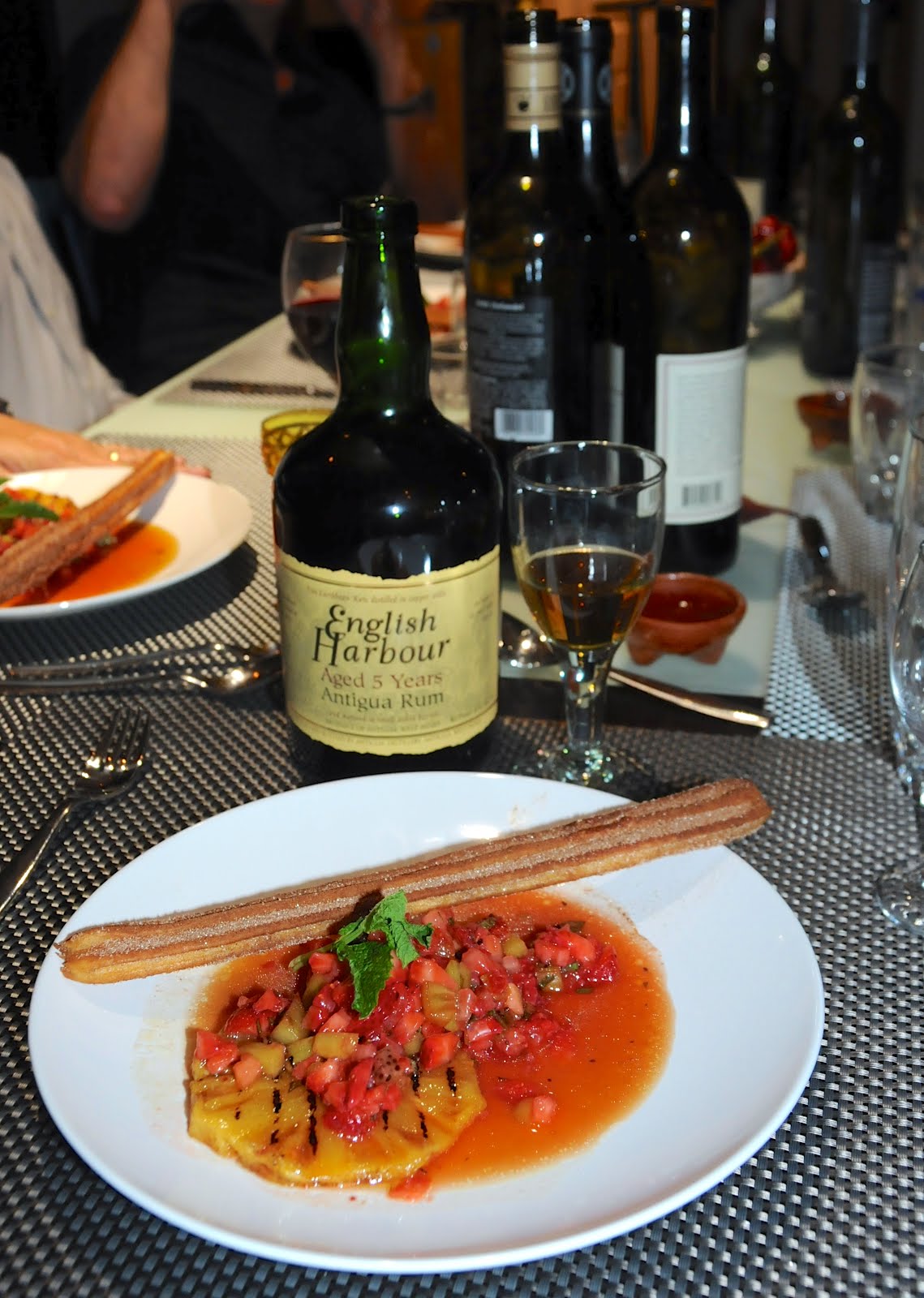
English Harbour 5 Year Antigua Rum
Jeaux and Mattinder have raised the bar yet another level for our little gathering - and as if that wasn't enough - they've suggested that the gang all try to make it down to Antigua for a bit of a vacay for one of the next times it's their turn to host the Dinner Club. With Tyrant having already hosted his last dinner on Salt Spring Island, there seems to be a new travel theme on the rise. Whatever will Boo and I be able to pull out of the bag when it's our turn? The closest thing we have to a vacation home is my Mom and Dad's trailer in Washington state. I think it was a table big enough to fit two comfortably. We'll need an awful lot of wine to be able to pull that one off with any success.
1149. 2010 Argento Reserva Bonarda (Mendoza - Argentina)
J&M served up a pair of appies: chalupas - tortillas with chicken, salsa and assorted condiments - and hongos rellenos de chorizo (stuffed mushrooms). Whether or not it was deliberate - especially since our hosts know the general bent of this crowd - all the evening's wines were of the red persuasion. So, we picked what we expected would be the two lighter bodied wines from the assortment available and started the wheels of wine a-movin'.
The Viñas Elias Mora was a 100% Tinta de Toro or Tempranillo and the Bonarda was simply that - Bonarda, Argentina's second best known red varietal.
The roughest thing about describing these dinners and wines is that time dictates a truncated version of any recap. I can't recall having tried either of these wineries before but, in consideration of space and time, I'm going to have to leave this at a basic mention.
1150. 2006 Langmeil - Blacksmith Cabernet (Barossa Valley - Australia)1993 Rosemount Estate - Balmoral Syrah (McLaren Vale - Australia)
Our second course was oxtail posole - the traditional Mexican soup of meat, hominy, chili peppers and vegetables. Given the oxtail, we figured it was time to bring on the bigger guns. Plus, it only made sense to try them while we still had some of our senses working. The Balmoral doesn't get a number for The List because, believe it or not, we've already enjoyed and added a bottle of the '93 vintage back at #314. It's not too surprising that the earlier bottle involved an evening with Tyrant since this bottle came from his cellar as well. It's more interesting, however, that it was served with another bottle of Langmeil - their Fifth Wave Grenache. I don't think that Tyrant and I are that predictable in our wine contributions but it is quite the coincidence.
1151. 2008 Sobon Estate - Old Vines Zinfandel (Amador County - California)
I think the posole was a favourite course of the evening as were these two wines. Given Jeaux' propensity to serve interesting meats (gator, rabbit and "make-do pigeon") at past dinners, we made her swear that it was really oxtail in the soup. When she started serving up the dish, we tried to get her to admit that it was that Caribbean staple, goat, since that'd go a good distance on the queasy scale for Lady Di and She Who Must Be Obeyed. Never having cooked oxtail myself, it was a great introduction.
And Tyrant can bring out his remaining Balmorals anytime I'm around.
1151. 2008 Sobon Estate - Old Vines Zinfandel (Amador County - California)1152. 2009 1884 Reservado Malbec (Mendoza - Argentina)
The soup was followed by Pan de Cazón- tortillas with shredded fish, black beans and a tomato salsa. We likely could have gone with a white wine here but the fruit forwardness of the Zin and Malbec allowed everyone to keep eating and sipping without any concerns. My guess is that we would have carried on eating regardless of what was being served. It was all that tasty.

1153. 2010 Domaine Paul Autard - Côtes du Rhône (AOC Côtes du Rhône - France)
1154. 2002 Kettle Valley - Rock Oven Red (Okanagan Valley)
We weren't done on the food front yet though. Jeaux and Matinder served up a meat course of achiote & wheat-ale marinated flank steak, together with jicama slaw and nopales salad - a mix of prickly pear cactus, onion & tomato. And, funnily enough, we just happened to have another couple of big reds to go along with the beef.
Once again, the Côtes du Rhône was new to me, but the Rock Oven Red is known quantity - even if it's one that I don't get much opportunity to try. There are times that you might think my middle name is Syrah or Shiraz. So, I didn't have any issues with either of these two wines. The Côtes du Rhône, in fact, was mostly Grenache with only 15% Syrah but I could easily come back as a Rhône Ranger in another lifetime. The Rock Oven Red is a blend of almost equal parts Cab Sauv and Shiraz, a blend that doesn't seem to be made a whole bunch in BC, particularly seeing as this bottle is from 2002. Really, it's quite a surprise to see it served tonight as there can't be many bottles of it still hanging around. There were only 120 cases made of the '02 vintage and I should think most of them have long been tipped back. I don't think there can be any issue with the ability of BC wines to age when made properly - and when stored in Tyrant's boffo cellar.
English Harbour 5 Year Antigua RumThe dessert course was accompanied by an appearance of a guest alcohol - aged rum. A 5-year old rum is a bit of stretch for a wine blog, but our hosts thought they'd end with a bit of a more authentic note. Jeaux said that she hadn't run across any Antiguan wines during their vacation but there were no complaints at the table. The sipping rum matched the homemade churros with roasted pineapple and strawberry salsa better than any wine that immediately comes to my mind. The rums that I drink are usually hidden away in eggnogs or daiquiris or maybe the odd mojito; so, it was a welcome change to have it poured this way.
Jeaux and Mattinder have raised the bar yet another level for our little gathering - and as if that wasn't enough - they've suggested that the gang all try to make it down to Antigua for a bit of a vacay for one of the next times it's their turn to host the Dinner Club. With Tyrant having already hosted his last dinner on Salt Spring Island, there seems to be a new travel theme on the rise. Whatever will Boo and I be able to pull out of the bag when it's our turn? The closest thing we have to a vacation home is my Mom and Dad's trailer in Washington state. I think it was a table big enough to fit two comfortably. We'll need an awful lot of wine to be able to pull that one off with any success.Sunday, May 13, 2012
A Last Look at Melbourne
Hard to believe that it's our last day in Melbourne already. As such, we've decided that another day of pounding the pavement is in order.
Nest up was a quick stop at the Melbourne Arts Centre to take in an exhibit showcasing pre-eminent aboriginal paintings of ancestral dreamings. I find such pieces to be fascinating. I only wish we'd had the opportunity to take in one of the spotlight lectures that were being offered during the show's tenure.
A couple tram rides later, it was the Queen Vic Market - one of my absolute favourite attractions in the city. Trying to decide what to nosh on is a ridiculous task. I need a week to just shop here daily so that I can try something exciting for dinner night after night. Our little street-side luncheon would have been an ideal opportunity to add another bottle to The List but this hadn't been a planned stop for the day's tour and we weren't prepared in the least. Settling for coffee doesn't help out when it comes to wine blogging - but it was undoubtably better for our livers.
Visiting a cemetery is pretty much a pre-ordained stop on any trip with Boo. If there's a cemetery of note that's remotely accessible, I know we'll be headed there. The gal manning the front desk at our hotel this morning pointed us in the right direction; however, she wasn't so convinced that there was much of note to take in. Boo later told her, happily, that she under-sold the site. Melbourne Central might not be the equivalent of or as interesting as cemeteries in Buenos Aires, Paris or New Orleans, but it still gives an insight into some of Melbourne's history and development as a city. I'm sure there were many more stories to be had but there were no tours planned during our stay here. As an example, who knew that Elvis has his own tomb here in Melbourne? I can't recall having seen an elaborate memorial in a cemetery for someone who isn't actually buried there.
Trust MB to know a couple of lovely spots to take in a cocktail or two. From street level bistro to tiki room cool, we had a great little start to the evening. We might have been able to cover all colours of the wine spectrum - red, white and rosé - at our first stop but, unfortunately, we never ordered an actual bottle. Still nothing to add to The List. On the other hand, we learned that an enterprising Aussie has mastered - and upped - a Canadian tradition. I'd never heard of smoked maple syrup. Nor would I have guessed that it blends nicely with bourbon-based libations. I think I'll have to follow up on that at home. I see a "guest liquor" posting on the horizon.
The Tempranillo matched up nicely with our Spanish fare. Funny that. It was nicely balanced with enough body that it neither faded against nor overpowered our food. We could easily have devoured a second bottle but our waiters more-or-less disappeared as soon as our food arrived. An unfortunate loss for all involved - particularly since this was to be our final stop of the evening. Both Merlot Boy and Bluey had early starts to the upcoming day and Boo and I had to ready ourselves to hit the highway as early as we could since we had a full day of driving - on the wrong side of the road - ahead of us.
A couple tram rides later, it was the Queen Vic Market - one of my absolute favourite attractions in the city. Trying to decide what to nosh on is a ridiculous task. I need a week to just shop here daily so that I can try something exciting for dinner night after night. Our little street-side luncheon would have been an ideal opportunity to add another bottle to The List but this hadn't been a planned stop for the day's tour and we weren't prepared in the least. Settling for coffee doesn't help out when it comes to wine blogging - but it was undoubtably better for our livers.As our feet quickly approached their own death, we made the touristy mistake of confusing the trendy shopping allure of Brunswick Street with Brunswick Road, the latter being found in the near-by suburb of Brunswick. Naturally, the Street is not located in the suburb - and, having arrived at Brunswick Road, I can tell you there was no confusing it for a trendy shopping and dining mecca. Luckily, a local cyclist shed a little light on the situation for us and the two areas are only a short tram ride and walk away from each other.
More coffee was in order before we were scheduled to meet up with Merlot Boy for a little dinner and adventure on our last night in town.
We finally managed to put a full wine bottle in front of us when Merlot Boy's bud, Bluey, joined us for dinner. We'd met Bluey at the cocktail party MB threw for us the other night and we quickly hit it off with him. If it weren't for the fact that he lives on the other side of the world, I think he'd make a fitting regular as a drinking buddy on the blog.

1111. 2009 Artadi Estate Tempranillo (DOC Rioja - Spain)
Dinner proved interesting in that you might have expected haggis on the menu of a restaurant named Robbie Burns - as opposed to the paella and Spanish tapas we ordered. That also explains why I'm adding a Spanish wine to The List despite being on an Aussie walkabout. The wine list was composed of nothing but Spanish wines; so we didn't have an alternative. That in itself was a different approach than we've come to expect in Oz.
As little as I'd expected to be sipping a Rioja with dinner, it was a nice wine - and it did fall under my primary goal of drinking wines that I'm not familiar with at home. Artadi is a largely organic and biodynamic producer in the Rioja Alavesa region - with its vineyards having among the region's highest altitudes. The winery was established approximately 25 years ago by Juan Carlos Lopez de la Calle and has garnered heavy praise and scores for its premium releases - including a 100 point score from none other than Robert Parker, he from whom all points flow.
Our bottle of the "Estate" Tempranillo is Artadi's entry level Rioja - and it clocks in locally in the mid $30 range (bottle shop prices, not restaurant). That's a good hunk of change for Spanish wines back home, but then Rioja DOC commands a premium over most of the other Spanish regions. Plus, all but one of Artadi's other Rioja wines range from $148 to $572 on their Aussie distributor's price list.
And, on that note, we bid "adieu" to the lads and to Melbourne nightlife.
Wednesday, March 7, 2012
A Night at Memphis Blues with the Boys
It's been awhile since the Gang of Five got together for dinner. The Gang finished off our university days decades back now but it's been meeting for dinner every so often for almost as long just to keep up with everyone's going's on. As much as it's an informal Gang of Five, we haven't been able to assemble the full crew for the last so many meetings. Tonight was no different. Usually it's Downhill Doug that bows out, but tonight it was The Pink One that wasn't be able to make it. So, once again, we were a Gang of Four - or perhaps more accurately, a Gang of Pour.
Since The Pink One is a pescatarian, we took advantage of his absence and met up at a venerable Vancouver shrine to meat - Memphis Blues BBQ House. I was surprised that none of the other boys had ever been, especially since Memphis Blues has been around for over a decade now and Mr. Big is the personification of meat-eater.
I'm rather sure that most folks reach for the nearest beer when it comes to BBQ, but the folks behind Memphis Blues have always looked to keep a small, but well thought out, wine list. I doubt there are many restaurants that can win accolades in wine list competitions with a list of only a dozen or so budget priced wines. The guys at Memphis manage just that - and we tested out a couple.
1076. N.V. Don Leòn - Tempranillo Merlot Syrah (La Mancha - Spain)We went for the Spanish blend to start as it came highly recommended by our enthusiastic waitress - although it was a rather roundabout procedure in picking the wine. They were out of our original Spanish choice and this was the last bottle they had of this wine; however, she had just opened it to give a sample to someone looking for a glass of wine. Can't say that I've ever agreed to take a previously opened bottle - even if she offered it with a slight discount on the price.
I hadn't heard of the wine before and couldn't find out anything more about it online. My guess is that it's a bulk, cooperative effort - particularly since it's a non-vintage wine. It showed a more modern Spanish profile, with bigger presence than I'd normally expect for a Tempranillo, but it wasn't over the top in its fruit forwardness. It didn't wow me but it was fine for BBQ fare.
1077. 2009 Château Pesquié - Terrasses Rouge (Côtes du Ventoux - France)I'm a little more familiar with the Pesquié. I may not regularly imbibe, but I certainly recognize the Terrasses label and I'm cognizant of its reputation of good bang for buck. Terrasses is definitely an example of a more modern style coming out of Provence and the Southern Rhône. A blend of (predominantly) two-thirds Grenache and a third Syrah (with traces of Carignan and Cinsault fleshing it out), the boys preferred this bottle with their pulled pork, ribs and brisket.
I'm gonna admit that the conversation and the BBQ took precedence over the wine tonight. I was impressed, however, that the boys - for the most part - even preferred the wine over beer given tonight's fare. We sure wouldn't have gone that route back in university days.
Labels:
France,
Grenache,
Red Blends,
Rhone,
Shiraz/Syrah,
Spain,
Tempranillo
Subscribe to:
Posts (Atom)