So, my last entry was for the arrival of the Year of the Sheep. Silly me, I'd made a special effort to go out of my way and find a particular wine that Haywire had fashioned to celebrate Chinese New Year. I then promptly forgot to open it to mark the occasion. Good thing the Chinese celebrate the new year for a good two weeks. I can still open this bottle and be totally in line with the sentiments behind it.
Boo, however, did not spend another day prepping an inspired Chinese meal for me.
Luckily, this wine would have paired with almost anything - or nothing at all.
1865. 2012 Haywire Lunar New Year Red (Okanagan Valley)
For two years now, Haywire has released a Lunar Red and Lunar White blend that they have hopefully "crafted to work in perfect harmony with local cuisine found in our Asian community." Both wines are a limited release timed to coincide with the lunar new year and the wines feature specially crafted labels - with lucky red and gold colouring and calligraphied Chinese characters - to commemorate this year's welcoming of the sheep.
The Lunar Red is largely made from Gamay Noir grapes - a favourite variety at Haywire; however, a small percentage of Syrah was added and it seemed to add a little heft to the body and depth to the palate. It's not a blend that I can remember seeing before, but it certainly worked in this instance.
There were only 200 cases each of the red and white blends made but this was a tripling of 2014's initial offering when only 60 cases of each wine were offered. Even still, the volume is such that the wines are not going to be found on every shelf in every wine shop.
It might be easy to simply write this initiative off as a gimmicky, marketing ploy to entice Vancouver's teeming Chinese population - after all, the winery's initial lunar wines in 2013 sold out within days of release - but it's nice to see that there's a bigger goal involved as well. Wanting to combat a preconception that only sweeter wines or big, bold reds can effectively pair with asian cuisines, Haywire "has also developed a food and wine pairing initiative for the Asian market." In releasing the initial vintage of the lunar wines, they worked with local broadcasters and foodies Stephanie Yuen and Nathan Fong "to develop a program and guide of how to pair flavours from various parts of Asia with the flavour profiles that emerge from BC wines." That exploration of Asian cuisine and wine continued with the new releases.
And, then there's the fact that both Boo and I really enjoyed the wine. I don't know what the winery will have in store for 2016's Year of the Monkey but I'm hoping it will be just as tasty as this effort.
Showing posts with label Gamay Noir. Show all posts
Friday, February 20, 2015
Saturday, February 14, 2015
Desert Hills Gamay
We/ve been watching a new condo development go up on The Drive for what seems like years but the commercial spaces at street level have started opening. We've walked by JamJar, a small restaurant that serves Lebanese folk dishes, for awhile now and it always seems to be crowded; so, Boo and I decided to start the weekend off with a visit.
There was a bounty of hot and cold mezze to choose from - well beyond the regular hummus and baba ghanous. Not only did all the dishes on offer sound delicious but many of the names brought back grand memories of our two visits to the Emirates when Boo and I experienced some Arabic culture with Miss Jaq while she was working in Abu Dhabi.
Seeing as how the dishes encompassed all ranges of tastes, I thought a lighter red might pair nicely. It wasn't a big wine list but I've always liked Desert Hills' Gamay and it was there. So, I was happy to give it a go.
1861. 2013 Desert Hills Gamay (Okanagan Valley VQA)
As Gamay Noir goes, this was a big one - bigger than those I recall from Desert Hills in the past. Maybe it was just the vintage and the heat on the Black Sage Bench but I don't think I would have identified the wine as Gamay if it had been served to me blind. Not that it mattered. There was still an abundance of fruit and a bit of spice on the palate that matched the subtle spicing on our lamb and beef dishes.
Between the mains and an assortment of mezze, we likely ordered more than we needed. So, we passed on the dessert and waddled back onto The Drive to make our way home.
As we strolled by Cafe Deux Soleils, we noted that it was hopping and that the evening's draw was - wait for it - a drag show. CDS is known for open mic nights and slam poetry, but drag? Granted, I've seen many a drag show - top of the line pro and first time amateur efforts - but this was something neither of us had encountered in our neighbourhood. And it was about to start at the entirely reasonable hour of 9 pm.
I haven't seen a lot of drag in over the last decade or so. The shows are generally found in the downtown bars and start too late in the evening for this old boy's liking but, all the same, I've been aware of a growing stable of East-side drag divas. I just hadn't actually seen a show further east than Main Street. How could we pass it by?
This was also the first time I've seen Thanks Jem - and her guest gal pal Celestial Seasons - in action. Anyone serving up Annie Lennox is okay in my book.
All in all, not a bad evening. We got to take in two new welcome additions to our hood in one pass. I know we'll make our way back to JamJar (hopefully with Miss Jaq in tow) and I'll just hope to hear of more drag on The Drive.
Wednesday, March 19, 2014
A Little Wine With That Snorkel?
Having bundled Lady Di and She Who Must Be obeyed off to the airport only last night, it was now time to say "goodbye" to Axel and English Doc.
They didn't need to leave for the airport until about noon. So, there was just enough time for Axel to take a final stroll with us up to the beach just past Jeaux and Matinder's villa. Antigua apparently has 364 beaches and we're discovering that there's a rather wide assortment of environments to be found. Called the North Beach at Jolly Harbour, this is a small beach where the sand is largely broken shells as opposed to fine, soft sand. The fact that we were the only souls on the beach for most of our visit just made our beachcombing that much more special.
The far end of North Beach finishes with a series of beachfront villas - villas that are a tad more luxurious than the townhouses we're all staying in. Boo and I noticed one that seemed to particularly fit our style; so, we took the liberty of posing for a picture poolside since it didn't look like anyone was staying at the villa at this time. Something tells me this little bit of luxury goes for a somewhat higher nightly rental than our unit does.
A boy can dream though, can't he? I can only imagine the tea dances or wine tastings and cocktails parties that I could put together with these digs at my disposal.
Maybe next time we're down here.
Once the boys were on their way to the airport, Jeaux, Matinder, Boo and I took to the road. The afternoon's plan was to lounge over a picnic lunch at one of Jeaux and Mat's favourite beaches. Although this new beach was located right next to one of the island resorts, it was amazing how - once you were past the resort layout - we could count the number of people we encountered on the fingers of one hand.
Talk about your idyllic picnic location. It definitely calls for a little wine.
1559. 2012 Douglas Green - the beach house Rosé (W.O. Western Cape: Wellington - South Africa)
Something tells me that, perhaps, the Douglas Green winery had occasions just like our picnic when they were coming up with a name and style of wine. The name, "the beach house," might have played just a tiny role in our picking the wine before we hit the beach. That and the fact that the wine had been sitting in the grocery cooler and was all ready for our sun splashed adventure. It didn't hurt that it was from South Africa and that was a bit of a different route than all the Mediterranean Rosés we'd been drinking so far. We see very little Pinotage grown at home in the Okanagan; so a 100% Pinotage Rosé was alluring.
Despite the Pinotage base, the wine featured all sorts of red berry notes and had a touch of sweetness to it. Once again, in the heat of the day, that sugar note didn't hurt when following the spices that were fully evident in our picnic foods.
In addition to the variety of beaches, Boo and I were quickly finding out that there are remnants of abandoned colonial forts and towers all over the island as well. Following our picnic, we took a hike to and wander through the small fort found on the headland of our little cove. That was followed by a swim and a snorkel - and another bottle of wine as a reward for having burned off so many calories on the Caribbean sands and waters.
1560. 2011 Château de Varennes - Beaujolais-Villages (Beaujolais-Villages AOC - France)
As previously mentioned during these Antiguan posts, the Caribbean heat doesn't particularly lend itself to big reds. But that doesn't mean that we can't venture into red territory with some lighter red wines - like Beaujolais. Château de Varennes is new to me - particularly since we don't drink an awful lot of Beaujolais - but the lightness of the Gamay Noir grape was well suited to our beachside repose. It was a heartier sip than all the whites and rosés that we'd been quaffing so far; yet, it was anything but overbearing in the heat of the afternoon.
Once that bottle quickly disappeared, however, we realized that our beach time was done and that there might be just enough time left for a quick nap at "home" before dinner. And that's always a welcoming thought - whether on vacation or not.
On the way home, we passed a small pineapple plantation. The Antiguan Black pineapple is the national fruit and is branded as being the world's sweetest pineapple. We sure didn't see much evidence of them though. Indeed, thus far on the trip, I'd been surprised at how little agriculture overall I'd noticed on the island. Jeaux tells me that the bulk of the island's food is imported and that - to a great extent - there is a perception by the locals that working in the fields is still negatively associated with slavery during the colonial years. It appears that farming is still a long way from being seen as an enviable means of making a living.
With that understanding, it doesn't sound like anyone is about to take on the task of growing grapes and trying to make an Antiguan wine any time soon. I'll ask Jeaux to keep her ears and eyes open for an Antiguan Black pineapple wine though. After all, I tried a pineapple wine from Hawaii previously and actually thought it was quite tasty. Here's hoping an Antiguan Black wine might be added to The List down the road.
Wednesday, August 21, 2013
To Market, To Market to Buy a New Red
Despite all the canning and saucing over the weekend, I kept an assortment of fresh tomatoes to cut up and throw on some pasta. Add a healthy dose of olive oil, basil and shrimp and...voilà. I'd usually grab a white for such a concoction but I didn't have anything handy and cold. So, I opted for a bottle that I'd come across at Edible Canada on Granville Island.
I've been looking forward to opening this bottle because it's interesting from a couple of viewpoints. First off, it's a unique blend (at least to me) of Gamay Noir and Syrah and, secondly, it's the creative payoff from a collaboration between Granville Island's Edible Canada and Okanagan Crush Pad.
The last couple of years has seen some notable Vancouver restaurants (and restaurant groups) partnering up with Okanagan wineries to produce custom bottlings for use in those restaurants. CityFood Magazine has noted joint efforts between the Top Table Group (which includes West and Araxi) with Foxtrot; GLOWBAL Collection (Italian Kitchen and Coast) with Painted Rock, Hawksworth with Orofino and Cactus Club with Haywire.
1399. 2010 Edible Canada Market Red (VQA Okanagan Valley)
Market Red is the first release from Granville Island's Edible Canada after they worked in conjunction with winemaker Michael Bartier and the folks at Okanagan Crush Pad to craft a wine that would match well with the fare being served at Edible Canada's Bistro (just across from the Market). The Bistro chefs have a hankering for heritage pork, BC salmon and wild mushrooms and the 80% Gamay 20% Syrah blend was thought to be particularly suited for those flavour profiles. I think they succeeded nicely.
There were only 100 cases of the wine made though. So, it's not going to be the easiest of bottles to find outside of the restaurant.
The tasting notes speak of wild raspberry and cracked pepper - and, for me, the lighter body of the Gamay Noir presents itself to being paired with all sorts of dishes, while the bolder fruit of the Syrah gives the Gamay a little more oomph.
While it lasts, the Bistro has been offering Market Red by the glass and by the bottle. To my knowledge, however, Market Red is not available by the glass - together with the Bistro's duck fat fried donuts - from their take-out window. The wine worked nicely enough with our pasta, but, if they could manage to pull off a glass of wine with donuts to go, they'd have elevated "bliss" to a whole new level.
Wednesday, August 14, 2013
Wine Blogging Wednesday 80 - Rebounding With Rosé
I think it's safe to say that the wine world is as prone to trends as any other topic or product with a high public profile. Whether it be skinny jeans or Viognier, molecular cuisine or indigenous Italian grapes, nouveau alternative folk or restrained Aussie Shiraz, you pretty well know that there's going to be something new and exciting right just around the corner.
From all the internet and traditional print buzz about Rosé wines, you could easily conclude that Rosé is the new "it" in the wine world. Maybe that's the reasoning behind this most recent resurrection of Wine Blogging Wednesday. Is there a more topical taste in the wine world than Rosé right now? Maybe we'll find out by the participation levels in WBW80.
A year on the internet can seem like an eternity - and this is the first Wine Blogging Wednesday to be attempted since this time last year - so, maybe a bit of a re-introduction is apropos. WBW was conceived over nine years ago by New York blogger, Lenn Tompson, as a monthly, virtual event. I was rather late to join to game. My first participation was with WBW65, but the concept is simple enough. It's been described as "people interested in wine, the world over, would coalesce each month around a single theme." Anyone intrigued by the month's topic submits their post or e-mail comments to the coordinator - or nowadays, their Twitter, Tumblr or Google+ witticisms (not that I know what the last two are) - which are then coordinated and shared. This round is the the 80th such outing.
This month's host, Tim Elliot from Winecast announced WBW80 with: "Good dry rosé is one of the most versatile wines in summer matching with light to heavy fare. But like some other wines, Rosé (here in America anyway) doesn't get the respect it deserves. So I'd like to see everyone explore beyond their regular summer Rosés and try something new. it might be an obscure varietal or a region you haven't tried before. Or maybe just kicking it old-school and picking up a Rosé from Bandol, Tavel or Provence from a new producer."
It's a topic that I can heartily support - and NOT just because of the whole "gay" affiliation with the colour pink (as I raise I my eyebrows in mild exasperation). We tend to drink a healthy share of Rosé wines at our household as, on the whole, we tend to like reds over whites but find that a Rosé can give you some extra body and profile than a white while still matching up nicely with the summer's lighter fare and warmer temperatures. In fact, I've taken to drinking Rosé throughout the year. Why limit it to summer?
For WBW80, we invited the beautiful and talented Elzee over for a dinner of moules frites - thinking that a little quasi Provençal fare would be a grand accompaniment to a trio of wines. The Rosés I had in the cellar are all Okanagan wines and I wanted to mix things up a bit. Elzee was going to bring a surprise bottle; so, I thought I'd hit a couple of bottle shops (government and private) to see what they had. The thought was to serve a BC, a French and one other region.
Talk about being disappointed. Despite all of the media hype on Rosé, each of the shops had a small assortment of BC wines and precious little else. The government shop had a few commercial, mass market bottles from a couple of regions and one Spanish Rosado (which I'd already added to The List). At least the private shop (Liberty) had a choice of four French wines. I grabbed one of those to go with my bottle of BC at home.
Turned out that Elzee ran into the same problem. Of all things, she managed to choose the same French wine that I did. Rather than just drink two BC wines along with our French bottle, we made a quick run to another small shop not too far away. They had a total of three Rosés in stock. We grabbed the one Washington state bottle they had as it would offer us a bit of a contrast.
Our lack of choice begs the old chicken and egg question: do these stores not carry Rosé because no one really buys that wine style or does no one tend to buy Rosé because there's so little of it to choose from?
In any event, we had our three bottles and they were very different from each other - and it's interesting in that Boo's, Elzee's and my takes on the wines all changed over the course of the evening.
1391. 2012 Clean Slate - Gamay Rosé (Okanagan Valley)
As a simple sipper, this new entry on the BC wine scene impressed all three of us. Clean Slate has only been around for a couple of vintages and it is a partnership between Ross Hackworth of Nichol Vineyard, Matthew Sherlock from Nichol and previously of Vancouver's wine and restaurant scene and Gitta Pederson of Poplar Grove Cheese fame. She's provided the vineyards and the shared tasting/sales room, while the men look after the wine production.
Clean Slate's total production is only 650 cases and that includes a white and a couple of reds on top of the Rosé. Needless to say, there isn't a whole lot of this Rosé around. I managed to grab a bottle when I stopped in, during the recent Wine Bloggers' Conference, to pick up some of our fave Tiger Blue cheese. The bottle of Clean Slate was a side benefit.
The lightest of the three wines in colour, there was a vibrant acidity that just made you forget the heat of the day. Rosé wines can be made from pretty much any grape the winemaker wants and there are a couple of Gamay-based versions coming out of the Okanagan. The Clean Slate didn't pair quite as memorably with the strong flavours and heat of the mussels but I was still very glad to get a chance to try one of their wines for the first time.
1392. 2011 Château Calissanne (AOC Coteaux d'Aix-en-Provence - France)
Rosé is the primary wine of note in Provence and the Château Calissanne is about as classic as Provençal Rosés get. It's a blend of the traditional Grenache, Cinsault and Mourvèdre grapes, with just a touch of Syrah added to round out the wine. We found that it was subtler in its flavour profile than the two North American wines - with most of its soft fruit not appearing until the mid-palate and finish, but the body and acidity was certainly well balanced.
All three of thought that we enjoyed this wine more and more as the evening continued - and all three of us reached for it first when it came to refilling our glass while munching on mussels.
If mussels and Rosé are staples of Provence, I need to get me there!
1393. 2012 Charles & Charles Rosé (Columbia Valley - Washington State)
I had neither seen nor heard of our third wine of the night before but I saw, after the fact, that it was recently picked as a Best Value by Wine Spectator. This Rosé is a collaboration that started in 2008 between Charles Smith of K Vintners and Charles Bieler who started producing Rosé at family-owned Château Routas in Provence until they sold the estate in 2005. The Bieler family then invested in Bieler Père et Fils, a winery also in Couteaux d'Aix-en-Provence. Finally, Charles B. approached Charles S. to consider taking a stab at producing a quality Rosé in the US as the former saw a definite opportunity to fill a perceived void in the American market.
They started with a batch of Syrah grapes that Smith didn't think were ripe enough or big enough for his trademark K Syrah and they now produce 20,000 cases.
Interestingly enough, the Washington Rosé uses the same classic grapes used in Provençal wines - and as in the Calissanne - but the percentages are turned on their head. Instead of playing a small part - as it did in the French wine - here the Syrah takes a dominant position at 81%. The balance of the blend is Mourvèdre (16%), Cinsault (2%) and Grenache (1%). It seemed that, of the three, this was the wine with the most noticeable fruit. It wasn't, however, necessarily overwhelming, or even alluring, with its fruitiness on an initial taste. The C&C grew on us once it was paired with food though. Indeed, it particularly seemed to come alive after it had warmed up a bit and was paired with the tomato and bocconcini salad we started out with.
In the end, all three wines had their moments - which, I suppose, is just how you'd like an evening's selection to go. Despite all three being quite different from the others in their takes on Rosé, I think it's a joy to see that North American wineries are beginning to pay as much attention to making Rosé as the French and Provençal wineries have for a very long time.
I'm also quite enthralled with the return of Wine Blogging Wednesday. Tim and the WBW powers that be deserve kudos for taking another stab. Hopefully, the concept will strike a chord with plenty of other wine loving bloggers out there and we can make a more regular go of the event. Here's to having WBW81 next month as opposed to next year. See you then.
Labels:
France,
Gamay Noir,
Grenache,
Okanagan,
Rosé,
Shiraz/Syrah,
Washington,
Wine Blogging Wednesday
Monday, April 8, 2013
Curling Dinner
Generally, I only get to add a whack of wines to The List in one night when it's our Dinner Club gang getting together or a Wine Boyz tasting. Tonight, however, Fisher threw a dinner for our curling team now that our regular season is over and the playoffs are about to begin.
And I can attest that the wine was flowing - particularly when you consider it was a school night. Guess we really worked up a thirst on the ice today. Ending the regular season with a win might have had something to do with it.
Despite the fact that we had two bottles of one wine and two of the wines have already made it to The List, I'm still adding four new wines to the total.
2011 Lang Vineyards - Farm Reserve Riesling (Okanagan Valley)
2006 Langmeil Valley Floor Shiraz (Barossa Valley - Australia)
The Langmeil Shiraz is a favourite around our home; so, it's hardly surprising to already be on The List. The Lang Riesling isn't quite as common since Lang was in receivership and this is the first vintage of wine that's been produced in a number of years. Nice to see that the Riesling doesn't seem to have lost any of its tastiness.
1281. 2011 Domaine de Milhomme - Cuvée Le Mûrier (AOC Beaujolais - France)
Fish was new to our team this year and a rookie to the league. Turns out that he and his partner, Paddy, are wine aficionados as well. I'm all for chumming around, on and off the ice, with wine geeks - especially when Fish can dig into his cellar of wines for bottles like this Beaujolais that I wouldn't normally see otherwise. Fisher and Paddy are members of the Opimian Society and I understand their case deliveries can be full of surprises. This was pretty big for Beaujolais but I'm not complaining. I'm not sure that, in retrospect, I caught the "hint of blueberry, cognac and balsamic reduction" that the Opimian notes mentioned though.
The man behind the label is the Commercial Director at Chapoutier wines and Monsieur Morel established the winery in 2007 when he purchased the assets of a winery that had gone bankrupt. He makes two Châteauneuf-du-Pape with grapes grown on the home vineyard and three wines, including this Côtes-du-Rhône from purchased grapes. The wines are made by the staff at Chapoutier and this primarily Grenache sip is blended with Syrah and Mourvèdre to meet the specifications required by the AOC in order to be designated as Signargues - a small plateau region in the Côtes-du-Rhône Villages. It looks like he's aiming to match Chapoutier's reputation of delivering nice wines at reasonable prices. It's certainly nice to see at least this one of his wines hitting our market because he's apparently only making about 250 cases of each of his wines.
1283. 2008 Quinta da Barreira Reserva Touriga Nacional & Cabernet Sauvignon (Portugal)
I think this was another of Fisher's Opimian bottles because I can't find much reference to the producer or the wine in local searches. I can't say that I can recall a blend like this. We're starting to see a few more still, red wines from Portugal in our market but most of them are entry level commercial bottles and the mixing of Cab and Touriga Nacional sure seems like a bit of new school Portugal to me. It would appear that Portugal will no longer simply be known for Port in local markets.
1284. 2010 Layer Cake Garnacha (D.O. Calatayud - Spain)
Seeing as how, thus far, the evening's additions to The List hailed from France and Portugal, I suppose it might make sense that we sipped back on another bottle from that part of the world. The last wine of the dinner - although we were long past the ever-so-tasty crab cakes and lamb stew that we feasted on - was from Spain. This Garnacha (or Grenache) is one of the newest entries in the Layer Cake collection. As a side project, California cult wine proprietor, Jayson Woodbridge, produces wines from regions around the world, picking what he feels is the top grape grown in a particular region and making big, fruit forward wines.
The Spanish Garnacha joins a Californian Cab (and Chardonnay), an Oregon Pinot, an Argentine Malbec, an Aussie Shiraz and an Italian Primitivo. The wines are continually lauded as over-delivering with bang for your buck. Despite the number of bottles that had already been polished off, there was no problem finishing this one off as well.
That last bottle pretty much polished me off for the night though. Being the oldest member of the team, I know better than to try and match the younger bucks glass for glass. For all I know, Kaz and M'og probably hit a bar on the way home. All power to them - provided they've sobered up for our playoff game next weekend.
There was no doubt that Fisher and Paddy passed Fish's rookie initiation! He's definitely invited back for next season - regardless of whether he offers to cook up another dinner or hit the wine cellar for us. Hell, he even earns a few "free" hogged rocks next year as a thank you for the evening. We might normally end our games at the club with a pitcher of beer, as opposed to a bottle, but get togethers like this might just harbour the start of a new trend. Curlers getting their rocks off with a bottle of wine. I like it.
Labels:
France,
Gamay Noir,
Grenache,
GSM,
Portugal,
Red Blends,
Rhone,
Spain
Wednesday, November 21, 2012
Beaujolais, But Hardly Nouveau
I've seen a few references lately that announced the arrival of this year's Beaujolais Nouveau. I'll admit that maybe I fell prey to the hype back in the 80's, but I can count the bottles of Nouveau that I've tried recently on the fingers of one hand.
That doesn't mean that I have to avoid the name "Beaujolais" altogether though - and I figured we could celebrate Beaujolais Nouveau's arrival with a Beaujolais of a different sort.
1289. 2010 Villa Ponciago - La Réserve Fleurie (Fleurie AOC - France)
I tasted this Cru Beaujolais at this year's Vancouver International Wine Festival and, out of the 800+ wines that were being poured at the Festival Tasting Room, this one impressed enough for me to grab a bottle. When there's that many wines being poured at an event though, I can't always be positive that I'm going to like the wines as much in saner situations. So, I'm always happy - and relieved - when the wine is just as enjoyable at home as I must have thought it was at the Festival.
Villa Ponciago was actually known as Chateau Poncié when it was purchased in 2008 by the Henriot family - owners of well known Burgundy labels Bouchard Père et Fils and William Fèvre. Villa Ponciago harkens back to the historical roots of the domaine, some 1,000 years ago, when the property was known by that name and was given to a local abbaye due to its renown for the quality of its wines. The Henriot family has announced its intention to restore the property to its former acclaim.
I know nothing of that former acclaim but I think the family is doing something right if this current release is any indication of the wines they strive to produce. There are ten crus (or appellations/regions) in Beaujolais and they differ in character from light bodied through full bodied; however, all the regions make their red wines from the Gamay Noir grape (although, technically, the AOC regulations will allow up to 15% of the appellation wine to consist of white wine but this in't that common in practice).
Fleurie is generally considered to fall in the middle in terms of wine style - and, for a Gamay, this wine certainly had a nice medium body with plenty of red fruit on the palate and a brace of acidity coming through, along with some soft tannins.
I've started looking for more of the Gamay Noirs that come out of the Okanagan and Similkameen Valleys as they are really starting to come into their own. This Ponciago wine is a nice example of where those BC wineries might look to for comparison.
Saturday, October 6, 2012
Just Ducky
Canadian Thanksgiving Long Weekend has arrived. Like so many other locales, it's going to be a weekend of family, food and wine around here - and, if that's not something to be thankful for, I don't know what is.
That is, even if all that thankfulness does mean that I'm going to have all that more wine to blog about and add to The List (when I'm already too far behind).
First up, though, is one of the bottles that we nabbed on the BC Wine Appreciation Bus Tour we joined with last month. I thought it would match up nicely with the duck and sautéed peaches we were going to chow down on.
1256. 2011 Blue Mountain Gamay Noir (Okanagan Valley)
Blue Mountain - as local winos will know - is one of the first BC cult wineries. Indeed, I remember my first bottle of Blue Mountain. It was at a company dinner - back in the early '90's - and one of our gang recognized the name on the wine list. Now, back in those days, I was just as likely to be drinking u-brew plonk as I was to be trying wine made by a real winery. Let alone a wine made in BC. I've come a long way since those days, but Burrowing Owl is still delivering the goods.
The Mavety family has been farming on their original estate since 1971 when they started championing the planting of noble varietals in the region. Long attracted to Burgundian and Champenoise grapes, the winery exclusively uses estate grown grapes and is probably best known for its Pinot Noir and sparkling wines. All the same, their Gamay is regularly named as one of the best in the province.
The Gamay vines are now 14 to 21 years old and the Mavety's grow two clones of varietal. Generally, they aim for a more Beaujolais Cru style of wine - heavier and darker than many of the Beaujolais wines found in the market. They consider themselves lucky, however, in that their corner of the Okanagan Valley allows their wines to have brilliant fruit and acidity coming through even with the bigger body of the wine.
With a second generation of Mavety's participating fully in winery operations nowadays - including the winemaking - there's been a leaning towards a little more risk taking. Around 50% of the 2011 Gamay vintage saw fermentation with wild yeast that is native to the vineyard. Wild yeasts are known to be volatile and winemakers can be disappointed with unexpected end results but those wild yeasts can also lead to an even grander sense of terroir when they work. I think everyone on our tour - and the winemakers as well - feel that everything worked out just fine with these wines. The folks at Blue Mountain feel that this Gamay can age 4 to 6 years. Guess it's pretty clear that this bottle didn't quite reach point.
A cloudy September morning greeted us and our visit to the winery. It didn't affect the taste of the wines at all but it did mean that one of the most recognizable views in the BC wine industry wasn't quite as vibrant as it might have been normally. Guess it just means that we'll have to make another visit to the winery. Thankfully, on the chance that this next visit might take awhile, we still have a nice selection of wines that Boo and I can enjoy and add to The List.
Sunday, July 8, 2012
k.d. lang live with a little Birthday Boneta
1192. 2010 Small Vineyards - Le Rote Vernaccia Di San Gimignano (DOCG Vernaccia Di San Gimignano - Italy)
(Boy, I need to write something about this one - if only because it gives me another varietal to add to my Wine Century Club tally)
Labels:
Alternative Whites,
Gamay Noir,
Italy,
Okanagan,
Red Blends,
Sparkling,
Wine Century Club
Friday, May 25, 2012
Hiding Sailor, Crouchen Riesling
Despite making a wrong turn on a highway exit - during rush hour none-the-less - and having to retrace so many miles of our drive back to Perth, we made it back to our B&B just in time for Happy Hour. Our host, Richard de la Haye, had already opened a first bottle. We quickly followed with a second.
1134. 2010 Pierre Naigeon Beaujolais (AOC Beaujolais - France)I always enjoy seeing the wines that other people buy and I definitely found the choice of a Beaujolais in the farthest point of Australia to be an interesting one. Through most of our trip Down Under, wine lists - and often entire bottle shops - have been decidedly Australian. The Aussies are real home court drinkers when it comes to wine.
Then again, Richard isn't your everyday Aussie either - and, no, he doesn't wear his vintage naval outfit all the time. He did appear willing, however, to don it at a moment's notice. If only because, every time he sported the jacket, he got around to plugging his historical novel of Captain Bligh's untold story of forbidden love - Beyond the Capes.
I know as much about Pierre Naigeon as I do about the times of Nelson's Navy. But a little Google shows that Naigeon is a fifth generation winemaker who's company produces 50 different wines, including three Grand Crus and several Premier Crus Burgundian wines. The big reason for all the different wines is that they take single vineyard to the extreme with their Burgundian Pinot Noirs. They also make a number of village and regional offerings - and, so it would seem, at least one Beaujolais or Gamay Noir.
1135. 2010 Moss Wood Amy's (Margaret River - Australia)
A simple and quaffable red for the Aussie heat. It was nice to come home to.
1135. 2010 Moss Wood Amy's (Margaret River - Australia)As a thank you for his hospitality, we gave Richard a bottle of Moss Wood's introductory wine - which he graciously opened right away.
It might have been Moss Wood's introductory level but this was no light Beaujolais. It was a classic Bordeaux blend - with a touch of that extra, Aussie kick of dark fruit. Amy's is made from fruit grown on three of Moss Wood's six vineyards. The final blend for the 2010 vintage was 50% Cab Sauv, 32% Petit Verdot (don't see that too often), 12% Malbec and 5% Merlot.
I was particularly happy to fit in a bottle of the Moss Wood since we're only able to take one bottle home with us and it should be laid down for awhile before opening it.
Merlot Boy lined up dinner for our final evening and called up Bluey and Rosie, his newly transplanted Perth buddies, and they joined us for cocktails - performing an invaluable service by helping to finish off much of the remaining vodka. A few martinis to the good, we wandered down the street and found one of the local pan-Asian restaurants that populate the area. Scanning the wine list for something to match with pork intestines (Boo's and Rosie's contribution to the family style meal) isn't one of my strong points, but I did see a wine that piqued my interest.
I figured why not end the trip with another Aussie surprise.
Crouchen Riesling sounded like a sequel to the movie, Crouching Tiger Hidden Dragon. Turns out Crouchen is yet another varietal that I've never heard of before. The Crouchen grape originated in the Western Pyrenees of France; however, it's hardly grown there anymore. Writer, Jancis Robinson, notes that there are records of the grape being shipped to South Australia in 1850, where it was long confused with Semillon, "which Australians were wont to call Riesling." It was called Clare Riesling until 1976 when French ampelographer (or grape classifier), Paul Truel, toured Australia and identified it as the little known French varietal. The grape is also grown to some extent in South Africa where it is often called Cape Riesling.
Crouchen is hardly a popular varietal in Oz though. In the mid-2000's, there were maybe 250 acres of the grape grown in the whole country.
This blend from Brown Brothers (the winery that also brought the Tarango grape to my attention for the first time) is 2/3's Crouchen and 1/3 Riesling. Light in alcohol at 9.5%, the wine was a touch off-dry and it had a good whiff of passionfruit on the nose and taste on the palate. The sweetness actually did match well with the spices and curries that coursed through our plates as well.
My guess is that I'm not too likely to run across this varietal very often. So, a last minute addition to my Wine Century Club tally is a nice little going away present from our little Aussie adventure.
It was grand of Merlot Boy and Margarita to fly across the country to join us in Perth and Margaret River. They helped make our visit all the more fantastic. As sad as it was that our trip was coming to an end, I suppose all the untasted wines and missed locales will just spur us on to come back again.
The realization finally hit us that it was time to click our heels and prepare to leave Oz. Our 4.30 wake-up call wasn't all that far off. So, with good-byes to good friends all in order, we shuffled off to finish packing - and to count the number of wine bottles we were still lugging around. With both of us facing a two bottle allowance at Canadian Customs, we figured we were going to have to face the reality of paying extra duty. Bugger. I think the trip was worth it though.
Thursday, April 12, 2012
A Last Sip
Surprisingly, I wasn't able to find out a whole lot of information about this latest bottle. The magic "Google" didn't generate a whole lot of links to anything useful. I would have thought this bottle and the marketing efforts would result in a whole lot more being written about it. Guess not.
I'll just have to go with what little I could gather. Hopefully, some of it is still current and correct. On the more positive side, this will be a quicker post to write - especially seeing as this is likely our last bottle before we leave for Oz.
1100. 2008 St. Hubertus Fire Man's Red (VQA Okanagan Valley)I'm pretty sure I've written a bit on St. Hubertus previously in the blog - both because of the big fire that devastated the winery close to a decade ago and the fact that they won a Lieutenant-Governor's Award for Wine Excellence last year - but it's the 2003 Okanagan forest fire that is the primary focal point in this post. It's hard to believe that it's already been nine years since the forest fire was front and centre on everyone's mind for much of the summer. It's even more difficult to comprehend that St. Hubertus was the only BC winery that was pretty much wiped out by the flames.
Despite the devastation that befell St. Hubertus that summer, there were some good news stories that surfaced as well. The Gebert family was quick to thank their neighbours and fellow winemakers for all the support and assistance that was given after the fire. It was great to hear of all the goodwill in the valley. Similarly, I loved the story of how St. Hubertus immediately set out to produce both a white and a red to honour all the firefighters and foresters that helped save as much of the winery and vineyard as they did. If memory serves, $2 from every bottle sold was donated to local fire fighting services - and this from a winery that was almost completely wiped out.
I haven't heard much more about the fundraising aspect of Fire Man's Red but the winery is obviously still producing it - since a 2008 vintage was made long after that 2003 fire. I didn't see any additional information on the bottle but I believe the 2008 was a Gamay Noir wine.
Unfortunately, we didn't like the wine as much as we like the background story. Not knowing that it was a Gamay when I opened the wine, I wasn't really expecting the lightness and thin body. There's lots about Gamay that I do like, but this one just didn't seem to capture what the varietal has to offer.
Hopefully, I'll come back from Australia all rested, excited and happy and I'll run right on back to St. Hubertus and love the next wine we try. Until then...
Monday, January 2, 2012
O Joie! A PTG.
For me, tonight's wine is quite an intriguing wine for having come out of the Okanagan. Not that you could never find it being made elsewhere. But it plays homage to a heritage that is actually a take on a classic Burgundian wine - and is a neat indication of a route that is eminently possible in the Okanagan.
PTG is an abbreviation for the little known Burgundy blend, Passetoutgrain. Burgundy may best be known as the home of Pinot Noir and Chardonnay, but there are a couple of other wines that still fall under appellation dictates. The Passetoutgrain is an AOC of its own and, while most Burgundy wines are primarily produced from single varietals, the PTG must be a blend - although it can be a blend from fruit grown anywhere in the entire Burgundy region.
JoieFarm's version is 63% Pinot Noir blended with 37% Gamay Noir and the grapes are sourced from five different vineyards on the Naramata Bench. This version veers from the more traditional Burgundy wines in that it is heavy on the Pinot Noir. In Burgundy, the roles are usually reversed as the Gamay grape is less expensive and the PTG is produced primarily as an easy drinker, made for early, casual drinking. I would hardly call this PTG a "casual" wine though. It's a serious player that offers up some bright Okanagan fruit from the Pinot Noir and accents it with some spicier notes from the Gamay.
The Burgundy version is also allowed to contain Chardonnay, Pinot Blanc and Pinot Gris; however, those white varietals must encompass no more than 15% of the blend. Interestingly, JoieFarm has access to Chardonnay and Pinot Gris as well but the varietals haven't made it into the PTG - at least not yet.
We picked up this bottle after tasting the wine some months back at Chef Meets Grape. Both Boo and I marked it down as one of our favourites from the evening. Too bad it's not the easiest wine to find. Fewer than a thousand cases were made; so, I'm glad I happened upon a bottle when we were in the Okanagan for the Red Rooster Adopt-A-Row weekend.
Discussions have it that 2009 wasn't the kindest vintage for BC's big red wines. Finding a few more lighter reds might make up for the vintage - if they're anything like this. I rather think the bottle started us off on a great note for 2012.
Labels:
Gamay Noir,
Naramata,
Okanagan,
Pinot Noir,
Red Blends
Thursday, November 24, 2011
Kill Devil Hills, Sand & Bubbles
I'm one of those guys that feel that celebrations and bubbles make a brilliant friendship. Our catching up with Desirée is certainly a celebration; so, it only made sense to bring along a bottle of sparkling fun.
The concept of sipping bubbly on giant sand dunes is not a new one to Boo and I. One of my favourite wine memories is popping open a bottle of Champagne to watch the sun set from the top of a giant sand dune outside the oasis town of Liwa on the edge of the Arabian Desert. The dunes weren't quite as big here, but, at the same time, the penalties aren't probably as harsh if you're caught with your wine out in the sand in North Carolina as it would be in the Muslim, non-drinking world of Abu Dhabi.
996. N.V. Louis Bouillot - Perle d'Aurore Rosé Brut (Crèmant de Bourgogne AOC - France)

Other than the seasonal hurricanes, sand dunes and a memorial for the Wright Brothers and their Kitty Hawk flights, the Outer Banks is maybe best known for its trademark lighthouses. We didn't have time for the hour's drive down to the largest of the lighthouses, Cape Hatteras, but the twenty minutes to the Bodie Island lighthouse seemed reasonable. Having already polished off a bottle of bubbles before noon (it is a vacation after all), it's probably just as well that we weren't able to climb the lighthouse.
996. N.V. Louis Bouillot - Perle d'Aurore Rosé Brut (Crèmant de Bourgogne AOC - France)Many of you will know that it's illegal to call a sparkling wine "Champagne" if the wine isn't actually made in the small French region of Champagne - even if the wine is made using the same process called méthode traditionelle. That illegal bit even goes for sparkling wines made in other parts of France. Many other world regions have tried to overcome the inability to use the "C" word by creating their own sparkling wine brand. There's "Cava" in Spain, "Prosecco" in Italy and "Crémant" in much of the rest of France.
Louis Bouillot is a new producer to me; however, the company has been making sparkling wines since 1877. They currently produce 13 different Burgundy Crémants and 2 Cuvées de France (the difference being that the grapes for the latter designation can be sourced from regions outside of Burgundy).
This Brut Rosé is a blend of 80% Pinot Noir and 20% Gamay Noir, the two traditional red grapes of Burgundy. The winemakers allow a short maceration of the crushed juice on the skins to get the brilliant hue. Following that, the wine is made in the méthode traditionelle with additional ageing on the lees (or spent yeast cells produced as the wine ages) to impart a more complex and intense flavour.
In general, a really great thing about Crémant wines is that you can get Champagne quality wine at a fraction of the price. The wine was a great perk for having hiked through the sand for about a half hour or so. Sitting back in the sand, the early fruit, followed by bright acidity on the finish was a lot more refreshing than the bottled water we'd been drinking up to that point. I didn't find the mousse or degree of bubbles in the wine to be that exciting but the occasion was another one for the books.
Other than the seasonal hurricanes, sand dunes and a memorial for the Wright Brothers and their Kitty Hawk flights, the Outer Banks is maybe best known for its trademark lighthouses. We didn't have time for the hour's drive down to the largest of the lighthouses, Cape Hatteras, but the twenty minutes to the Bodie Island lighthouse seemed reasonable. Having already polished off a bottle of bubbles before noon (it is a vacation after all), it's probably just as well that we weren't able to climb the lighthouse.We did, however, decide that a little lunch was in order and, after a bit of a nature walk through the lighthouse's surrounding marsh, we dropped in to catch crabs at Dirty Dick's. A touch on the naughty side - and totally touristy - but having some crab while visiting OBX was high on Boo's and my wish list.
A little more relaxing than traversing New Orleans or treading carefully with family, I could get use to this.
Sunday, November 6, 2011
B.S., You Say?
As established as the BC wine industry seems to be now, there's no getting over the fact that the industry is really still in its infancy. Whether you want to debate the merits of producers focusing on specific varietals or you want to bemoan the high costs of vineyard land and operations - or discuss any one of multiple other topics - it's clear that the industry scene of today is exponentially different than it was ten years ago and that it will likely look completely different in another decade.
With each passing vintage, a dizzying number of new wineries and new industry initiatives (or lack thereof) seem to appear. One new concept that arrived this year was the emergence of custom crush wineries in the Okanagan - a take on cooperative wine production facilities that can be found in other winemaking regions. I understand that two different options for custom winemaking are now available for Okanagan vintners who neither own nor have access to winery facilities. I've seen brief mention of Alto Wine Group, one of the new facilities, but I know nothing about them.
The second initiative is Okanagan Crush Pad and there's been no shortage of press and marketing to celebrate their arrival. There is a whole team of folks behind Crush Pad, but two of the driving forces are Michael Bartier and David Scholefield, the "B" and "S" that make up B-S wines.
971. 2010 B-S Rosé Table Wine (VQA Okanagan Valley)
Michael Bartier's name has appeared previously in this blog as I think it's fair to say that he's one of the better known winemakers in the Okanagan. A native-born son of the Okanagan, he's made wine at Hawthorne Mountain (now See Ya Later), Township 7, Stag's Hollow and, perhaps most notably, at Road 13.
David Scholefield, on the other hand, has played a completely different role in the development of the BC wine industry. A long time writer, speaker and competition judge, he was a senior wine buyer for the British Columbia Liquor Distribution Branch - one of the largest, single buyers of wine and alcohol in the world - for many a year. His experience has resulted in his travelling the world and meeting with wine icons from every region.
The two of them have joined forces to try and put a stronger face to Scholefield's long held belief that "BC is capable of producing distinctive wines that articulate their origin." Scholefield argues that the Okanagan environment can deliver a "natural style" that is "light, clean, juicy and refreshing." What's more is that he sees the wine-buying public as being ready for a distinctly BC wine.
This first vintage has only seen the release of two wines so far - a white blend and the Rosé that we've opened here. The Rosé is made from 100% Gamay Noir grapes and this first vintage is limited to a release of 792 cases. We're not likely to ever see big numbers coming B-S in the future either. Home base, Okanagan Crush Pad is dedicated to the production of small lot wines and currently only has the capacity of 25,000 cases for all of its customers.
Small release or not, the wine - and the partnership - has garnered a lot of buzz, with almost all of it being favourable. Almost everyone has commented on the ever so dry and brilliant acidity that dominates on the palate. There has also been plenty of comments on the deeply hued colour. For having soaked on the skins for only 24 hours, the wine was definitely on the darker range of Rosé. Boo and I thought we could have easily been sipping away on some beach in the South of France.
I'm becoming a bigger and bigger fan of Rosé wines. I don't see there being a BC style of production yet, but this is definitely an interesting gambit for a first release. And I'll be interested in learning more about Crush Pad and the wines that get produced there down the road.
Tuesday, October 11, 2011
Such a Sparkling Event!
A beautiful bride. Sparkling Hills Resort. What better nom-de-ma-plume could there be for my cousin, Centreman's, now legal squeeze than Sparkle?
I could go on about the stunning setting and lovely outdoor ceremony, the several "sap boy" moments or the abundance of hockey players, firemen and lively gal pals at the wedding, but this is a wine blog (at least, primarily a wine blog). So, I'll bypass all the wedding niceties and say that I was intrigued to find out what wines had been chosen for the reception and dinner. I know that we did a whole lot of tasting before we chose the wines for our reception. As such, I like to see what other folks decide upon for big events.I was hoping to be able to add a couple of new wines to The List and hadn't counted on being lucky enough to add four new wines.


953. N.V. Yellowglen Pink (Australia)
Unfortunately, I didn't get a chance to get a shot of the bottle. The glasses kept coming out ready and filled - with nary a bottle in sight. But I did get a shot of Boo toasting his glass of Pink in the art piece that was a wooden "fur" coat.
I don't think I've ever tried this easy sipping, fruity sparkler prior to the wedding. I see that Yellowglen promotes itself as Australia's "#1 sparkling wine brand" and, as part of the omnipresent Aussie juggernaut, Fosters Group, I maybe see how Pink (and its mate, Yellow) are the biggest selling bubblies Down Under. It's definitely entry level - as opposed to vintage - bubbly but it's priced well and is made from the classic Champagne varietals, Chardonnay and Pinot Noir. An interesting choice, but I can see how it perfectly suited the reception and Sparkle's pink-themed wedding.
The dinner tables all featured red, white and rosé wines - so that all tastes could be covered - and so that I'd get three more bottles to add to The List.

954. 2010 Quails' Gate Rosé (VQA Okanagan Valley)
It was nice to see that a Rosé had been included in the wine choices. Rosé wines can be a tough enough sell in downtown Vancouver - let alone with the rough and tumble interior guys. Quails' Gate produces a nice, dry version though - made, largely, from Gamay Noir (90%) with some Pinot Noir filling in the balance. Nice and dry, the bottle was quickly emptied at our table.
The remaining two wines were special bottlings for the Sparkling Hills Resort by Bounty Cellars. The Resort had teamed up with Swarovski Crystal for the design of the resort and Swarovski is found throughout the hotel and spa. They've even connected with a local winemaker for a pair of house brand wines that are called Crystal. Naturally, all the labels sport small Swarovski crystals on them.

955. 2008 Bounty Cellars - Crystal Gewurztraminer (Okanagan Valley)

956. N.V. Bounty Cellars - Crystal Cabernet Sauvignon/Merlot (Okanagan Valley)
These are the first Bounty Cellars wines that I've added to The List. I have seen their products around but I've never actually had a bottle. Bounty's is an interesting story. They work much in the way of a French wine négociant where the company buys wines and grapes from other producers and growers from BC, Washington state and elsewhere and then puts out a finished product.
They also fill a particular niche in that they specialize in private labels for their wines - just as we see with the Crystal label. Most wineries won't get involved with private labels unless there is a large, minimum order; however, Bounty will apparently produce a wine for individual customers for as few as two cases of wine. John Schreiner has reported that the company created more than three hundred private labels in the winery's first three years of existence. He also states that the "private label niche accounted for about 60 percent of the revenues" in 2007.
To be honest, we were all far more caught up in the wedding to pay an inordinate amount of attention to tasting and thinking wine.
I've been to a great many weddings over the years, but Boo and I don't take in many nowadays. Most of our friends are long past married (or divorced). I certainly go to a lot more wine events than I do weddings. So, it was nice to see the younger folk kicking up their heels and having a great time. I know that there have been more than a couple weddings that I've been to where the joy of the occasion was not only on the happy couple's face but more than matched by the guests. This one actually stands out for me though. I am sometimes reminded of my Mom raising her hands in the air to sing along with "It's Raining Men" and our reception, but I'm glad to say that there were some equally memorable moments here.
Cheers - and our very best wishes - to the happy couple.
Labels:
Australia,
Cellared in Canada,
Gamay Noir,
Gewurztraminer,
Meritage,
Okanagan,
Rosé,
Sparkling
Sunday, October 9, 2011
Wedding Prep
Having only been up in the Okanagan a couple of weeks ago, it's a rare occasion for me to find myself here again so soon after the last trip. Much to Boo's relief, this trip isn't purely wine-based - except to the extent that we'll no doubt enjoy some wine at my cousin's wedding.
Well, that and the fact that I'm going to have to stop in at least a couple of wineries seeing as how we're up at the Sparkling Hill Resort, found north of Kelowna at Predator Ridge. I don't recall ever having been up in this neck of the woods before and I figure you have to take advantage of an opportunity to visit a new winery when it's presented - even if that visit brings the possibility of buying a bottle or two of wine when you're on a "No buy Leash."
But that's a problem for down the road. For the moment, we only needed to settle into the rather plush surroundings. Sparkling Hill is a "wellness resort and spa" and is inspired by Swarovski crystal. Upon checking in, I was somewhat apprehensive when told that our room was on Floor -01. I know we didn't take the most expensive suite, but I never would have expected to be in the basement. Who has "negative" floor room numbers? Thankfully, it turned out that there was no need for concern. The hotel is built partially into the side of a cliff top and, as such, even some of the residential floors are found below the lobby floor.
Boo would have liked to just flop out in the room, but we'd arrived a bit later than planned due to a bit of forgetfulness. Accordingly, I needed to catch up with my parents, my sis, Vixen, and her paramour, Big Trucker. We found them at the Predator Ridge Club House but they'd been there for some time already and the folks were just about to head off to get ready for dinner. Luckily, Vixen is never one to say "no" to another cocktail - and I needed one.

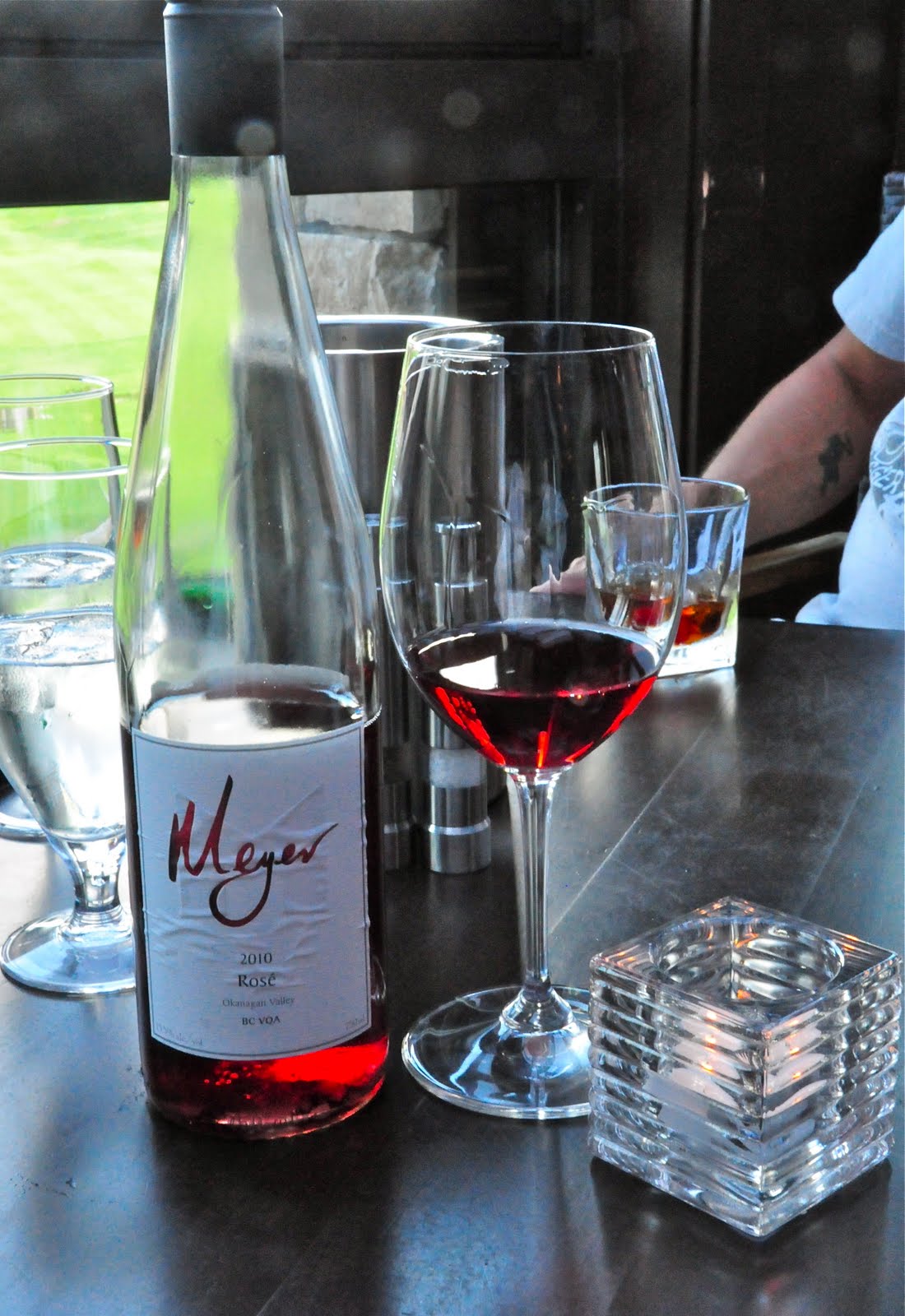
950. 2009 Meyer Family Vineyards Rosé (VQA Okanagan Valley)
I don't know a ton about Meyer Family Vineyard - after all, they still produce less than 3000 cases and have only been around since 2008 - but what I do know generally revolves around their production of well-received Chardonnay. I knew they had a Rosé and thought it'd be a good afternoon sipper when I saw it on the club house's wine list. The bottle label didn't say much and the winery website has moved on to the 2010 vintage, so I haven't found a lot of information on the Rosé but I did see one mention of the 2009 vintage being Gamay Noir. Whether that's 100% Gamay or a blend, I couldn't tell you. I suppose, however, that Gamay would make some sense since the bulk of Meyer's production is based on Burgundy varietals.
We couldn't tempt Big Trucker away from his Black Russian, but I don't think it was only because the wine was pink. Maybe he's just not much of wine drinker. That'll likely see some change if he continues to hook up with Boo and I at these events.
We made good work on the Meyer - even without Trucker's assistance. But we needed to make our way back up to Sparkling Hill to start thinking dinner.
Only one of our dinner companions joined with us for wine. So, there's just the one bottle to be added to The List. We'd only just met our new wine buddy as she was a family friend of my aunt's but she was game to try whatever we ordered. She did mention, however, that she didn't particularly like Merlot.
951. 2009 Laughing Stock Blind Trust (VQA Okanagan Valley)
I went with the Blind Trust - even though I knew that, as a BC Meritage, there was likely going to be a good percentage of Merlot in the blend. A blend with Merlot in it can be quite a different wine from a straight varietal and I know that Laughing Stock is reliably tasty. One of the fun aspects of this wine is that the winery doesn't tell you up front what the blend is.
As with all of Laughing Stock's wines, they like to incorporate aspects of the stocks, bonds and financial investing into their marketing of their wines. The winery's website advises that "a blind trust is a financial trust in which the executors have full discretion over the assets, and the trust beneficiaries have no knowledge of the holdings of the trust. In this case, our Blind Trust is a wine in which the winemaker has full discretion over the blend so you'll just have to trust us."
Once you've opened the bottle, you can discover the actual blend by removing the foil wrapping. We did just that - after our new drinking buddy had proclaimed that she loved the wine - and found out that 70% of this blend was Merlot. The remaining components were 22% Cab Sauv and 8% Malbec. She was rather shocked and said that she'll definitely have to re-think her stance on Merlot.
Taking a look back through the blog, I'm a little surprised that this is the first Blind Trust Red that I've added to The List. There's a Blind Trust White from a couple of summers ago, but this is the first red. I think we'll need to look at adding some more.
However, with another bottle behind us, it was time to rest up for the upcoming big day of spa and wedding activities.
Subscribe to:
Posts (Atom)