Wednesday, June 13, 2012

La Dolce Vita on The Drive

Once again, it's time to celebrate all things Italian on The Drive. Commercial Drive and our little East Side neighbourhood closed the street to the 2012 version of Italian Day and an estimated 50,000 folks turned out to revel in La Dolce Vita for the afternoon.

In years past, I remember locals referring to the Commercial Drive community as Little Italy. With the abundance of older gents watching soccer games in the coffee bars, numerous pasta and pizza restaurants, fashionable Italian tailors and all the shops specializing in pastas, salumi and oils, it wasn't all that hard to imagine yourself in a little bit of Italy.

Nowadays, however, the community is a virtual United Nations. In addition to the still-present taste of Rome and Venice, you're as likely to go shopping for El Salvadoran pupusas, Ethiopian injera, sushi or butter chicken. The Drive is still chock-a-clock full of those old Italian coffee bars - and a gaggle of upstarts. Long before Starbucks arrived in Vancouver with its omnipresence, The Drive was alive with Vancouver's coffee culture. If one bar's full, you only have to walk a block for another.

Indeed, activities on The Drive are often food-centric and Italian Day ramps it up another, big notch. Between local restaurants moving into the street, the recent arrival of food trucks and various charities setting up grills for the celebration, a single day would never allow you to sample everything that calls out to you.
Boo, Mr. D. and I took a wander over to The Drive to check out the scene and nosh a little. We didn't catch any opera on the big stage this year but we did watch a messy final of the spaghetti eating contests - no hands, of course - saw gladiators fighting it out in the street and marvelled at just how many Italian soccer jerseys and different Italian t-shirts there are in the city. The fact that we're in the throes of the 2012 Euro Cup might have played into the fashion statement just a tad.

It wasn't the sunniest or warmest of days but at least it didn't pour with rain like it did a couple of years back. All that walking built up our appetites and - despite having already succumbed to the odd nibble here and there - we stopped in at the new Falconetti's butcher shop and picked up a grab bag of sausages to grill at home. By taking them home, we'd not only get to sit while eating but we could wash the sausages down with some wine. Italian, of course.

1170. 2009 Tenuta Maggiore - Amphorae (Oltrope Pavese IGT - Lombardy - Italy)

I grabbed this bottle a while back at Marquis Wine because it featured another varietal that I could add to my Wine Century Club tally but, lucky for us, the folks at Marquis recommend that "this wine would be perfect with an Italian sausage." Italian Day on The Drive. Italian sausage on the plate. Italian wine for sipping. Works for me.

Tenuta Maggiore is found in Lombardy, the Northwestern part of Italy. The pre-eminent grape in the region is Croatina - although the best known DOC (or appellation controlled) wine using the varietal is called Bonarda, not to be confused with the grape of great stature in Argentina. The Amphorae is a Croatina wine that is blended with Barbera and Shiraz - hence its production under the IGT label instead of being a DOC wine. The other two grapes are used mostly to counter the strong tannins that are characteristic of the Croatina grape.

It may not be a varietal that I see very often, but there was no doubt that we could have used more of it at the moment. Not having a second bottle, we moved on to dessert and to Boo's version of that quintessential Italian treat - red velvet cupcakes.

1171. 2010 Poderi dal Nespoli - Bradamante Vino Bianco da Uve Stramature (Emilia-Romagna - Italy)

This was a favourite of mine from this year's Vancouver Playhouse Wine Festival. A Passito wine where the grapes are dried and raisinated, the result in this instance is a rich sweet wine. It was a perfect way to end the Grand Tasting room at the Festival and just as enjoyable here at home.

The vineyards and winery are found just inland from the Romagna coast, in a river valley that connects Forli to the Apennine mountains and Tuscany on the other side and Poderi dal Nespoli is seeing its third and fourth generations of the Ravaioli family own and manage the farm.

An added bonus, for me, is that the wine sees a blend of 60% Albana, 30% Chardonnay and 10% Sauvignon Blanc - so I, unintentionally, get to add a second new varietal to the Wine Century Club. The history and genetic history of Albana is largely unknown but it is primarily grown in the Emilia-Romagna region. I don't know if you're likely to find a dry Albana wine, but I think you'd have a difficult time convincing me to give up this Bradamante for any still white.

And thus ended another Italian Day in the neighbourhood. Viva Italia!

Tuesday, June 12, 2012

Wine Boyz - The Grenache Edition

I always look forward to our little Wine Boyz gatherings - where we round up a gang for the evening and we taste a series of wines on a double blind basis. Whoever plays host that night decides on the "flavour du jour" and everyone brings along a bottle, in a brown paper bag, to fit the theme. While tasting the wines, we neither know what the wine is, nor who brought it. We try the wines both with and without food and are ultimately cajoled into ranking them - top choice through least - before the night is out.

The revealing of who liked or disliked what wines is always a great part of the evening - especially when the overall favourites are revealed. We all just sit there praying that we brought one of the favoured drops.

I'm afraid, however, that this is going to have to be one of those "Colour Me Bad" posts. In the time since the actual tasting and my writing this, I've misplaced all my notes from the evening - including my preferences and the overall rankings. The best I can do now is add the wines to The List and let you know that Boo's and my wines, naturally, were among the favourites.

Honestly.

Skipper assumed the host's mantle and he decided that Grenache and Grenache blends (so long as the "G" figured prominently in the mix) was the chosen path. We'd tried a Grenache tasting years ago and it was one of the most popular evenings that we could remember. Skipper wanted to see if a different set of wines would be as popular with a different "gang of pour." We had some Wine Boyz virgins joining us and there was a fair bit of "what the heck is Grenache anyhow?" before the actual evening. The fact that you find it called Garnacha, almost as often as not, on local shelves wouldn't have helped. I 'm pretty sure they'll have a good chance of remembering what it is now.

There were no restrictions on where the wines could come from tonight - and, after the reveal, I was intrigued by the sources: four Spanish, two French and two Aussies. I truly regret that, for the moment, I can't even say whether there were any preferences by region - personal or overall.

1162. 2007 Conde Valdemar Garnacha (Rioja D.O.C. - Spain)

1163. 2010 Bodegas Artazu - Artazuri Garnacha (Navarra D.O. - Spain)

1164. 2008 Malondro Besllum (Montsant D.O. - Spain)
- 50 Garnacha 50 Cariñena

1165. 2007 Torres Gran Sangre de Toro (Catalunya D.O.C. - Spain)
-60 Garnacha 25 Cariñena 15 Syrah

In retrospect, it's interesting that there were twice as many Spanish wines as there were French or Aussie. Since I'm usually the one picking wine for dinner and outings, a big part of the fun for me is seeing what wines other people choose. It's not too often that I'm familiar with them.

1166. 2007 Domaine Vieux Lazaret - Châteauneuf-du-Pape (AOC Châteauneuf-du-Pape - France)
- Grenache, Cinsault, Mourvèdre & Syrah

1167. 2010 Perrin Réserve Côtes du Rhône (AOC Côtes du Rhône - France)
-GSM

I was glad to see that there was a Châteauneuf-du-Poof, as my sister refers to them when around us, brought to the table. It's just appropriate given the crowd.

1168. 2007 d'Arenberg The Custodian Grenache (McLaren Vale - Australia)

1169. 2010 Rosemount Grenache Shiraz (South Eastern Australia)
- 55 Grenanche 45 Shiraz

I'm kicking myself about the lost notes because Boo and I brought the d'Arenberg as one of our wines. It was one of the wineries that we visited when we visited McLaren Vale a couple months back. I'd love to know how it stacked up against the others - and what we thought of it when tasting it blind.

The fact that there's a picture of me with Elzee and the Conde Valdemar has me wondering if that was the favourite of the evening. That bottle also happens to be on the "end" of the bottle line-up (down below); so, there's always a chance that they'd been lined up in order of favourite to least for the shot. Or, that could have been just too organized and thought out - after polishing off the better part of eight bottles.

In any event, we obviously enjoyed Skipper's hospitality and the wines since the evening carried on for hours. Should I ever find the notes, while cleaning, I can always revise the post and give the rightful winner its due taste in the sun. I'll just have to be more organized when it comes to our next edition. Hopefully, that'll be sooner than later.

Monday, June 11, 2012

More Aussie Goodness

Ben Glaetzer is a name that I've heard quite a bit when it come to Aussie wines and the Barossa in particular. I can't say that I know his wines much though. The ones that I recognize from our market - like Amon Ra and Anapurna - check in at like $70 or $80 a bottle. As much as I'd like to be a regular consumer of wines in that range, I'm not.

But I do recognize the name.

1161. 2007 Heartland - Dolcetto & Lagrein (Langhorne Creek/Limestone Coast - Australia)

I'll readily admit that it was the Glaetzer name on the label that attracted me to this bottled - even though it's a wine bottle by Heartland. Well, the Glaetzer part at least cemented the deal. I was just as enthralled with the Dolcetto/Lagrein blend. Don't think I've even seen or tried that before - at least not set out as a varietal blend on the label.

According to its website, Heartland Wines is a group effort of "leading South Australian identities who are all good friends and share a passion for making great wine." Glaetzer is a logical focal point - his being the winemaker among the varied businessmen, viticulturists and vineyard managers that form the group. The same gang puts out the Stickleback label as well but that's another name I recognize but am not familiar with more than the name.

Part of what's intriguing about the wine at hand is that it's not only a rather unique blend of grapes but that neither Dolcetto, nor Lagrein are grown much in Australia. Indeed, Lagrein isn't grown much anywhere. Largely limited to production in northern Italy in the Tyrol, I read that there are maybe 15 growers of Lagrein in all of Australia and the acreage dedicated to the varietal is largely experimental.

I do know, however, that Lagrein in a new varietal that I get to add to my tally with the Wine Century Club - a definite tipping point in the decision to buy the bottle.

The Heartland wine is blended with almost an even split of the two varietals - 55% Dolcetto and 45% Lagrein. The label shows that the grapes are sourced from both Langhorne Creek and the Limestone Coast (pretty close to being neighbours anyhow) but most of the fruit - 90% - comes from Langhorne Creek.

Although the blend isn't all that common - or familiar to me - it makes sense. What little I know about Dolcetto is that it's on the lighter end of the red wine spectrum. Lagrein, on the other hand, is known for its high tannins. Lagrein is also known for its high acidity - which plays nicely into the hands of Aussie producers since acidity isn't a characteristic Aussie reds are particularly recognized for.

I quite liked it. I found it at just under $30; so, it's not the cheapest bottle on the rack. But, I wouldn't have any problem with buying another bottle.

Maybe there's something to this Glaetzer name.

Fetzer Mussels in on The List

After saying, just a few posts ago, that we don't drink much California wine at home, here we are opening a second bottle of a California white in the same week. What's going on?

There's no chance that said proclamation has Californian winemakers raising their voices to the heavens - or BC producers quaking in their boots - nor should it. Boo is just pushing me really hard to drink up the wines that we already have - and this one was laying around. It didn't hurt that it should match up with tonight's mussels either.

1160. 2008 Fetzer Vineyards - Valley Oaks Sauvignon Blanc (California)

The Fetzer brand is one that I certainly recognize but I can't say that I'm at all familiar with their wines. This is the first wine of their's that I'm adding to The List - and, to be honest, I don't even think I bought it. I think it's a straggler that was left behind from a party.

Not knowing much more than the name, I asked Mr. Google for a bit of assistance. I'm not surprised that (at least in the early 1990's) it produces over two million cases annually - which I'm sure is far more than the entire BC wine production - but I was surprised by the emphasis their website places on the winery's commitment to sustainability and environmental impact. I was also oblivious to the fact that Fetzer operates the organic producer Bonterra that does so well in our market and that Fetzer, itself, was purchased by Chile's Viña Concha Y Toro in 2011.

Entry level. Easy drinking. 96.6% Sauv Blanc with small percentages of Chardonnay, Semillon and Viognier, it's not going to set any sophisticated palates on fire. But then, at the same time, it's quaffable and affordable - and there's lots of it. So many of the wines I find myself drinking are ones that I'll never find again because there was so little of it made, one site I saw says that Fetzer made 630,000 cases of this wine alone.

What more do you need on a weeknight as the summer starts to kick in?

Sunday, June 10, 2012

A Toast to the Old Alma Mater

It's Alumni Weekend - sometimes known as the Party on the Point - at the University of British Columbia. I figured I'd take in a couple of events since I rarely head out to UBC nowadays and had yet to see the new Law School. It didn't hurt that there were a couple of wine-centric events being presented as well.

I'll readily admit that I was looking forward the most to the UBC Wine Library Tour. There was nothing like a wine library when I was attending classes. The Lido Deck at Sedgewick, yes, but no wine library. The Library forms an integral part of the Wine Research Centre and was established when Dr. Hennie van Vuuren arrived at UBC in 1999 to help pioneer research into the molecular genetics of yeasts and vines, fermentation and viticulture among other topics. Dr. van Vuuren arrived with a fascination in the ability of some varietals to age gracefully while other wines fall apart quickly. The Wine Library was set up to help study how wines, in general - and BC wines in particular - age and participating wineries send two cases of the wine to be studied. This allows the wines to be tasted annually over the next two decades, the hope being that the Centre will "eventually establish a correlation between viticulture and enology practices in BC and the ability of wines to age well."

Dr. van Vuuren advised us that the Wine Library can store up to 30,000 bottles, but that they currently have about 6,000. In addition to the winery participations in the study, the Centre has, fortuitously, received some donations from the estates of deceased collectors in the city. One such donation included some 103 year old bottles of Château Margaux. There are six bottles left. Not surprisingly, Dr. van Vuuren continually receives offers from wine drinkers offering to volunteer for tasting panels. Nice job if you can get it, I figure.

I suppose when we hear about winemaking techniques continually being improved and modernized and read about how there's so much science that goes into a bottle of wine nowadays, the Wine Research Centre is front and centre with the introduction of those changes.

Unfortunately, there was no tasting involved with the Wine Library tour but it was very intriguing all the same. I had signed up for a "class" in tasting later in the day though. Passing the time between the two events was easy enough in that the university was abuzz with activity.

I missed out on guided tours of the new Law Building and of the Chan Centre for the Performing Arts, but I did spend some time in the Beaty Biodiversity Museum. I remember all the media hoopla that accompanied the establishment of the museum in 2010 - particularly the unveiling of the two-storey glass gallery that displays the largest blue whale skeleton on display in Canada - but this was the first time I've come anywhere close to seeing it. The immensity of both the whale and the museum's purpose was inspiring. There's no doubt that UBC is continually upping the ante with what it offers to the educational community.

The tasting event was an introduction to wine tasting; so, I wasn't exactly immersed in new information but it was interesting to see a different approach to tasting - including the testing of our senses of smell and taste while blindfolded. It was also interesting to discover that there's now a 300-level credit course offered in the introduction to wine. Now, there definitely was never any course available like that when I was a student. Had there been, my enthusiasm for wine might have been tweaked a whole lot more - and a whole lot earlier - than it was. Ah, no use lamenting over (un)spilled grapes.

With all the touring and tasting it was definitely time for a drink when I got home.

1159. 2008 Cantina Zaccagnini - il vino "dal tralcetto" (Montepulciano d'Abruzzo DOC - Italy)

One of the bottles we picked up with our Bellingham Costco run last year, I didn't know anything the winery, but the packaging is fetching - and I simply love saying "Montepulciano d'Abruzzo." For someone like me that doesn't speak Italian, mastering this little phrase is like being swathed in a whole layer of romantic swagger. You can't help but sound suave when saying it. Plus, it just sounds delicious.

And, you know, this was perfectly matched to my palate and to our simple Margherita pizza. I often find entry level Italian wines to be too spare for my liking, but the Zaccagnini had some nice body and bright red and dark fruit.

It was a thoroughly enjoyable way to wind down from the day. If we make it back to Costco, I'm going to have to look for another bottle.

La Crema Chard

I suppose drinking a California Chardy is about as far from a standard drop as it gets in our home. Chardonnay isn't generally my first choice for whites and I don't tend to buy many US wines - except when south of the 49th parallel - since I'm far from thrilled with the way our provincial government tends to force the prices through the roof as soon as anything except American bulk wine crosses the border.

That position of mine may change a bit next year since the 2013 Vancouver Playhouse International Wine Festival has named California as its Theme Region and Chardonnay as the varietal for Global Focus.

In the mean time, we're drinking California Chardonnay tonight.

1158. 2007 La Crema Chardonnay (Sonoma Coast - California)

Given the lack of California Chardonnay in our cellar, I don't know much about La Crema or its wines. A quick look at the website reveals that they only produce Chardonnay and Pinot Noir - the two star varietals from Burgundy. However, they do have vineyards in five different regions in the state and produce both varietals from each region, this bottle featuring fruit from the Sonoma Coast district.

Most references online point to this wine as having good value (when being purchased in the US, no doubt) but I still found it to be a little oaky for my palate. Fairly lush and full, but a bit of a switch from the bright whites that I tend to favour.

No doubt, I'll be paying a little more attention to the whole Cali Chard genre over the next year. Guess we'll see if the number of appearances at our table has increased at all come next summer.

Saturday, June 9, 2012

Wine Century Club Anniversary Count

The obvious goal and raison d'être of this blog is to drink our way through 2001 unique bottles of wine, but a integral part of the blog name is "A Wine Odyssey." Dictionary.com, in part, defines an "odyssey" as "a long series of wanderings or adventures" and, for me, trying new and different wines that come from far-flung corners of the earth or feature previously unknown varietals is an integral - and exciting - part of the quest.

I've written about and made many a reference to The Wine Century Club during my blog meanderings. The premise of this clever idea is that if keep track of all the varietals that go into the wines you're drinking, you can join the club as soon as you've reached 100 different varietals. I didn't discover the club until long after I'd started this blog, but I get a little kick out of adding a new grape every time I run across one in my glass. Prior to this entry, I'd logged 128 varietals and I'm definitely hoping to hit a double century before I reach my goal of 2001 bottles.

The Club is celebrating its 7th anniversary and, to mark the occasion, today is a collective effort by all interested to taste as many different varietals as possible in one day. A few years back, a similar task was laid out for those in the know and a formidable total of 314 varietals was tallied.

With this post, I'm adding a couple of unique grapes that are certainly new to me - and hopefully to the tally at large.

1157. 2009 Salt Spring Vineyards - Blattner White (Gulf Islands - BC)

I picked up this bottle when visiting Tyrant on Salt Spring Island last summer and I've been keeping it for an occasion just like this. Despite the entirely unromantic name of Blattner White, I really enjoyed this wine. The "Blattner" part of the name is a reference to Valentin Blattner, a Swiss horticulturalist who's passion is to create grapes that are resistant to disease - and, therefore, don't require as many spray applications - but are still capable of yielding wines that can gain viable acceptance in the marketplace. While he's not exactly taking the wine world by storm, his grapes can now be found in Germany, Switzerland, Belgium, Holland, BC, Ontario and the Maritimes. Like most hybrid grapes, many Blattner varietals are designed to be hardy enough to withstand the colder weather of nothern climes and to ripen earlier than the more common vinifera varietals that most people are familiar with; hence their great fit with Canadian wine regions.

Salt Spring Vineyards - and its winemaker, Paul Troop - are among the foremost propagators of Blattner varietals. They produce both a white and a red wine made from Blattner grapes and this vintage of the white actually won a silver medal - and best overall hybrid wine - at the 2010 Wine Access Canadian Wine Awards. Petite Milo and Epicure are the names of the two grapes being blended in this wine and, as mentioned, we quite enjoyed the wine. I can see why it was awarded the silver medal.

The wine is a full bodied white and is quite fruit forward. In trying to find out more about the wine or the grapes, I see that it has been favourably compared to Alsatian wines, exhibiting characteristics of Riesling and Gewurtztraminer and even a hint of Sauvignon Blanc.

Unless someone else from BC is trying the same wine tonight, I doubt you'll see anyone looking to add either Petite Milo or Epicure to the Wine Century Club's Anniversary Count. I'm quite happy to be doing so and to be adding both varietals to my own tally for the club. This will bring me up to 130.

(PS. I see that this year's final count for The Wine Century Club count was 179 varietals. Far from that earlier record but pretty formidable in its own right.)

Wednesday, June 6, 2012

An Orofino Pinot

After our cherry wine from the Similkameen Valley the other night, I figured "why not just stick with the same region?" for tonight.

1156. 2006 Orofino - Sagebrush Series Pinot Noir (Similkameen Valley - BC)

Over the years, the Similkameen has grown into the organic fruit and veggie capital of Canada. Grapes have definitely been following suit over the last decade and a bit, but the Valley still isn't particularly thought of as a region that is well suited to growing Pinot Noir. The summers here are just seen as being too hot to keep the "heartbreak grape" from breaking most vintners' heart.

That doesn't mean that Pinot isn't being grown in the Similkameen; it just isn't usually the first varietal that we see being offered. John and Virginia Weber offer up a small amount of Pinot every year from their estate vineyard; however, they also released this Sagebrush Series Pinot from the 2006 vintage. It was a second line made from non-estate fruit that was seen as a lighter, more easy-drinking version of the estate Pinot Noir. I don't recall having seen the Sagebrush Series offered in subsequent years.

We might have missed out on a bit of the red fruit that was being exhibited early on in its life - as the fruit wasn't as prominent as the reviews had led me to believe - but luckily the wine was under screwcap and I don't think we lost too much of the wine's character to the years gone by. Not my favourite Orofino wine - but then, as a whole, Orofino is one of my favourite BC wineries and I think it'd be tough for every wine to be a favourite.

Tuesday, June 5, 2012

Winner. Winner. (Butter) Chicken Dinner.

I figured we must have been long overdue for a round of butter chicken - after all, no one should have to go for long without this basic food group. Luckily Boo whipped some up. My task was to match it up with a wine - but only from wines in the cellar - I wasn't allowed to buy anything new.

1155. 2009 Forbidden Fruit - Cherysh Cherry Rosé (Similkameen Valley - BC)

I figured that the fruit and residual sugar of the Cherysh would counter the spice and heat of the butter chicken nicely and I think it did - even though it wasn't nearly as off-dry as I'd expected. Made from organic Stella cherries, this is one of my favourite table fruit wines. IMHO, Forbidden Fruit (along with Elephant Island) stands at forefront of fruit wine making in BC. I find that many dessert wines and fortifieds made from fruit can stand tall with those made from grapes; the still wines, however, aren't necessarily on the same level - yet.

Cherysh consistently fits the bill though. The only "problem" is that it can be hard to find in the shops that I tend to frequent because the BC Liquor Board doesn't carry it and it's not made from grapes, so the VQA shops can't carry it. We pass by the winery every other year or so and we generally manage to pick up a bottle or two at that time.

Being a 2009 bottle, I wasn't sure that the wine would still be fresh. Can't say that I know the ageing capability of cherry wine. But, thankfully, it still tasted fine and we'll no doubt continue to pick up that bi-annual bottle next time we drive by.

Monday, June 4, 2012

Dinner Club - Caribbean Style

As if our trip Down Under wasn't extravagant enough, here we are, back less than two weeks, and it's time for our next Dinner Club instalment. It would seem that all those pounds I managed to put on while dining on roo and barbee are going to stick around for awhile longer.

This time around, it's Jeaux and Matinder's turn to wow the gang with culinary splenders. Those guys have just returned from a grand vacation of their own - wasting away, again, in Antigua. Needless to say, our intrepid hosts have decided to whisk our palates away to the Caribbean and Yucatan. Now, wine may not be the Caribbean locals' first beverage of choice, but there was still plenty of it being knocked back at our dinner.

Before we popped the corks though, Jeaux whipped up
Chupacabra Martinis for everyone. Named after the infamous "goatsucker" that haunts Mexico and parts of the Caribbean, this little concoction of coconut rum, açai juice (supposedly an aphrodisiac), guava, pineapple and blood orange goes down far too easily. I'd already seen the array of wine to be opened; so, I limited myself to one as I was still hoping to be somewhat functional come the morning.

1148. 2008 Viñas Elias Mora (D.O Toro - Spain)

1149. 2010 Argento Reserva Bonarda (Mendoza - Argentina)

J&M served up a pair of appies: chalupas - tortillas with chicken, salsa and assorted condiments - and hongos rellenos de chorizo (stuffed mushrooms). Whether or not it was deliberate - especially since our hosts know the general bent of this crowd - all the evening's wines were of the red persuasion. So, we picked what we expected would be the two lighter bodied wines from the assortment available and started the wheels of wine a-movin'.

The Viñas Elias Mora was a 100% Tinta de Toro or Tempranillo and the Bonarda was simply that - Bonarda, Argentina's second best known red varietal.

The roughest thing about describing these dinners and wines is that time dictates a truncated version of any recap. I can't recall having tried either of these wineries before but, in consideration of space and time, I'm going to have to leave this at a basic mention.

1150. 2006 Langmeil - Blacksmith Cabernet (Barossa Valley - Australia)

1993 Rosemount Estate - Balmoral Syrah (McLaren Vale - Australia)

Our second course was oxtail posole - the traditional Mexican soup of meat, hominy, chili peppers and vegetables. Given the oxtail, we figured it was time to bring on the bigger guns. Plus, it only made sense to try them while we still had some of our senses working. The Balmoral doesn't get a number for The List because, believe it or not, we've already enjoyed and added a bottle of the '93 vintage back at #314. It's not too surprising that the earlier bottle involved an evening with Tyrant since this bottle came from his cellar as well. It's more interesting, however, that it was served with another bottle of Langmeil - their Fifth Wave Grenache. I don't think that Tyrant and I are that predictable in our wine contributions but it is quite the coincidence.

I think the posole was a favourite course of the evening as were these two wines. Given Jeaux' propensity to serve interesting meats (gator, rabbit and "make-do pigeon") at past dinners, we made her swear that it was really oxtail in the soup. When she started serving up the dish, we tried to get her to admit that it was that Caribbean staple, goat, since that'd go a good distance on the queasy scale for Lady Di and She Who Must Be Obeyed. Never having cooked oxtail myself, it was a great introduction.

And Tyrant can bring out his remaining Balmorals anytime I'm around.

1151. 2008 Sobon Estate - Old Vines Zinfandel (Amador County - California)

1152. 2009 1884 Reservado Malbec (Mendoza - Argentina)

The soup was followed by Pan de Cazón- tortillas with shredded fish, black beans and a tomato salsa. We likely could have gone with a white wine here but the fruit forwardness of the Zin and Malbec allowed everyone to keep eating and sipping without any concerns. My guess is that we would have carried on eating regardless of what was being served. It was all that tasty.

I haven't heard of the Sobon Estate previously, but the 1884 was a familiar brand because Boo and I had actually visited the winery without knowing it when we travelled to Argentina. And, no, it wasn't that we were too far gone to realize where we were. Rather, it was because the 1884 Francis Mallman restaurant is connected to the winery and, by the time we arrived at the restaurant for dinner, everything was dark and deserted on the winery side of the complex and we didn't even know it existed. Finding the wine back in Vancouver is the bigger surprise for me.

1153. 2010 Domaine Paul Autard - Côtes du Rhône (AOC Côtes du Rhône - France)

1154. 2002 Kettle Valley - Rock Oven Red (Okanagan Valley)

We weren't done on the food front yet though. Jeaux and Matinder served up a meat course of achiote & wheat-ale marinated flank steak, together with jicama slaw and nopales salad - a mix of prickly pear cactus, onion & tomato. And, funnily enough, we just happened to have another couple of big reds to go along with the beef.

Once again, the Côtes du Rhône was new to me, but the Rock Oven Red is known quantity - even if it's one that I don't get much opportunity to try. There are times that you might think my middle name is Syrah or Shiraz. So, I didn't have any issues with either of these two wines. The Côtes du Rhône, in fact, was mostly Grenache with only 15% Syrah but I could easily come back as a Rhône Ranger in another lifetime. The Rock Oven Red is a blend of almost equal parts Cab Sauv and Shiraz, a blend that doesn't seem to be made a whole bunch in BC, particularly seeing as this bottle is from 2002. Really, it's quite a surprise to see it served tonight as there can't be many bottles of it still hanging around. There were only 120 cases made of the '02 vintage and I should think most of them have long been tipped back. I don't think there can be any issue with the ability of BC wines to age when made properly - and when stored in Tyrant's boffo cellar.

English Harbour 5 Year Antigua Rum

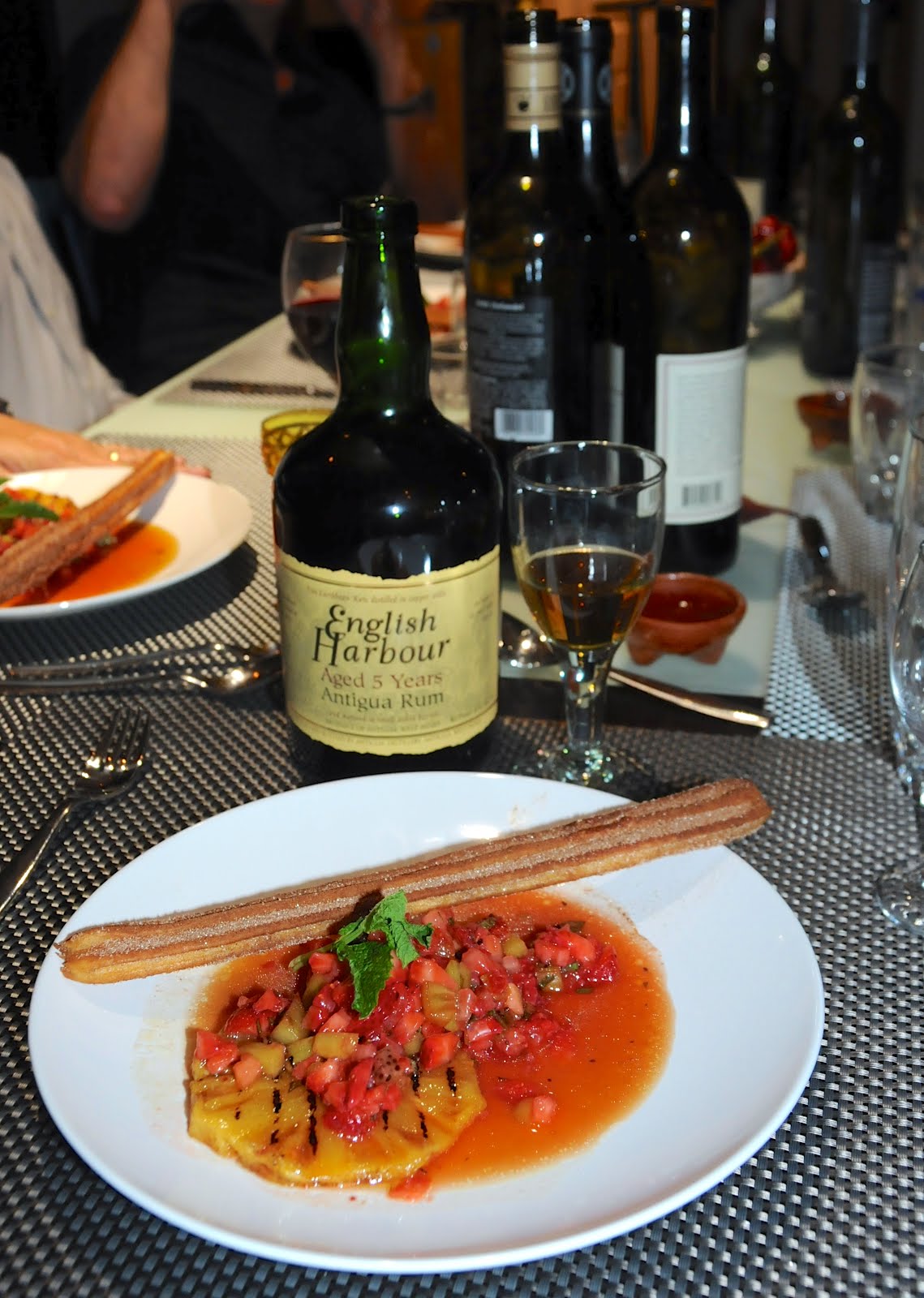
The dessert course was accompanied by an appearance of a guest alcohol - aged rum. A 5-year old rum is a bit of stretch for a wine blog, but our hosts thought they'd end with a bit of a more authentic note. Jeaux said that she hadn't run across any Antiguan wines during their vacation but there were no complaints at the table. The sipping rum matched the homemade churros with roasted pineapple and strawberry salsa better than any wine that immediately comes to my mind. The rums that I drink are usually hidden away in eggnogs or daiquiris or maybe the odd mojito; so, it was a welcome change to have it poured this way.

Jeaux and Mattinder have raised the bar yet another level for our little gathering - and as if that wasn't enough - they've suggested that the gang all try to make it down to Antigua for a bit of a vacay for one of the next times it's their turn to host the Dinner Club. With Tyrant having already hosted his last dinner on Salt Spring Island, there seems to be a new travel theme on the rise. Whatever will Boo and I be able to pull out of the bag when it's our turn? The closest thing we have to a vacation home is my Mom and Dad's trailer in Washington state. I think it was a table big enough to fit two comfortably. We'll need an awful lot of wine to be able to pull that one off with any success.

We'll worry about that later though. In the mean time, big thanks go out to Jeaux and Matinder for another masterfully delicious evening - and for providing the opportunity to add another seven bottles to The List.