Monday, June 21, 2010

A Slow Can Do Weekend

We're off to the Slocan Valley in the Kootenays for the weekend. Boo is celebrating one of those landmark birthdays that involve zeros - and his twin and younger brother have flown up from the Southern States for a bit of a family bash. If the powers that be were to declare a single region in Canada as a throwback to the 60's and hippie-dom, I think the Slocan would be a prime possibility.

Mom Mary (formerly known as Princess Long List) has lived in the idyllic surroundings for many a year now and this is the first time in my Boo years that the family has been up here together. It was tough taking a bit of extra time off of work, but how could I not make the effort? The eight hour drive was made a bit easier by the opportunity for a couple brief stops at a handful of wineries in Cawston (Similkameen Valley) and Osoyoos (Okanagan Valley) as we drove through on our way to the Kootenays.

We didn't have much time to stop though because we were going to be late for a birthday dinner as it was, but Boo was in a happy place (it's more likely that he was just tired from the lingering effects of a night shift) and I managed to fill the trunk a bit more with a couple new cases of wine.

We managed to catch up with the family just after they'd ordered dinner at the local hot spot. In fact, the Cedar Creek Cafe might be the only spot for many a mile. Mom Mary kinda lives in the middle of nowhere and I've never actually been out for dinner when visiting. It's a beautiful middle of nowhere, but the middle of nowhere all the same. We've always eaten at home. I was pleasantly surprised by the whole atmosphere and by the food. Our BBQ'd chicken pizza was quite tasty - and the Friday night stomp music completed the atmosphere.

True to the region, the wine list was one that I'd never encountered before - every wine on the list was organic or biodynamic. There are likely such wine lists in Vancouver, but I've never run across them. There wasn't a huge choice on the wine list, but we were very pleased with the bottle we ordered.

491. Vinedos Emiliana Adobe Reserva Syrah (Rapel Valley - Chile)

Turns out that Emiliana is operated by the same family that owns the Chilean wine giant, Concha y Toro, and Emiliana itself consists of a handful of brands - Etnico, Adobe, Novas, Coyan and Ge - many of which are available in our market. All of Emiliana's wines are either organic or biodynamic. Indeed, local wine writer anthony Gismondi reported that Emiliana is the single largest source of estate-grown organic wines in the world.

The winery has been operating its vineyards since 1986 and it started converting them to organic and biodynamic practices in the late-90's. Their website dedicates a healthy proportion of its space to discussing viticultural practices and the philosophy behind their wine. This was the first time that I've seen a bit of extended detail, by a winery, on the different preparations used with biodynamic viticulture.

I'm not all that used to Chilean Syrah, but it offered up big new world fruit, without going over the top. The wine sells for $15 in the liquor stores and that's the price point that I more-or-less look at as the upper limit for bargain priced wines (it is a BC market and our inflated prices after all). Guess this qualifies as a nice, little QPR wine (Quality Price Ratio).

With a behaved, but restless, babe in tow tonight, we hurried up on the last glass and made our move back to the homestead. I could have lingered a bit longer with the Syrah and listened to the music since the down home sounds had morphed into jazz, but it had been a long day and Boo had been up for 30 hours straight - save a few uneasy "zzzz's" while in the car. And, we still had to get to Sparrowhawk and unpack.

Welcome to "slow."

Tuesday, June 15, 2010

World Cup of Wine - Round 1


So, my little concept here is that I'm counting on a tournament format - with bi-national taste-offs between countries participating in this year's World Cup - to give us a neat opportunity to try wines from around the globe, all while finding our own way to have a little hands-on participate in all this "soccer madness."

Prior to our Wine Boyz World Cup-themed tasting the other night, I'd hit a couple of the bottle shops in town (government and private) to find a bottle or two of red wine from as many countries as I could that were participating in South Africa. It was a given that there wouldn't be wine available from all 32 nations competing - although they likely make wine, the expectation of finding juice from soccer favourites like Brazil, England or Holland wasn't too high. Indeed, it was a bit of a stretch to find the 13 countries that I did. There was actually a 14th - Uruguay - but our market only has one wine and we've already tried it and added to The List (early on at #7 actually) and if that tasting was any indication, I think the Uruguayans would have a whole lot more success on the soccer field.

So, the best I can aim for is a draw of 16 - allowing for 3 byes into the quarter-finals. Since we Canadians don't seem play soccer as well as hockey or curling, there wouldn't be any BC wines in the tournament. That likely leaves Boo's and my favourite red wine producer as Australia. Therefore, the Socceroos (or should that be Wine-aroos?) get the number 1 seeding and a direct spot in the next round. When Spanish and Argentinean wines took the first three spots at our Wine Boys tasting the other night, they also earned a free pass.

The highly anticipated draw was facilitated by the youngest niece, who happened to be gracing us with her appearance. I'd seeded the participating countries into two groups - the bigger guns in the red wine world and those that aren't necessarily considered top producers - so that we wouldn't end up with a France vs. Italy or a Germany vs. Mexico match right off the bat.

The draw ended up as follows:

Australia - bye
USA vs. Mexico
Argentina - bye
France vs. Germany
Italy vs. Greece
South Africa vs. New Zealand
Chile vs. Portugal
Spain - bye

There might not be a Group of Death to fight your way out of, but I think there are some intriguing match ups there. We'll see if there are as many surprises in the wine glass as there are on the soccer pitch.

Our first taste off is between the US and Mexico. Not the easiest start to our tournament since there aren't exactly a lot of Mexican wines in our market to choose from - particularly since we recently opened a bottle for Cinqo de Mayo.

But let the games begin. We're off and sipping -

489. 2008 Casa Madero San Lorenzo Cabernet Sauvignon/Tempranillo (Valle de Parras - Mexico)

490. 2005 Columbia Crest Walter Clore Private Reserve (Columbia Valley - Washington)

I've never actually seen San Lorenzo wines in our market before this. Usually, L.A. Cetto is the only Mexican producer that I see on a "regular," if very limited, basis. It didn't help that the producer, Casa Madero's, name isn't anywhere on the bottle, but I eventually found a website for Casa Madero. That wasn't necessarily offer a whole lot of assistance though because the English translation pages weren't working. If my meagre Spanish skills got it right though, it seems that the winery claims to be the oldest winery in the Americas, having got its start in 1597.

Despite the winery's pedigree, I still don't think of Mexico as much of a wine hotbed. Hot, yes. Top notch wines, not so much. But, Boo and I were rather surprised at how drinkable the wine was. The only problem was that we were drinking the Columbia Crest at the same time.

The Washington State wine was one of the bottles forming the "Costco Collection" from January's trip below the 49th Parallel. A Bordeaux blend of almost equal parts Cab Sauv and Merlot (with 7% Cab Franc thrown in for good measure), the Walter Clore was just a more sophisticated and balanced wine. I didn't know this at the time we were drinking the wine, but the "Private Reserve" brand actually is the higher end of Columbia Crest's portfolio and the '05 Walter Clore vintage was scored at 92 points by Wine Spectator. I'm not a regular point-chaser, but I think the scribes got this one right. I'd easily pick this up again.

Maybe not the fairest of line-ups for the Mexican bottle, but, hey, the Mexcians have no problem taking it to the Yanks on the soccer field either.

Verdict - a big win for the US (but a surprising performance by Mexico). Let's say 3-1 (and the US had some near misses that could have driven up the score).

Sunday, June 13, 2010

A Multi-Layered Dinner Club

Excitement may have been mounting for the World Cup - particularly for this blog and my World Cup of Wine playdowns - but our first "match" will have to wait a bit because tonight Lady Di and She Who Must Be Obeyed are hosting the Dinner Club gang. These evenings are always awash in wine, but it's the Lady's party - and menu - so, she played head sommelier and suggested the wines we were to bring for the evening. There was to be no commandeering of the wine list by me for my little soccer games.

Luckily for us, the weather actually cooperated and we were able to enjoy the repast al fresco in the girls' lush patio. As we started nibbling on a trio of tasty hors d'oeuvres, the Lady brought out one of her favourite bottles and it starts off our new additions to The List.

479. 2007 Joie - A Noble Blend (Okanagan Valley)

Could there have been a better start to the evening? An (almost) summer evening, a garden setting and one of BC's signature white blends. Since the winery opened in 2004, this aromatic blend of Germanic varietals looked to take advantage of some of the oldest vines in the Okanagan. Taking a shot at producing big reds might have been the flavour of the day for BC wineries, but the white varietal vines had already been in place for years and were well-established and producing wonderful fruit.

The lady might have brought out a magnum but it didn't last long with our crowd and her assortment of bruschetta, beef sates and filo rolls. So, next up was a little bubble (as modelled by the equally bubbly Jeaux).

480. N.V. Mumm Napa Brut Rose (Napa Valley - California)

A methode traditionelle cuvee that is made from Napa Valley Pinot Noir (with a small addition of Chardonnay - which, curiously, is not a "noir" grape), it was equally as refreshing as the Joie. And, bubbles just seem to go with almost anything.

As refreshing as these wines might have been, they did sport a touch of an off-dry sweetness and the boys were already calling for a red. The Lady and She Who Must are doing a little renovating and cleaning of stuff - and that includes a bunch of wine. A fortunate happenstance for the gathered, but not necessarily for the blog. The reds that she produced were a treat, but one of the bottle had already been added to The List and the other was another vintage of the iconic BC wine that we'd just done two library tastings of recently (at home and at the BCWAS dinner).

2002 Barossa Valley Estate E&E Black Pepper Shiraz (Barossa Valley - Australia)

Too bad for The List. We don't see $100 bottles offered up very often. I love this wine, but why couldn't it have been any other vintage than a 2002?

481. 2003 Black Hills Nota Bene (VQA Okanagan Valley)

Considering that the 2008 vintage of Nota Bene was just released at $60 (more in the private wine shops), you'd likely have to drop $100-plus for a bottle of the 2003 by now as well. Nothing but the finest for this crowd, I tell you. I think this addition will definitely solidify Nota Bene's position as the single wine that has seen the most vintages added to The List. I think this puts us a five years now.

482. 2004 Quinta do Ameal Escolha (Portugal)

483. 2008 Burgans Albarino (D.O. Rias Baixas - Spain)

Being time to start dinner proper, Lady Di was serving up a favourite of mine - mussel soup. She'd asked for two bottles of Alvarinho and I'd ordered two bottles online from Everything Wine - one Spanish and one Portugese - but it turns out that the Portugese bottle was an imposter. It was actually a Loueiro varietal which is often (generally) used in producing Vinho Verde - but at least it's another addition to my Wine Century Club efforts. Loueriro is regularly blended with Albarino; so, perhaps that's why it was listed as such online. We preferred the Spanish wine but that might be because the Portugese wine was actually oaked - interesting for a supposedly fresh white.

As the plates kept coming, Jeaux asked She Who Must Be Obeyed if there was a theme to tonight's dinner. Her reply, "Pandemonium." Given all the preparation and varying tastes on each course, it's no wonder the kitchen was "off limits" to all the guests. The Lady was raising the bar. Tyrant has used plates with four sections over the years but our hostess was pushing it with her introduction of a six-sectioned plate. Good thing that Boo and I are scheduled to host the next dinner. We may need to bring the menu plan back down to mere mortal levels.

To match the multi-plated courses, the Lady had me open five different Pinot Noirs for pairing up with the main course. My first thought was good lord, we'll never get through them all. One doesn't question a Lady however.

484. 2006 LaFrenz Reserve Pinot Noir (Naramata Bench - Okanagan Valley)

485. 2008 Mark West Pinot Noir (California)

486. 2008 Meiomi Pinot Noir (Sonoma/Monterey/Santa Barbara Counties - California)

487. 2006 Paritua Pinot Noir (Central Otago - New Zealand)

2001 Kettle Valley Foxtrot Pinot Noir (Okanagan Valley)

Once again, it turns out that one of the wines is already on The List. It's getting to be a bit of a chore trying to keep track of just what vintages of what wines we've already tasted. Since the Kettle Valley is already noted up at #310, I was, thankfully, able to concentrate my efforts on the remaining four Pinots. I tasted the Foxtrot but there was more than enough wine to keep me occupied without returning to bottles that won't count a second time around on this little "trip."

Pinot was a wonderful match for Lady Di's extravagant main course - a salmon coulibiac. The servings looked huge and I was asking for a doggie bag before I'd taken the first bite. However, this pastry wrapped salmon, layered with spinach, mushrooms, onions, egg (and on and on) was so tasty, there was nothing left for me to bring home.

Having finished off that super-sized portion, I suppose I shouldn't be overly shocked that we also managed to finish off all five bottles of the Pinot Noir as well.

I thought that might have been a good enough haul on the wine for one evening, but, no, there was one final treat for the gang.

488. 2007 Pilliteri Estates Vidal Icewine (VQA Niagra Peninsula - Ontario)

Let's face it. Whether it was past my bedtime and I'd polished off a dozen wines alone (which I hadn't) or not, I'd still join in on a taste of icewine. Finishing off an evening with a sweet wine is a favourite pleasure of mine. The honeyed sweetness and brisk acidity is a perfect ending to a grand evening.

I'm just going to warn all of our Dinner Club mates that our next take on the dinner is going to have a theme of "simplicity" - whether it's going to be easy or not.

Saturday, June 12, 2010

Wine Boyz & World Cups

Today is the start of the 2010 World Cup being held in South Africa. Now I can't exactly say that I'm as passionate about my soccer as I am about my wine - particularly when Canada failed to qualify, yet again, for the world's favourite sporting tournament. But The World Cup does provide plenty of opportunities to for imaginative pairings of wine and soccer.

Unfortunately, for those of us following the tournament on the West coast of North America, I don't think there will be a lot of sipping back on wine while watching the games live. The games starting airing here at 4 or 5 a.m. and even the latest games of the day kick off at 11 a.m. I'm likely to neither still be up from a night of partying to carry on with drinking prior to "breakfast time" games, nor will I be opening many (any?) bottles - particularly during the work week - for the lunch hour.

That won't prevent us from finding ways to enjoy both wine and soccer over the next month though. And it started this evening when we called a Wine Boyz night. The World Cup only comes around once every four years and, lately, it seems that we haven't been calling in the gang for tastings much more regularly. I think our most recent gathering was last August. Sad.

But this was a great opportunity to meet and I thought an appropriate theme for the evening would be "red wine from any country participating in this year's tournament - for under $25, naturally." It was about as wide a theme as we've ever had - and, while we wouldn't be trying any Canadian wines, almost all the big guns in the wine making world also seem to have a bent for soccer. Italy, Argentina, France, U.S., Australia, South Africa, Chile. The list goes on.

As usual, all the wines were brought to the house in brown bags and they were numbered and decanted by a non-drinker so that none of the participants would know what they were tasting - or which wine was their's. Since everyone would be picking their most and least favourites of the evening, we don't want any pre-conceived notions floating around.

We had a full slate of eight wines for tasting tonight, but we actually started off with a meet and greet wine while we waited for everyone to arrive. I figured it was only fitting that kick the evening off with celebration of the South African tournament.

470. 2009 Nederburg Limited Edition twenty10 Dry Rose (W.O. Western Cape - South Africa)

Nederburg has created a limited edition of three FIFA sanctioned wines to commemorate the arrival of the World Cup on the African continent. There's a Cab Sauv, a Sauv Blanc and this Rose which is also made completely from Cabernet Sauvignon grapes. A Cab Sauv Rose would be a pretty rare product in our neck of the woods. If a BC winery can ripen Cab Sauv grapes, they inevitably go into a varietal or Bordeaux blend wine. Despite the use of a different - and big - varietal, the wine was still fresh and full of red fruit. I don't think anyone was shouting out "Goooooooooooal!" after sipping it, but it was a fine start to the night.

Unfortunately, in a subsequent cleaning frenzy, Boo threw out all our notes and "scoring" sheets. As a result, I don't have all the final scores after we all ranked the wines from first to last and tallied the scores. I still remember what the first three choices were and what the least favourite of the evening was - however, there wasn't a single wine that didn't have at least one admirer and, except for the two most popular sips, the total scores were pretty darned close.

I can list the three favourites in order, but after that, I don't know how we ranked the wines except for the bottle pulling up the rear.

471. 2005 Sabor Real - Vinas Centenarias (D.O. Toro - Spain)

A clear fave with this crowd. Out of the six voting participants, it received four first place votes and two second place votes. I was quite intrigued when we unveiled this as the favourite wine of the night. I had purchased this bottle after we thoroughly enjoyed the Sabor Real "entry level" wine last Christmas (#289). This makes two wines in a row for this producer; we've obviously hit upon a winemaker that meets our collective palate - and then some.

472. 2006 Bodegas Mahler-Besse - Taja Monastrell (D.O. Jumilla - Spain)

This bottle received the other two first place votes and it was probably the best bargain of the evening. Whereas the Sabor Real was $25, this bottle was only $12 - and in this city, that's a very reasonable price point. It's not a general listing at our government liquor stores though. It was picked up at Marquis Wine Cellars but they're now all but sold out. Too bad.

473. 2009 Bodega Renacer - Punta Final Malbec (Argentina)

I was also pleased to see that this wine was favourably reviewed. Renacer was one of the wineries that I'd enjoyed discovering at this year's Vancouver Playhouse Festival.

I don't recall the actual order of the next four bottles; however, there wasn't a whole lot of difference in their point rankings. A move up or down by one or two points might have completely changed any order in any event.

474. 2008 Clos de los Siete (Mendoza - Argentina)

475. 2006 Franco Molino Nebbiolo (Langhe Nebbiolo DOC - Italy)

476. 2008 J.P. Chenet Premier de Cuvee - Merlot/Cabernet (Vin de Pays d'Oc - France)

477. 2007 Chateau de Paraza Cuvee Speciale (AOC Minervois - France)

2006 Bodegas La Milagrosa Milcampos Tempranillo (D.O. Ribera del Duero - Spain)

I don't get to give a number for The List to the last Spanish wine. Not because it was the bottle garnering the lowest number of points among our tasters, but rather because we already added it to The List back in January (#332). I was really quite surprised to find that it was our least favourite because I recall quite enjoying that earlier bottle.

The funny thing about the bottle though was that Arty400 brought it. The poor boy has been cursed with his limited participation with the Wine Boyz. The first two bottles that RD4 brought to the table were corked. Tonight, it was the least favoured. Methinks he's never going to come by again. At least, the bottle wasn't corked tonight.

During the evening, we'd picked up some of the neighbours who were drinking in the streets. (Yes, we have a fun neighbourhood.) The Shameless Hussy and her Rock God stopped in and then Red and Marquis paid us a visit as well. As such, we figured another bottle would make a fine addition to the mix. I'd picked up a sparkler as well since this was a celebration - plus it provides another addition to both The List and my Wine Century Club efforts.

478. Luis Pato - Maria Gomes Bruto Vinho Espumante (Portugal)

I'd tried one of the Luis Pato wines last summer (#163) and was pleasantly surprised; so, I figured it might be fun to have another Portugese bubbly on hand. After all, Portugal is one of the faves heading into the World Cup. I think our tasting capabilities might have been a tad suspect by this time however. Suffice it to say that I think we'd all be happy to pop one of these corks should Portugal have a long run for the Cup.

All in all, it was a great little start to all the soccer madness to come. It was interesting to see that our selection of wines was so Euro-centric and that Spain led the way with our top two picks. Is this an omen for the tournament to come? And why no Aussies or South African wines?

We ended the tasting on a fun note that will continue into the next month. My niece, Skeletor, was around to play drawmaster and pick the line up of countries that will go head to head in our World Cup of Wine - but that's a whole other set of postings and this one's getting way too long. Until then, I think I better work on making sure that the Wine Boyz don't take so long to meet up again because this was a hoot.

"Sur Lie" or Surly?

I thought I might score another varietal on my Wine Century Club - seeing as how this is a 100% Melon de Bourgogne wine - but, much to my surprise, I find that we tried another bottle from this winery right at the very start of our Wine Odyssey. Bottle #4 on The List was another wine from the Loire at our Wine Boyz session that kicked off the blog. Funny, that.

469. Domaine de l'Ecu - Expression d'Orthogneiss (AOC Muscadet Sevre et Maine - Loire - France)

So here we are, 460-some odd bottles done, and another Domaine de l'Ecu wine shows up on our table. I just re-read part of that original post and the Nantais was not a crowd pleaser. There was even a reference to "nasty." I know that some of Domaine de l'Ecu's wines are vinified "sur lie" - meaning that the wine is aged on the lees, or the deposits of dead or residual yeast that precipitate in the wine, instead of fining or removing those deposits earlier in the aging process. And, while there is no reference, on the label, to this wine being aged "sur lie," our immediate reaction to the first so many sips was that it was rather "surly."

Everything I read about this winery sounds favourable, but the actual taste just didn't seem to pull it off for us.

The current owner/winemaker, Guy Brossard, is the fifth generation of the family to run the winery and he moved the winery in the direction of a full celebration of the terroir of the lands. They started farming organically in 1976 and, after ten years of organic viticulture, the winery followed fully biodynamic principles as of 1986. In fact, three of the reserve cuvees are actually named after the soil characteristics of the vineyards where the grapes are grown.

This "Expression d'Orthogneiss" was sourced from a five acre vineyard where the soil and rock resembles schist that is derived from igneous rock (and is pictured on the label) - as opposed to the winery's other vineyards that are composed of gneiss or granite.

As I mentioned, family-owned and operated, biodynamic, interesting varietal and a long history - what's not to like? Unfortunately, the contents in the bottle seemed to be the answer. Despite high recommendations from the bottle shop and some highly-regarded wine writers, Boo's and my initial reaction didn't have us running back for another glass.

I will say though that the wine opened up and became more approachable after an hour or so. But still didn't offer up much in the way of fruit and/or acid like so many white wines we see nowadays and I don't think it really matched our palates. Not sure that I'd pick up another bottle - even though I didn't remember having tried a Domaine de l'Ecu wine before this.

Thursday, June 10, 2010

Pear Tree & CdP

Over the last couple of weeks, I'd bumped into Scott and Stephanie Jaeger of The Pear Tree restaurant. I had to sheepishly agree with Stephanie when she noted that they hadn't seen us at the restaurant for some time. With Boo having a birthday coming up, I thought it was a perfect occasion to right the wrong that we had caused by not visiting them recently.

Now, I could easily make my way through a couple of different wines while dining with the Jaegers, but I knew I was getting up early in the morning to get into work. Hence, only one bottle to add to The List, but it did come highly recommended.

468. 2005 Domaine de Beaurenard Chateauneuf-du-Pape (AOC Chateauneuf-du-Pape - France)

This wasn't a winery that I was familiar with, but Boo thought that a little bit of French earthiness would match the dinner a touch more than the Barossa Shiraz we were considering. And, between dining at the restaurant and bumping into Stephanie at enough wine tastings over the years, she's gotten to know our taste well enough. Of the CdP's they had on the wine list, she thought this one would be a pleaser, particularly since it was from the banner 2005 vintage.

I think she hit the mark. We chatted wine a bit with the table next to us and they'd ordered a lovely Zin and we exchanged small glasses. The big fruit of the Zin would have been similar to the Shiraz we'd been considering and I think our Chateauneuf-du-Poof did match nicer with the food.

And, oh yeah, the food. If there's one thing I've learned about Scott's cooking, you should never turned down the pork belly if it's on the menu. The thought of matching the pork belly with a spot prawn ragout was not something that I was prepared to miss - even if they had to downsize an entree into an appetizer course. I could easily have just ordered another plate of it for my entree - it was that good.

Boo was having the two-way pork for his main and I was having the ribeye and short rib combination - not to mention the marrow-infused potatoes.

I could (and maybe should) go on about the food but this blog is supposed to be about the wine. Dme du Beaurenard has been making wine for seven generations in the Rhone. What's more is that they still use all thirteen varietals that are permitted in CdP. Granted, the wine is largely Grenache-driven (at approximately 70%), followed by Syrah and Mourvedre, but there's approximately 4% of the blend made up of the likes of Counoise, Tenet, Muscardin and Vaccarese. I don't think I've ever heard of any of the last ones - let alone be able to tell you anything about their most notable contributions.

The winery points out that the winery is family-owned and that all of their grapes are hand-picked and sorted . We also didn't know this at the time we ordered the wine, but it's been well-received by the wine press. Turns out we might have opened the bottle a bit early in its life though - Wine Spectator has said that, while lovely in its still youthful state, this wine could last for another 15 years.

By the time, those 15 years went by though, Boo and I might be too old to actually still enjoy - or be able to put away - a full bottle of wine over dinner. In the mean time, it was a wonderful night out and I swear we'll be back to The Pear Tree much sooner next time around.

Wednesday, June 9, 2010

Mad Fish & A Western Riesling

It never ceases to amaze me just how much information there is out there in the wide world of wine. We've enjoyed at least a couple of MadFish wines over the years, but I now realize that I don't really know much about the winery - other than the fact that it is based in Margaret River and the Great Southern regions of Western Australia - a definite plus in my books. In looking up this wine, however, I found out that MadFish is actually one of a series of brands produced by Howard Park Wines, one of twelve wine companies forming Australia's First Families of Wine.

The main criteria of the membership is that the family-owned companies have to have a "landmark" or "iconic" wine in their portfolios. Other requirements include being able to do at least a 20-year vertical tasting, having a history of vineyards that go back more than 50 years and that best exemplify Australian terroir, and having a history of at least two generations in the wine business.

MadFish wines aren't exactly the iconic wines associated with Howard Park Wines when it came to being asked to join the First Families. The line was started in 1992 and the wines are marketed on their drinkability and their exemplification of the cool climate fruit of the Great Southern.

467. 2006 MadFish Riesling (Western Australia)

As much as I love Riesling, Aussie versions tend not to be my favourites. In general, I find that they're often too acidic and driven with citrus and mineral notes. Not so with this bottle though. There was no denying the strong hints of lime and mouth-watering acid on the palate, but it was more roundly incorporated into an overall flavour. And, for me anyhow, what's maybe a bit uncharacteristic for Aussie Riesling, this wine had a nice touch of honey or sweeter fruit.

I know I grabbed the bottle because I don't usually think of Riesling when it comes to Margaret River and environs and the thought of another goodie from out West piqued my interest. Maybe it's because this was from Western Australia and its more temperate climate but it reminded me of some of my favourite BC Rieslings and that's no small feat. I'll definitely look for more West Coast Aussie Riesling if this is indicative of what I'll taste. Yumm.

Monday, June 7, 2010

Prosciutto & Prosecco


For the first time in 28 years, the celebration that is Italian Day was coming back to Commercial Drive. In the intervening years, The Drive has witnessed car-free days, the parade of Lost Souls, the Dyke Parade and the wild abandon that accompanies the spontaneous eruptions of national pride that erupt following big soccer matches - whether that exuberance be Italian, Brazilian, Portugese or Greek.

With vendor booths, stages and displays lining a kilometre of The Drive, the Day was being set up to party and revel in all things Italian - food, music, art, fashion, cars and, of course, soccer.

I was thinking that a stroll amongst the gathered throng, coupled with maybe a panini and some wine (possibly adding another bottle to The List), would be just the ticket.

One small problem. It rained on our parade. Big rain. And persistent to boot. Everyone, that I'd been chatting to about wandering over with, decided to take a pass because of the weather. Living mere blocks from The Drive, I was "obligated" to celebrate the neighbourhood. I delayed my departure for as long as I could in the hope that the skies would clear up, but, naturally, the rain started getting worse - as soon as I hit The Drive.

After a sandwich, a couple opera arias, a bit of dancing in the streets and a lot of wet, I headed home to prepare for a bit of our own Italian Night. The day might have been a bit of a bust, but there was no reason that we couldn't bring a bit of Little Italy home.

466. NV Cantina Breganze Prosecco Vespaiolo Vino Frizzante (Veneto IGT)

Spirits on The Drive might have been dampened a tad, but a little bubble should be enough to brighten anyone's spirits. This Odyssey blog of mine is taking Boo and I on quite an adventure at times and it has us trying different wines and combinations that we wouldn't have thought of previously. Tonight, I just decided to stick with the Prosecco throughout dinner. Lately, I've been hearing all sorts of wine-folk saying that sparkling wines can accompany almost any food. I figured we'd be pretty safe with melon & prosciutto and a crab ravioli.

I'd picked up this bottle at the recent Vancouver Playhouse Wine Festival and, despite the fact that this was apparently Cantina Breganze's third appearance at the Festival, I couldn't find out a whole lot about the winery after the fact. Indeed, even a visit to their website didn't help much as I couldn't seem to navigate myself through any pages that gave information. The website did, however, refer to "1000 gower-members;" so, I assume the winery might be a cooperative.

The winery is located near the small town of Breganza, found a short distance to the North-West of Venice. The region is gaining more prominence on the wine scene as it is trying to modernize to take advantage of export markets. Having been granted DOC status in Italy, the region allows the use of eleven varietals that have a historical heritage in Breganza. One of the facts that I didn't know, but found interesting, was that the inclusion of "Vespaiolo" in the wine name is actually a reference to the fact that the wine is a blend of Prosecco and Vespaiolo grapes - 55% and 45% respectively. I'd just assumed that it was some sort of reference to a region or a proprietary name.

The Vespaiolo grape is grown almost exclusively in the Breganza region and is primarily known for its acidity and aromatic characteristics - a good reason for its use in sparkling and frizzante wines. An additional property - that was included in the varietal's one paragraph entry in the Oxford Companion to Wine - is that its high sugar content is particularly attractive to wasps, "vespa" being Italian for "wasp."

This also means that I get to add another grape to my list and attempt to join the Wine Century Club. The wine not only added a little sparkle to our evening but it buoyed my spirits with its new varietal. Guess it's just another reason to celebrate Italy. Here's also hoping that the weather will be more cooperative should Italian Day come back to The Drive next year.

Sunday, June 6, 2010

Caribou For Two

While rummaging around in our small freezer, Boo ran across a surprise package - a "leftover" from our shopping spree in Yellowknife last year. While not quite as exotic as camel or kangaroo, caribou still isn't exactly a staple meat on Vancouver dinner tables. It was high time for us to throw the steaks on the grill.

Seeing as how this was a bit of special occasion, I figured we could do a bit of a two bottle comparison as well - and the two wines were as different as all get up. I grabbed one to start off as a marinade base; the other's - just like the caribou's - time had come.

464. 2005 Crane Lake Petite Sirah (California)

Although I should think that we will never experience the American phenomenon that is Two-Buck Chuck, we still hear about it up here. The Crane Lake wine is not exactly Two-Buck Chuck but it is made by the same parent company - Bronco Wine Co. Bronco's head honcho, Fred Franzia, has been quoted as saying that no wine is worth more than $10. Guess he'd have a hard time drinking any wine in our fair province - where finding a bottle for under $10, that is worth drinking, can be a major task.

This bottle was given to Boo as a gift and I like the fact that it prompted a bit of research in a number of directions. Although, according to its website, Crane Lake may be one of the most highly sought brands in Cameroon and West Africa, I don't think I've ever seen it in the BC marketplace.

I don't see Petit Sirah produced as a varietal wine very often and I don't know of any being grown in BC. In fact, this is the first bottle that I'm adding to The List and it's resulting in my being able to add another varietal to my quest of joining the Wine Century Club.

Due to its name, many folks confuse it with Syrah or Shiraz. It is a very different grape however. Originating in Southern France - where it is known as Durif - it is a cross between the Syrah grape and a little known varietal called Peloursin. Nowadays, it is rarely grown in France as the grape can be both vigorous and difficult. It is known for liking particular growing conditions and isn't particularly admired for its resulting wine. California and Australia are the primary regions to find plantings of the varietal but the grapes are mostly used for blending as the deep colour, strong tannins and spicy, dark fruit characteristics can be valued in fleshing out other varietals. It is often blended with Zinfandel in California wines.

The grape is seeing some revival as a varietal wine though. If cropped at lower levels, in favourable conditions, many feel that the resulting wine is worthy of single varietal status. Indeed, there is a California group dedicated to Petit Sirah - PS I Love You.

I don't know if the Crane Lake would be one of that group's prime candidates for adoration; it is being produced as a bulk wine after all. Keep in mind that the Franzia family has the capability of producing 230 million litres of wine annually - not all of it Petit Sirah obviously. I don't think there was any mistaking its simplicity of this wine and the tannins certainly weren't what I'd expected. But, the bottle was entirely drinkable and the caribou didn't seem to mind being marinated in it.

465. 2001 Nichol Vineyard Syrah (Okanagan Valley)

Nichol is definitely on the other side of the production coin. The entire BC wine industry only produced slightly more than 15 million litres in 2008. Compare that to the Franzia family's production. With this 2001 vintage, Nichol was producing between only 700 and 1200 cases - of all their varietals combined.

This is actually the third vintage of Nichol Syrah that I've added to The List. The 2000 wine is #93 and the 2003 is found at #321. We've generally had a couple bottle of these older vintages as Nichol Vineyard was one of the first Naramata Bench wineries that we stumbled upon. The fact that they were one of the few BC wineries producing a Syrah only made it that much more appealing to Boo and I. Indeed, as I've mentioned previously in this blog, in 1993, Alex and Kathleen Nichol were the first vineyard owners to plant Syrah in Canada - much to the surprise and disbelief of most in the newly emerging BC wine industry. At that time, not many thought that Syrah could be successfully grown in BC's cooler climate. Little did they know that the grape would become one of the most important varietals in the Okanagan Valley.

Nichol has always used 100% Naramata fruit and its current production, under new owner Ross Hackworth, is still only maxing out at 3500 cases.

We weren't sure about the aging capabilities of a BC red, but I'm happy to say that the Syrah was still tasting mighty fine. It's far more nuanced than a big Aussie Shiraz - or even a Two-Buck Chuck clone - but there was still enough tannin and fruit remaining to match up to the caribou.

BTW, the caribou was very tasty. Not as game-y as I might have expected. Next up from the freezer? I can only wait to see.

Wednesday, June 2, 2010

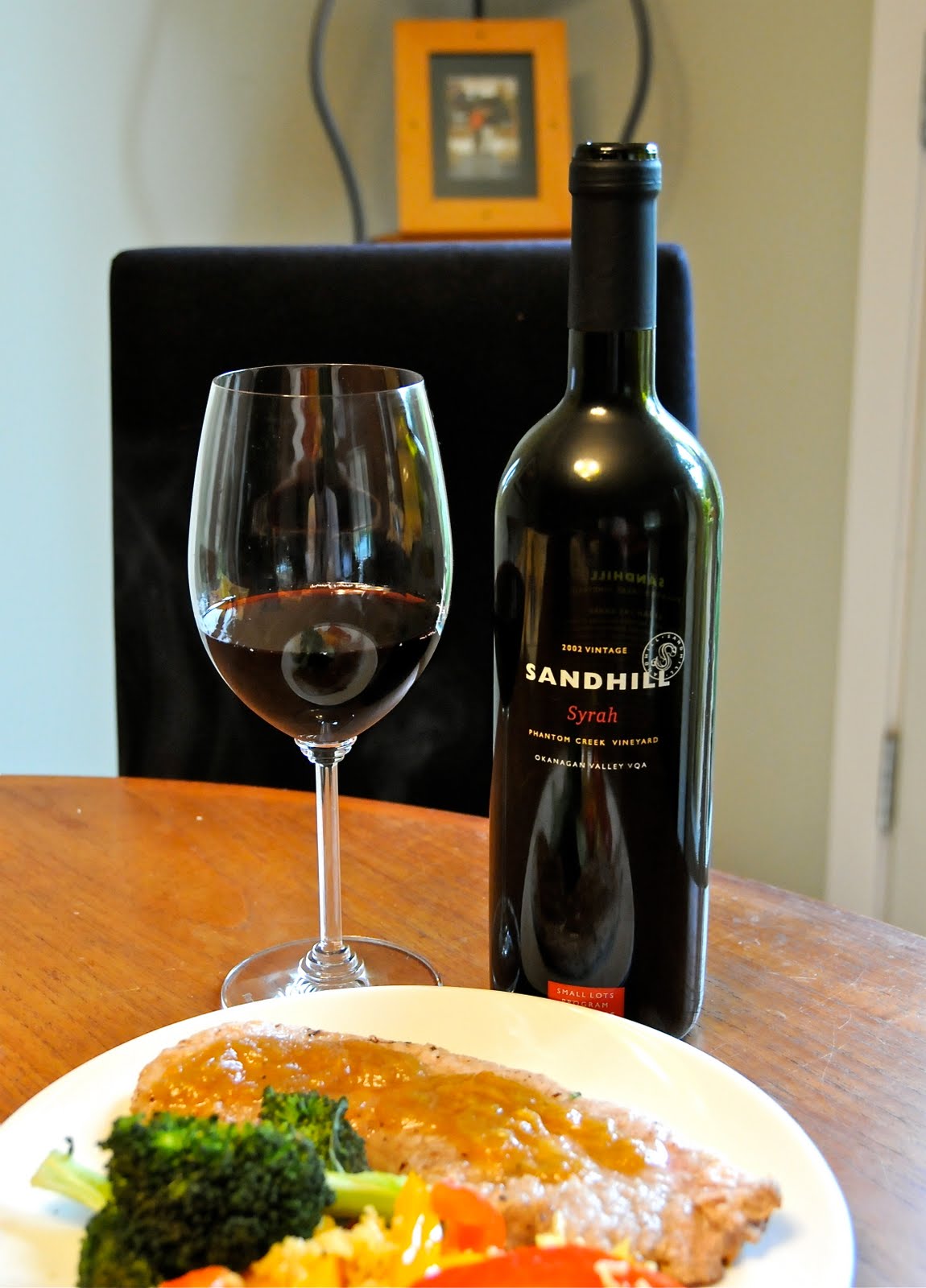
Adding Another Sandhill Syrah

Looks like I'll get off with a bit of an easy entry this time around. Sandhill wines have a tendency to show up on The List a fair bit. In fact, I wouldn't be too surprised if Sandhill shows up more often than any other winery. It'd be close in any event - but that's just because we like their wines so darned much!

I've actually added the '06 vintage of both the Small Lots (#327) and the regular Sandhill Syrah (#193) to The List. So, I won't repeat myself too much about the winery or the Small Lots Program, but this will be another of Howard Soon's stellar Syrah's to tickle our taste buds.

463. 2002 Sandhill - Phantom Creek Small Lots Syrah (VQA Okanagan Valley)

The Small Lots Syrah has been one of the standout wines for Sandhill since the start of the winery. Sandhill's first wines were produced in 1999 and the Small Lots Syrah commenced in 2000. By this 2002 vintage, the wine was already being touted as a winner. At the 2004 Canadian Wine Awards, the '02 Small Lots Syrah won Gold and Best of Class for Syrah and was one of three wines in a tie for Canada's Red Wine of the Year.

Similar accolades have continued to follow suit. Indeed, one local scribe has more-or-less referred to it as a definitive Pacific North-West Syrah - rich, round and sporting soft tannins.

There were only 195 cases of the wine produced in '02 and, despite the demand for more, the amount remains almost as miniscule today (hence the "Small Lots" moniker). We do our best, however, to try and snag at least a bottle or two of each vintage. This is the last of our 2002's. Too bad because, the wine was still holding its own and 2002 has been called a great vintage year for BC and the Okanagan.

There'll be more of Sandhill bottles to grace The List. I'll be looking forward to those moments.